
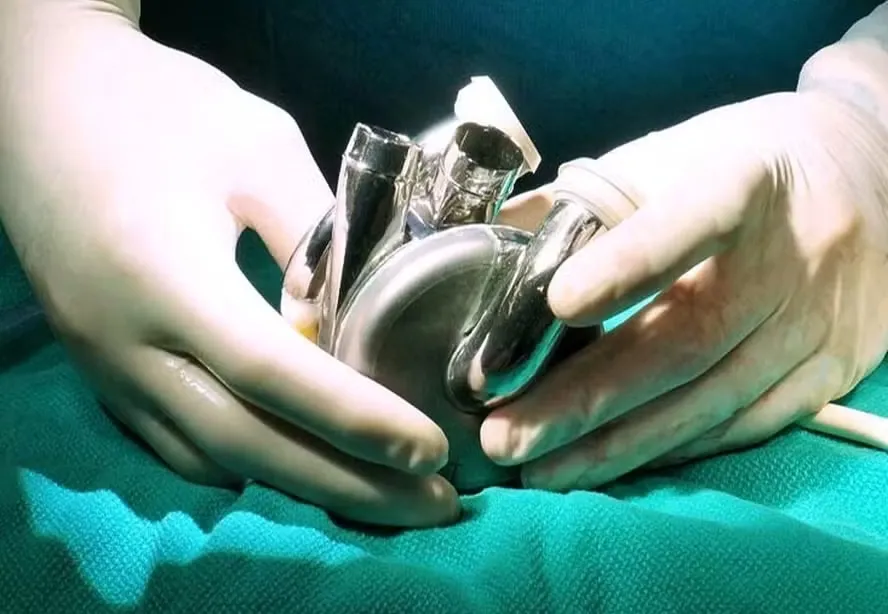
In the United States, doctors at the Texas Heart Institute (THI) and the medical technology company BiVACOR have for the first time implanted a fully artificial heart made of titanium in a human patient. The procedure, carried out as part of a clinical study, represents a milestone in the search for viable alternatives for people with severe heart failure.
The device, called the Total Artificial Heart (TAH), is an innovative blood pump that replaces both ventricles of the diseased heart. Its function is to ensure blood circulation in patients awaiting a transplant, but for whom the support options currently available are not suitable.
A solution to a global problem
Heart failure is a condition that compromises the heart's ability to pump blood efficiently, and can be caused by various factors, such as hypertension, diabetes and coronary disease. It is estimated that about 26 million people worldwide live with the syndrome, although some projections suggest that this figure could reach more than 150 million cases.
Given this reality, demand for heart transplants far exceeds the availability of organs. In the United States, for example, the National Institutes of Health (NIH) calculate that up to 100,000 Americans could benefit from mechanical support devices such as the new artificial heart. However, fewer than six thousand transplants are performed each year worldwide, making technological alternatives essential for critically ill patients.
After the success of the first implant, four other patients were included in the clinical trials. For Joseph Rogers, president of THI and principal investigator of the study, advances in the technology may offer new hope:
"With heart failure remaining one of the leading causes of death worldwide, BiVACOR's TAH represents a light at the end of the tunnel for countless patients awaiting a heart transplant."
How does the titanium artificial heart work?
The Total Artificial Heart developed by BiVACOR employs innovative technology based on magnetic levitation (MAGLEV), the same principle used in high-speed trains.
The implant consists of a single rotor suspended within a magnetic field, eliminating mechanical contact and, consequently, wear on the material. The rotor spins rapidly to drive blood flow, imitating the heart's natural beats by sending blood to the lungs and the rest of the body.
According to Daniel Timms, founder and chief technology officer of BiVACOR, this approach ensures greater durability and reliability, making the device a promising solution for patients with end-stage heart failure:
"I am incredibly proud to witness the success of the first human implant of our TAH. This achievement was only possible thanks to the courage of our patient and his family, the dedication of our team and the support of the specialists at the Texas Heart Institute."
Timms adds that clinical studies will continue to ensure the safety and efficacy of the device, stressing that the aim is to offer a viable and accessible alternative for thousands of patients around the world.
With this advance, scientists hope that in future the titanium artificial heart may serve not only as a bridge to transplant, but also as a permanent solution for severe heart failure.


