
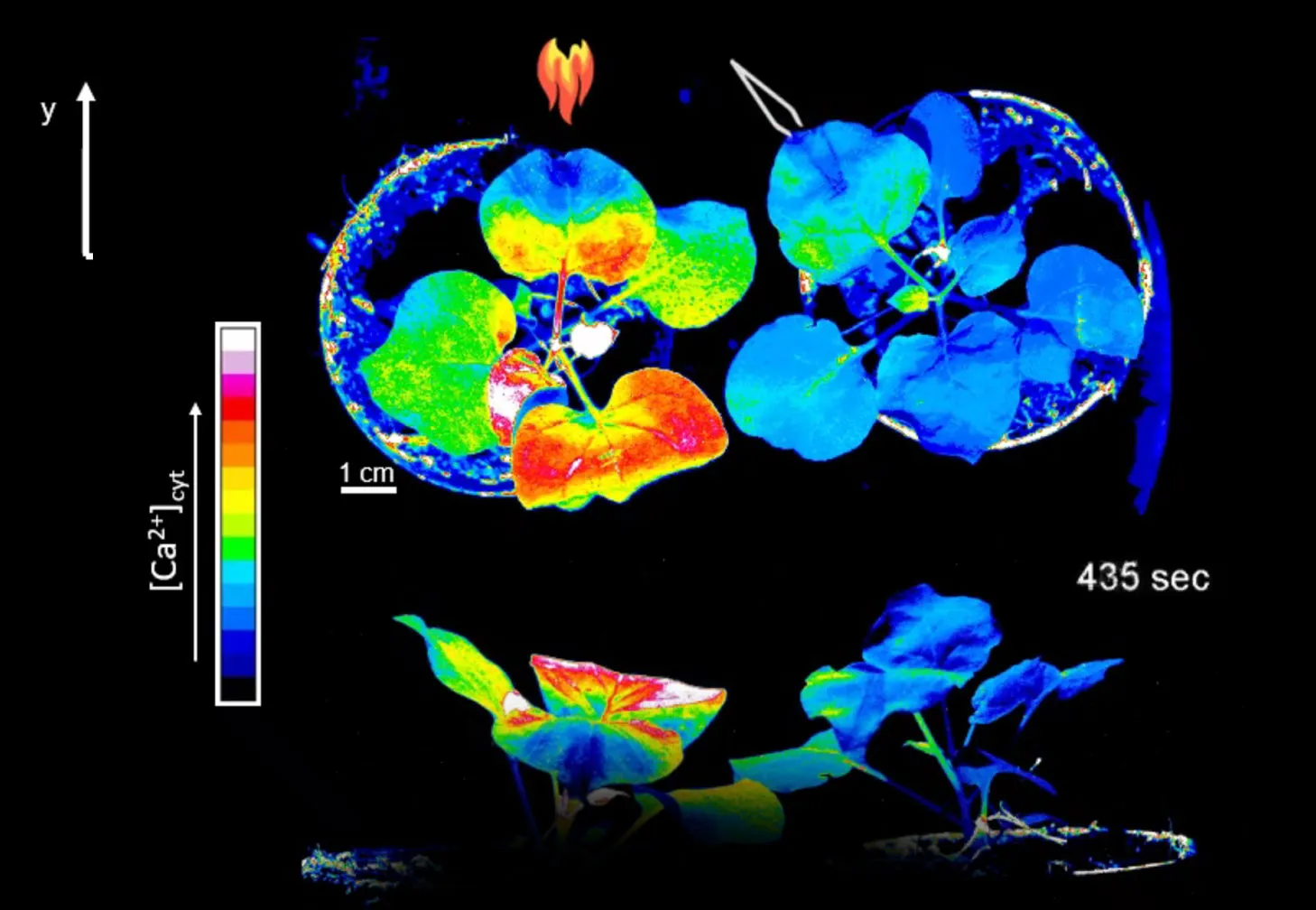
How does an adult plant coordinate, in real time, the response between leaves, stem and roots when it is wounded, submerged, burned or faces extreme environmental conditions? The answer is now beginning to take shape thanks to an innovative optical imaging system developed by the Università degli Studi di Milano, in collaboration with the Politecnico di Milano. The study was published in the journal Science Advances.
The technology is called MAPPI — MAcro Plant Projection Imaging — and makes it possible to observe leaves, stem and roots simultaneously while the plant reacts to stimuli such as wounding, submersion, burns or other environmental stress factors. Its most innovative element is its dual perpendicular view, which makes it possible to follow what happens throughout the whole plant at the same time, overcoming the limitations of traditional instruments, which are generally designed for small laboratory plants. This opens up the possibility of studying specimens comparable in size to those grown in greenhouses, something that until now was extremely difficult.
Unlike conventional imaging systems, MAPPI is modular, low-cost and open source, which makes it easy to reproduce in many laboratories. Using fluorescence, the platform makes it possible to visualise in real time signals that are decisive for plants' internal communication, such as changes in the concentration of calcium ions and the accumulation of glutamate, both of which act as cellular messengers. With this technology, the researchers showed that signals travel not only between leaves, but also in both directions between leaves and roots, revealing a communication network far more complex than had been assumed.
“MAPPI allows us to observe how these signals travel through the whole adult plant, dynamics that until now we could only imagine,” says Alex Costa, plant physiologist, professor in the Department of Biosciences at the Università degli Studi di Milano and lead author of the paper.
“MAPPI makes it possible to overcome the limitations of traditional microscopy. It opens the way to new research on the physiology of adult plants,” explains Andrea Bassi, professor in the Department of Physics at the Politecnico di Milano and co-coordinator of the study with Costa. “The aim is to make this technology accessible to the scientific community, facilitating studies on species of agricultural interest, in conditions very close to natural ones.”
The system was also designed so that it can be expanded with additional sensors, allowing multiple molecular signals to be monitored simultaneously. In this sense, MAPPI represents a decisive step towards understanding how plants react to stress — a central question for the future of agriculture, especially in a context marked by climate change.


