
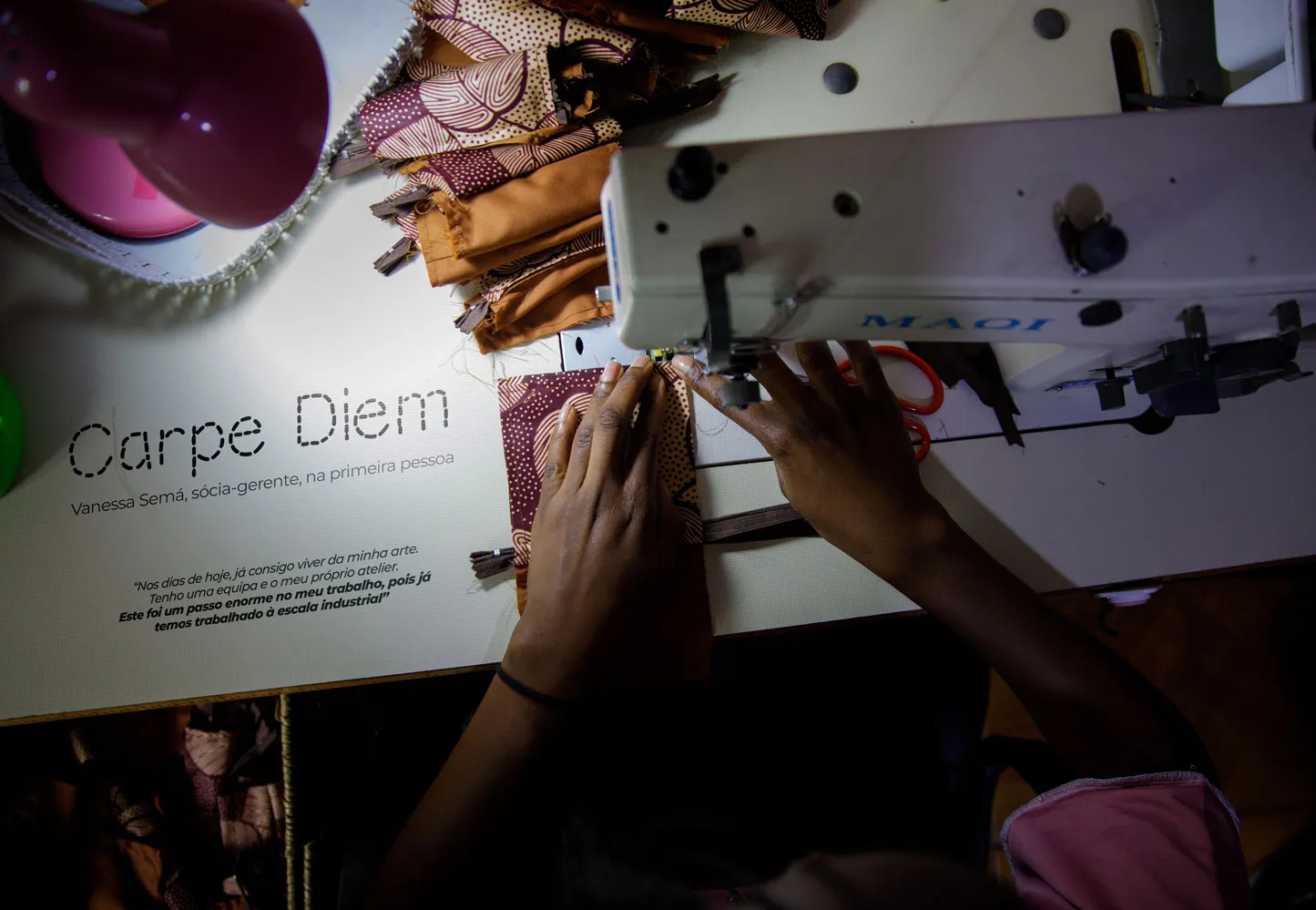
Carpe Diem, Vanessa Semá, managing partner, in her own words
My mother, besides her job, has always been a seamstress. In 2015 she had an enormous order to complete and, seeing how overloaded she was, I asked her to let me help. Until then I had never used a sewing machine in my life, and I understood nothing about sewing. I started by cutting and organising everything so it was ready for her to produce, until I dared to pick up the machine. I grew interested and began to practise on my own, using scraps and offcuts of fabric that would otherwise have been wasted. From the start, I had an enormous passion for the capulana, which at the time was not much used here in certain circles. I would even say that people were ashamed to wear it. In 2016, I began, slowly, to make small, fun and very colourful pieces.
Since I was little, the expression Carpe Diem has been very important in the way I see life. It means to live in the moment; I learnt this in philosophy class in the eighth grade: to live and know how to make the most of each day as if it were the last and most important of your life. When I was told there would be a crafts fair, the Mayfair, at the American School of Maputo in May 2017, I decided to exhibit my small creations, and it was a sales success. I received plenty of orders, made several contacts and began to have my first regular customers. Now I have my studio and I count on the help of a wonderful team. We make handicrafts, creative sewing, customisation, corporate gifts, wedding items and fashion accessories, always using the capulana as our raw material. We have always showcased our work on Instagram, and we usually interact with customers through WhatsApp; from the start, we considered online sales to be the best form of marketing. However, we also have several resellers of our products.
“We have had several orders, and some of our biggest customers become resellers of the brand internationally, which we consider excellent”
Whenever we take part in crafts fairs, I post on social media at the same time so that people know where we are at that precise moment and, strange as it may seem, we manage to make faster sales through those posts. Fortunately, as far as our customers are concerned, we have received very positive feedback about the products we make, since they are made with enormous dedication and attention to detail. We have had several orders, and some of our biggest customers become resellers of the brand internationally, which we consider excellent.
By coincidence, shortly before the pandemic we decided to make a line of health-related items: mask kits, small pouches, surgical caps, among other things. With the arrival of Covid-19, demand for capulana masks was enormous; we made hundreds of masks a week, which we consider to have been our greatest challenge in terms of sewing work. I worked practically alone, day and night without stopping, and I even taught seamstresses from other studios to make masks. During the initial phase, many of the masks we produced were donated to those most in need.
Nowadays, I can already make a living from my art. I have a team and my own studio. This was a huge step in my work, as we are now working on an industrial scale. However, my dream would be to open a place that could serve as a school, workshop and factory. I would also like to continue developing the brand to the point where it gains international recognition as a benchmark of quality when it comes to the art of sewing with the capulana.”


