
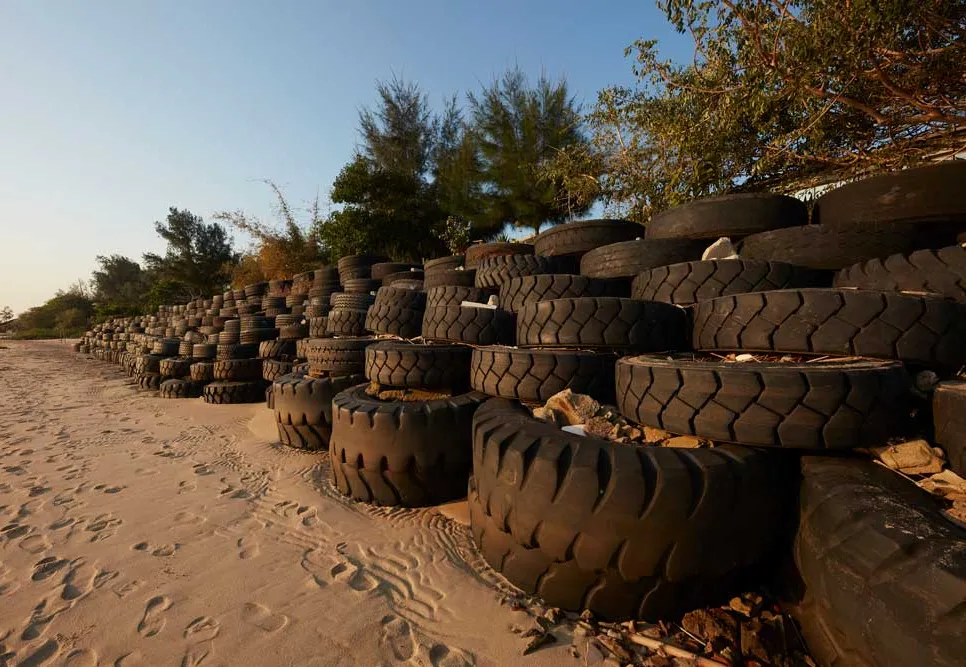
The environmentalist Carlos Serra has been developing a river and coastal protection project that makes use of old tyres, placing them along the banks of the Incomati River and on Macaneta beach, in the district of Marracuene, in Maputo province. For several decades coastal erosion has been getting worse, and it is estimated that some 50 metres of shoreline have been lost over the past 30 years.
Carlos Serra was born two years before independence in the country's fourth-largest city, Beira, in Sofala province, in central Mozambique. He grew up in the city of acacias, Maputo, where he qualified in Law. He has worked in the environmental field since the early 2000s, and in 2004 he became an environmental activist. He founded the “Repensar” Environmental Education Cooperative in late 2018, out of what had been the “Ntumbuluku” Environmental Education Cooperative, an initial experiment.
Serra does not like talking about his private life because, in his view, it is not relevant. He did, however, confide in us that he is divorced and the father of a little girl, who is his joy.
Building a barrier from reused tyres on the banks of the Incomati River is an idea that arose from a cry for help issued by Macaneta Beach Resort. “In desperation, they had already tried almost everything to stop the fury of the waters and prevent the river from overrunning their land and destroying everything they had”, the environmentalist said. “In reality, the Incomati River has been profoundly altered. There are various activities that have interfered with the normal flow of the water and its dynamics, and this began to pose a series of threats to the river along its course”, he explained, summing up the project as follows: “We came up with a solution that was relatively low-cost, that reused materials and waste that could be combined with natural or ecological restoration solutions. We developed a method, and we refined it”.
Carlos Serra also said that the experiment was launched in February 2021, successfully, but that they had learned from mistakes they also made: “There were moments of extreme weather that caused some damage at the start of the barrier's construction and made us rethink the whole concept and correct it successfully”.
With a serious, calm air, the environmentalist stressed: “The resort was under considerable threat. We had rain, we went through a critical and dramatic moment, and we ran the risk of losing the main infrastructure, made up of the restaurant, terrace and support facilities, including a conference room. It is a very high-risk area. Further south, erosion is a very serious reality”, he confided.
According to Serra, the first emergency intervention was carried out next to the buildings. Later, the coastal protection front was extended: “We extended it not only to the south but also to the north, towards the river. We created a line of defence of tyres and sand, and a lot of land was recovered. What is happening is spectacular. We are talking about a barrier of almost 300 metres. It is not finished; there are still two points to close. At the end of the process, we always plant vegetation and create conditions, by laying down mud from the river, so that the vegetation sprouts naturally, on its own, so some sections of the barrier are so green that you can hardly believe there are tyres in there”.
The tyres used by the Repensar project are mostly donated by institutions, as well as by private friends. “As well as using tyres, we rely on a lot of rubble and some stone from buildings that are being demolished in Macaneta to make way for others. We also go to the town of Marracuene to look for rubble – sometimes we have to buy it – so it is a reuse of construction waste. We use river sand and mud; for us mud is a kind of cement, and it is essential to stop the sand escaping with the movement of the tides”, Serra explained.
According to our source, the river protection project has no budget, as it is carried out with voluntary work. “Occasionally we pay for skilled labour, which is used to reinforce the weekends. After the working week, we devote ourselves to this work, and it has been like that for two years and two months”.
As for the number of tyres used in building the barrier, Serra said there is no estimate, although he acknowledged that thousands have been used. “The visible tyres are only one side of the coin; we learned to use tyres inside the barrier for better structure. As for aircraft tyres, which are smaller, we found a phenomenal use for them in building the skeleton, which is crucial for making the barrier more consolidated and solid. We always choose to look for extremely heavy tyres from large machines and tractors”, he said.
For the environmentalist, the ideal would be to always have heavy tyres in quantity, because they go at the base of the barrier. Unfortunately there are not enough for the whole length, but where they have been used the formula is truly perfect. When there are no heavy tyres or machines, they use lorry tyres; the lighter tyres, such as those from small cars, go at the top or in the internal structure.
On the same occasion on which we interviewed him, Carlos Serra spoke about more work he has been carrying out at Macaneta: “We have an integrated environmental programme that combines formal environmental education, through support between schools, with informal education, among communities, fishermen, traders and beach users, and domestic and foreign tourists, who are a key link, because really, now, with the opening of the new road, the beach has become more popular than before, and we carry out these education activities. We help with waste management. We do not do it across the whole locality, but in part of it; we keep the Macaneta road clean, as well as part of the coastal front. We also carry out monitoring, or rather study, of the types of waste found, quantities, brands and packaging. We built an eco-centre where we run a range of activities, bringing together a little culture and education as well as the environment. Through this building, we have tried to show that it is possible to find alternative ways of putting infrastructure in the space, above all in harmony with nature. Our main message is: Do not destroy the coastal forest!”, Serra emphasised.
Alongside this, there are some activities linked to land protection. Our interviewee is also active in this area: “We restored the mangrove; we planted about 4,000 mangrove seedlings last year, over a considerable area. We held World Clean-Up Day, successfully, nationwide, with a very strong focus on Macaneta, of course”, he concluded.


