
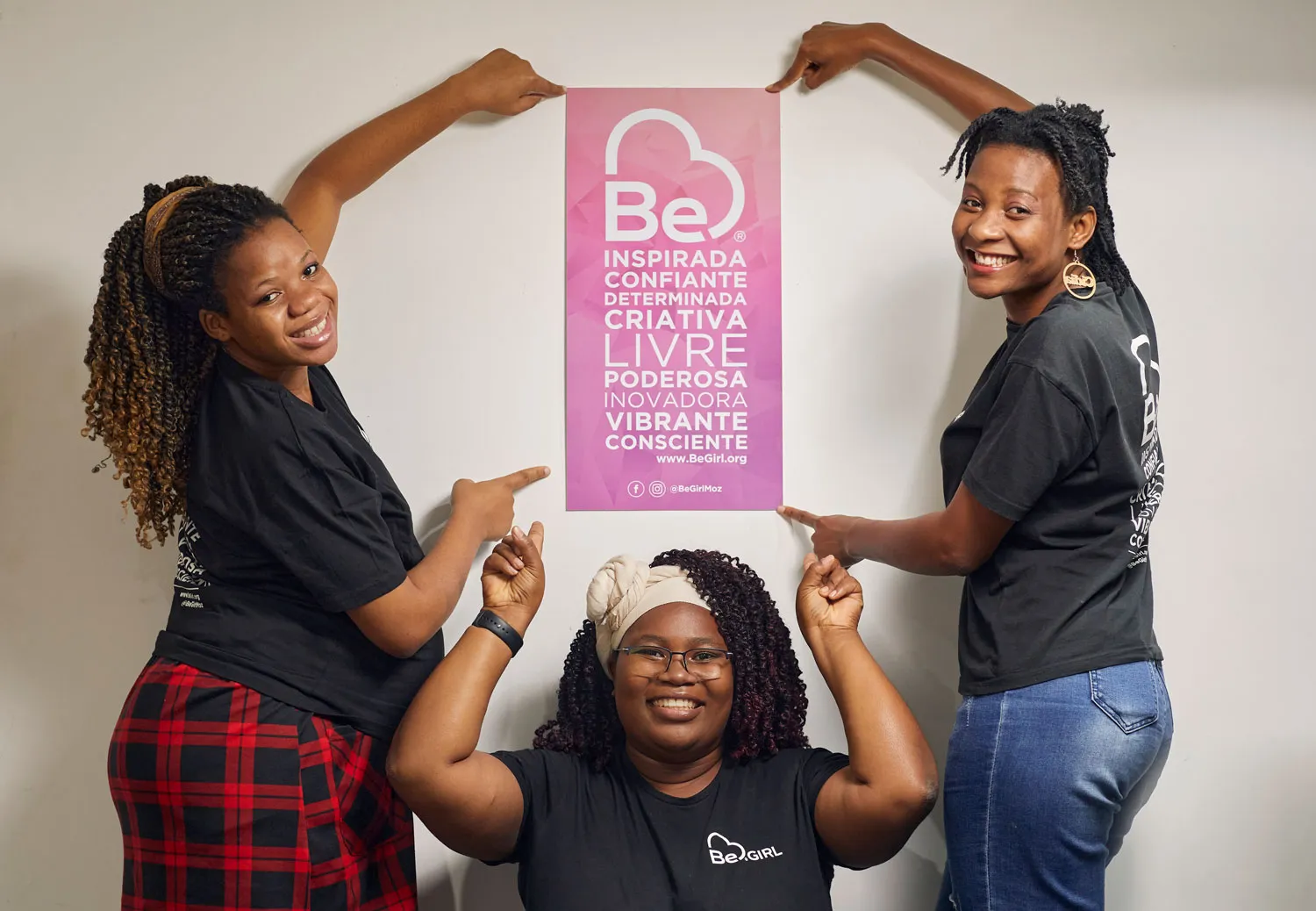
Reusable sanitary pads: in pursuit of women's self-esteem
Written by Precidónio Silvério
Menstruation is not an aberration! That's right, we are talking about menstruation. It really is not an aberration, and the people saying so are three Mozambican young women, Cídia Chissungo, Júlia Zandamela and Eleutéria Nhatava.
Some sites that write about reproductive health indicate that girls start to have their menstrual cycle at around 12 years of age, and it can happen up to 16. It is at this stage that a whirlwind of questions and sensations arises in girls, as they watch a part of themselves leave their body. For some, the doubts are dispelled on the spot, thanks to the guidance of someone close to them. For others, however, their menstruation is treated as a mystery.
Mozambican society, especially in rural communities, has often seen this feminine blessing as a horror. In some contexts, for example, girls are prevented from carrying out certain household tasks, or even from eating this or that, simply because they are menstruating. These taboos can often destroy their self-esteem. It was against these and other aspects harmful to women's mental and reproductive health that Cídia, Júlia, Eleutéria and other young women came together, seeking to break down the barriers imposed on the menstrual cycle.
Cídia Chissungo, Júlia Zandamela and Eleutéria Nhatava share a project – Be Girl Moçambique, which has been in the country since 2018
But what exactly do they do?
This group of young women share a project – Be Girl Moçambique, an initiative that also exists in other countries and has been with us since 2018. The young women say that at the beginning it was just a project in the making. Nowadays, a thousand and one steps have already been taken.
Be Girl is defined by two pillars: empowerment (through educational activities) and products, the latter being reusable sanitary pads. Thanks to the educational activities, a little over 15,000 girls and boys now know better that no taboo can explain menstruation.
According to our promoters, the reusable sanitary pads were designed to solve a problem that affects countless Mozambican girls: the lack of financial means to buy disposable pads. What Cídia Chissungo, Júlia Zandamela and Eleutéria Nhatava make is sanitary material that can be used for up to two years, whenever a woman is menstruating. It consists of a pair of knickers and a pad. Both pieces are washable and can be used over several menstrual periods. With the project, the group has taken talks to communities, mainly through schools, where messages encouraging respect for girls and their choices are delivered. Indeed, Cídia Chissungo told Xonguila magazine that the talks prioritise instilling the need for freedom of choice in adolescents and young people. “We always try to make girls understand that they must be able to make choices about themselves. The idea is to show the world that menstruation is no horror, a message that is also aimed at boys, because they must respect girls,” she explains. And as Eleutéria, in turn, said, it is an endeavour with no borders: “This year, for example, we managed to engage with 4,000 young Angolans in a talk held virtually.”
During the conversation with the three young women, on a Tuesday afternoon, the sun gradually disappeared without our noticing. Suddenly, the lights of the office where they work 8 or more hours a day became noticeable; night had already fallen. Xonguila pressed on with why the project takes educational messages to communities alongside the sanitary products, to which Júlia Zandamela replied: “It is not enough to show that a product exists to solve a certain limitation; it is important to pass on new knowledge about the issues related to it. We need to present the reusable sanitary pad – the product – and the knowledge about menstruation.” In fact, it is with this knowledge that Be Girl manages to break the webs of stigma built by taboos and other shackles.
Environmentally sustainable pads
Reusable sanitary pads are not only a way of relieving women of the cost of buying disposable pads. Cídia says they also respond to calls for the protection of the environment. Disposable pads have the potential to pollute the ecosystem. Reusable sanitary pads contain no plastic, so they decompose quickly. “We designed the product with the environment in mind. These pads contain no chemicals,” Júlia Zandamela assures us. And it is not only the absence of plastic and other chemical substances. Be Girl Moçambique's reusable pads can be used for up to two years, long enough to spare the environment solid waste.
Be Girl Moçambique's reusable pads are available, in the city of Maputo, in some shops that have a partnership with the project. They are not free; they cost 350 meticais each, still an amount that many girls cannot afford. So that the pads reach girls at no cost, the project relies on partnerships with various organisations that buy the product, often as part of their social responsibility. That is how many girls and women in Sofala province, in particular the victims of Cyclone Idai, and now in Cabo Delgado province, have been able to benefit from the product.
Besides sanitary pads, Be Girl has other products to offer, such as the menstrual cup, still rarely promoted because of its delicate use. The comfort of the pads, the attention to detail in the design and the attractiveness of the colours gave the project the opportunity to take part in Expo Dubai 2022. To these virtues are added, according to Cídia Chissungo, the narrative and language with which the subject of menstruation is addressed to young people.


