
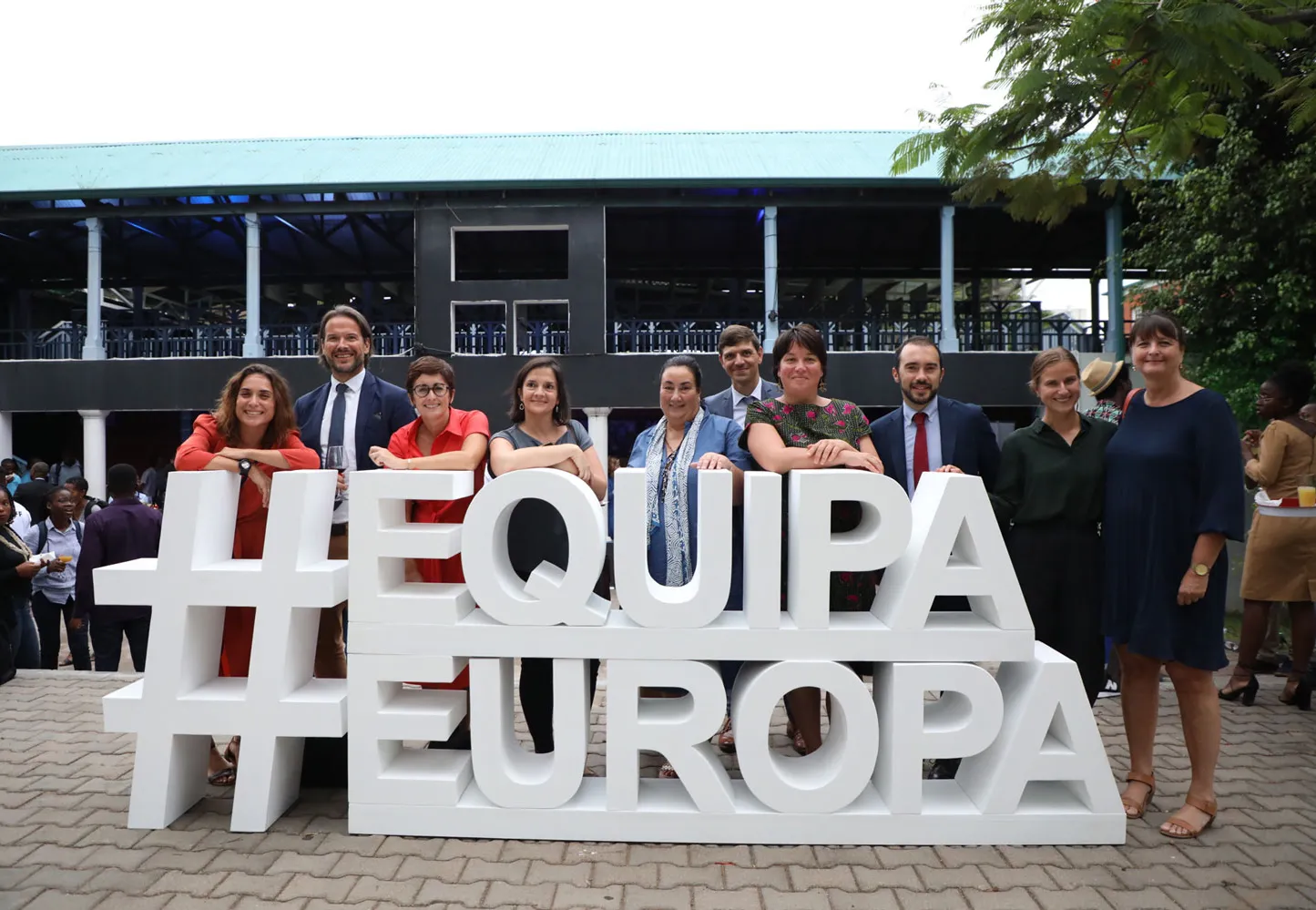
Mozambique and the European Union have been developing a partnership for decades, based on shared values and common interests, as well as on major strategies and policies, notably the Global Gateway and the Team Europe initiatives. This partnership is driven and consolidated in sectors such as development cooperation, political dialogue, economic, trade and investment relations, good governance, peace and democratic consolidation, the fight against the extremist insurgency in Cabo Delgado, and interaction with Mozambican actors from the central level down to the most local. The European Union Ambassador to Mozambique, Antonino Maggiore, who has been in the country for six months, spoke to Xonguila magazine about various aspects of his journey in the country and about what the “360-degree partnership” (his expression) between the European Union and Mozambique will look like over the next four years of his mission.
Could you please tell us, Ambassador, what led you to become involved in diplomacy, and describe your professional career?
Being a diplomat was always a dream, since I was a child. I went to university, where I studied Law, with the plan of becoming a lawyer, but my dream persisted and that was when I joined the Italian foreign service, in 1999, when I was 25. I worked as a diplomat at the Italian Embassy, first in Beijing, then in Turkey, and also at the Italian representation to the European Union, which was of vital importance to me, and then as Italy's Ambassador to Zambia. I decided to become a diplomat because, ever since I was a boy, I was always fascinated by the idea of travelling and discovering the world. That was the initial reason. Over time, I learned the importance of diplomacy in connecting people from different countries, creating links between societies and governments, and also in multilateral settings. I think that is the added value of diplomacy: to be at the service of your country so as to create opportunities for connections for society, for business people, men and women, for scientists, artists and academics, that is, to stimulate exchanges and allow societies to grow thanks to these connections.
You have served the Italian Government in several countries and have served the European Union. We would like you to tell us about your first experience in the service of the European Union and the major differences between serving a government and serving a governmental bloc.
When I served in Brussels, from 2013 to 2017, I had the opportunity to learn at first hand what the European Union is, and what a great political success this bloc is for the benefit of European citizens, European governments and their institutions. It is a complementary role, being an Ambassador of a Member State and being an Ambassador of the European Union, because we work together as “Team Europe”. The European Union is a complex political reality in which the Member States play an important part and their Ambassadors are also protagonists in the European Union's political activities, always with the Delegation of the European Union in the lead in coordinating the common position and implementing the bloc's policies in pursuit of strategic interests and of strengthening the partnership with partner countries. So I am enthusiastic about this role as Ambassador of the European Union, a unique experience. I have a team of 60 people who are committed and focused on stimulating the partnership with Mozambique, and important cooperation instruments to carry forward programmes with concrete results and impact. It is a very good experience to represent the European Union in Mozambique, to be accountable to the Member States and to European citizens, and to promote our fundamental values.
It has been 6 months since you arrived in Mozambique. What are your initial impressions, how do you assess your first interactions and what has fascinated you most?
My first months were extremely significant and rewarding, both professionally and personally. Mozambique is a vibrant country, with beauty and potential; its people interpret and lead their lives with social and cultural dynamism, navigating economic opportunities. But there are also the challenges of poverty and inequality, and the insecurity associated with the insurgency in the North and its consequences. From a political point of view, Mozambique is a country with an important history and trajectory; with hard times overcome, including a decade and a half of war; and with processes of development and of consolidating peace and institutions, whose role is crucial to the progress of an entire nation, under the leadership of President Filipe Nyusi and its people. It is a privilege to be able to contribute to raising bilateral relations to a new level and to realise my ambition of showing how the European Union is Mozambique's primary partner in every dimension. To give examples, a week after my arrival we received a visit from the High Representative for Foreign Affairs of the European Union, Josep Borrell, and, in October, the Commissioner for Democracy and Demography, Dubravka Šuica, to take part in the ACP–EU Joint Parliamentary Assembly and sign sectoral cooperation agreements. I have already been able to meet a range of interlocutors and, in a spirit of partnership, we continue to carry forward important agendas, such as the political dialogue between the Government of Mozambique and the European Union in December, the dialogue on trade and investment with the Ministry of Industry and Trade, and the launch of Team Europe initiatives, among other actions. The openness and commitment to overcoming challenges and delivering results are commendable, and that is the spirit we must maintain.
In the current world scenario, with the consequences of the pandemic and conflicts in various places, such as Ukraine, how do you see the role of diplomacy?
Over time, diplomacy has evolved. Various contexts and realities have reinvented the way diplomacy is done, and it keeps adapting in times of crisis, such as the Covid-19 pandemic and Russia's aggression against Ukraine, as you rightly gave as examples. The important thing is to recognise that, in these times of crisis, international cooperation is more than essential and must never be interrupted. With the pandemic, organisations, States and people adapted and embraced so-called hybrid diplomacy, which combines traditional in-person meetings with online participation, and important decisions were taken to find solutions to the pandemic itself, among other things. Russia's war against Ukraine, which I must reiterate was unprovoked and unjustified, was another test for diplomacy, in particular European diplomacy: our bloc of 27 did not cancel its international commitments, whether bilateral or multilateral; on the contrary, it accelerated, for example, its green and humanitarian agenda. The European Union and its partners carried forward all their diplomatic commitments, which made it possible to continue international cooperation and to respond to the Russian invasion, in terms of diplomatic support in forums such as the United Nations with the adoption of important resolutions, financial and humanitarian support and all the solidarity shown. All of this is to say that diplomacy always faces challenges, but the commitment of States and their leaderships, of regional blocs and international bodies, on the basis of commonly accepted rules, is what makes diplomacy stronger still and an instrument of solutions.
We hear about new initiatives, such as the European Green Deal, the Global Gateway and Team Europe. What do they involve and how do they fit into the European Union's agenda in Mozambique?
I will start with the Global Gateway, which is a forward-looking initiative. It was launched a year ago, but we have already seen it rolled out in every region, including here in Mozambique, where, as Team Europe, we are implementing the Green Deal for Mozambique and e-Youth. Globally, this initiative aims to boost smart, clean and secure links in the digital, energy and transport sectors and to strengthen health, education and research systems around the world. It is also fully aligned with the 2030 Agenda and its Sustainable Development Goals. In Mozambique, we intend to mobilise a collective European response to an increasingly challenging and changing scenario, and to become partners with greater impact. What is important about these two initiatives, the Green Deal for Mozambique and e-Youth, is that they result from consultations with the Government, civil society and other cooperation partners. The Green Deal for Mozambique will support the Government in protecting and restoring the country's natural capital; and in increasing the coordination of the investments that the European Union and its members are implementing and planning in the sustainable infrastructure sector, seizing the opportunities of the green transition. In this area, the European Union is already supporting Mozambique in realising its twin ambition of ensuring universal access to electricity and a just energy transition, based essentially on renewable energy, with strong private-sector involvement. On the other hand, e-Youth will support young people in reaching their full potential to lead socio-economic transformation through education, employment and empowerment. The European Green Deal, for its part, aims to eliminate greenhouse gas emissions; this is the European contribution to the commitment to climate neutrality by 2050, under the Paris Agreement. These strategies and initiatives are well aligned with the European Union's cooperation programme with Mozambique (2021-2027) in the areas of Green Growth, Youth Growth, and Governance, Peace and a Just Society, and with Mozambique's five-year priorities.
How has interaction with local actors and other organisations been in implementing the various projects, programmes and initiatives?
Interaction with local actors is an essential part of consolidating our partnership with Mozambique. From them we learn, from their sensitivities and their knowledge of the realities on the ground, and we gain a better understanding of the problems for which we are together seeking a solution. That is how we agree the priorities of our cooperation, preserving the shared values and common interests between Mozambique and the European Union. In coordination with the Government, we have international organisations as strategic partners, and agreements for implementing programmes in the areas of peace, local development, the protection of human rights, the prevention and fight against violence, and the promotion of gender equality. As Team Europe, I can highlight here the implementation of the peace agreement, in which we have reintegration strands involving local development, education for peace and empowerment; the DELPAZ programme, in which Austria and Italy are involved in its implementation in Sofala, Manica and Tete; and we have a youth employment promotion project in Cabo Delgado, with delegated management by Portugal's Instituto Camões. It is imperative to mention the European Union's integrated approach in Cabo Delgado: our interaction with the various partners is aimed at strengthening this triple nexus across the whole north of the country, in terms of humanitarian assistance, security, and peacebuilding and development. On the security front, the European Union Training Mission (EUTM) trains members of Mozambique's defence and security forces to combat the insurgency in the North. Equally important is our collaboration and coordination with other actors in the African region to find a response in Cabo Delgado; I am referring to the European Union's support for the SADC Mission (SAMIM) and for the Rwandan forces, which on the ground help to halt the insurgents' advance.
What strategies do you consider indispensable in communication between the European Union and Mozambique?
The first strategy is frank and open dialogue. It is dialogue that lies behind the solid relationship between Mozambique and the European Union, because we coordinate policies and plans, and we do so at the political, social, economic and trade levels, and in regional and global forums. Twice a year we hold the European Union–Mozambique political dialogue, in which we take stock of the progress of our cooperation and agree positions and priorities, but we also hold sectoral dialogues for more specific coordination of the actions to be implemented. To get to know the real Mozambique, we go out into the field and interact with actors, from community leaders to civil society to the private sector… They are the ones who help us make real the 360-degree partnership that the European Union cultivates with Mozambique.
How would you describe relations between the European Union and Mozambique in recent years? What do you consider to have been the greatest joint achievements to date?
Excellent relations! The European Union and Mozambique have aligned agendas in relation to national and global priorities, and these agendas intersect. I want to highlight the fact that Mozambique is officially beginning its term on the United Nations Security Council as a non-permanent member, a process that the European Union is proud to have supported. It is there that the Government of Mozambique will share its vision on various matters of the international scene, including on Russia's aggression against Ukraine and the preservation of a rules-based international order, in line with the Charter of the United Nations. Together we have achieved a great deal; we have managed to improve the lives of Mozambicans through local economic empowerment, youth job creation, and the construction and rehabilitation of infrastructure such as roads and bridges, and we have promoted peace and stability as key conditions for development.
What actions, plans and programmes are to be implemented in the near future?
I mentioned earlier the Multiannual Indicative Programme (2021-2027), which is the cooperation programme agreed between the Government of Mozambique and the European Union. This instrument is centred on the country's priorities, with gender aspects as a cross-cutting theme. There are 428 million euros for the period 2021–2024, and a total of 183 million euros under the Annual Action Programme for 2022, which covers measures in the three priority areas of the Multiannual Programme. At the moment, the 2023 Annual Action Programme is already under way, encompassing interventions in the sectors of active citizenship, democratic governance, the fight against sexual and gender-based violence, skills development for employment, and the sustainable blue economy. I also want to mention that, when I presented my credentials to the President of the Republic, we addressed the need to promote more business and investment exchanges between Europe and Mozambique. As a follow-up, this year we will host the European Union–Mozambique Business Forum and involve the European private sector, through EUROCAM, as well as the local one. To close, I would say that in May we will hold our annual celebration of Europe Day, which for us is a great celebration of Europe around the world and an important moment of exchange with Mozambique.


