
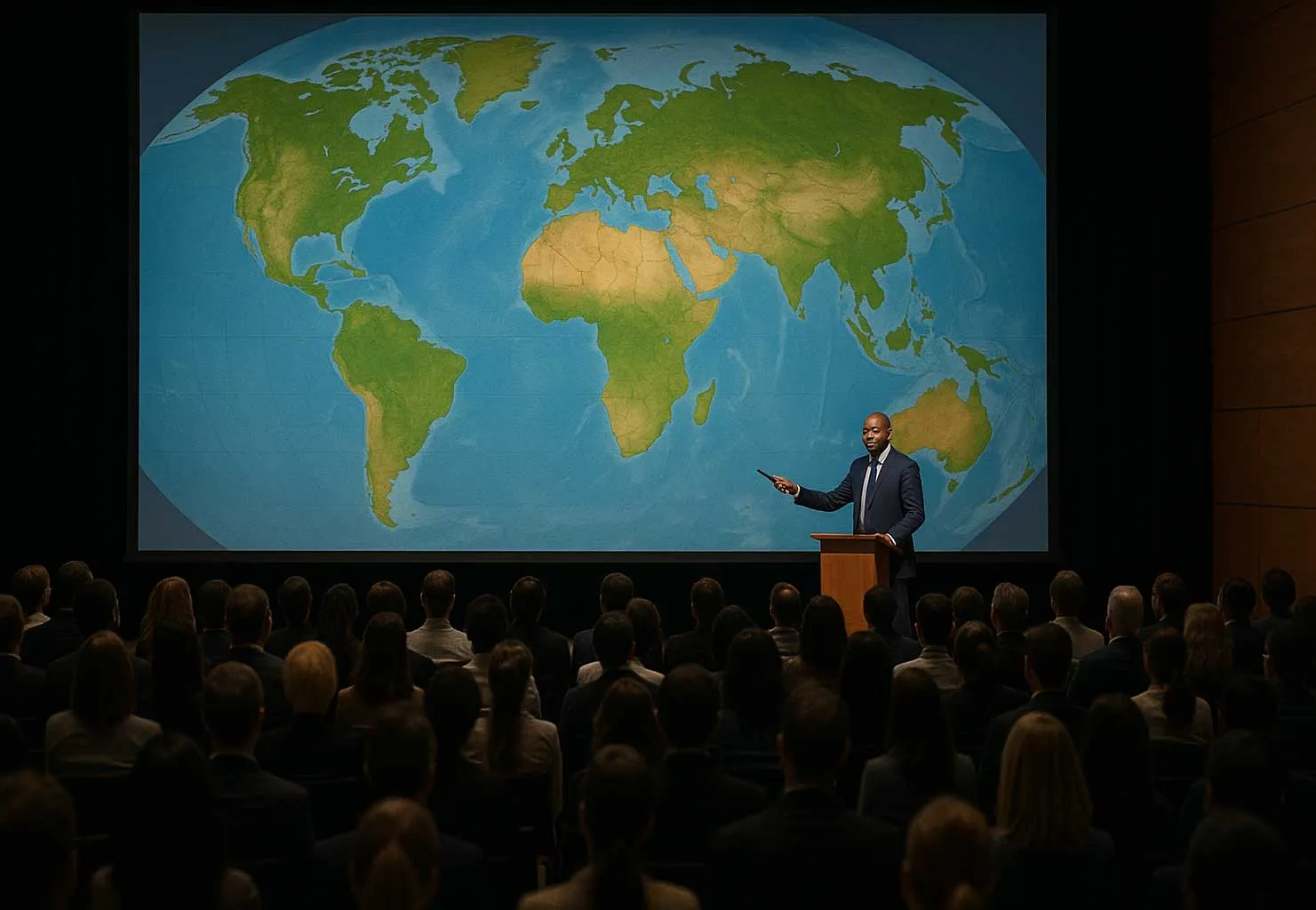
For centuries, the world’s most widely used map has told a misleading story about the size of the African continent. Now, Africa wants to rewrite that narrative – with facts.
Last week, the African Union (AU), the organisation that brings together the continent’s 55 states, gave its formal backing to a campaign to replace the Mercator map with more accurate projections, such as the Equal Earth, launched in 2018. The proposal is not merely cartographic: according to its promoters, it is a symbolic and political correction.
“It seems like just a map, but in reality, it is not”, said Selma Malika Haddadi, vice-chair of the AU’s executive arm, in an interview with Reuters. According to Haddadi, the Mercator projection feeds the mistaken idea that Africa is “marginal”.
Created in the 16th century by the German cartographer Gerardus Mercator, this model was designed to make European maritime navigation easier, but it distorts the proportions of the continents. In some versions, Greenland – with less than a million square miles and fewer than 57,000 inhabitants – appears about the same size as Africa, which covers 11.73 million square miles and has a population of 1.5 billion people.
In the Equal Earth projection, the African continent occupies its proportionate space – easily eclipsing Europe.
The Correct the Map movement, led by organisations such as Africa No Filter and Speak Up Africa, was the driving force behind the request to the AU. The official adoption of Equal Earth is scheduled for February 2026, during the summit of African leaders in Ethiopia.
The campaign, which is circulating with an online petition, also aims to pressure international bodies such as the United Nations and the BBC to make the change, promoting a new cartographic standard that represents Africa fairly.
The African Union’s backing is, so far, the campaign’s greatest asset – and, for the organisers, a decisive step.
“It is more than geography; it is about dignity and pride”, said Fara Ndiaye, co-founder and deputy executive director of Speak Up Africa. “Maps shape our view of the world – and also the way we perceive power. By correcting the map, we also correct the global narrative about Africa.”
In an internal document seen by The New York Times, the AU states that this initiative is aligned with its theme for 2025: “Justice for Africans and People of African Descent Through Reparations”. The text also stresses that the campaign counters false narratives and helps the continent reclaim its rightful place on the world stage.
Even so, some agencies linked to the African Union were still displaying the Mercator map on their institutional websites this week.


