
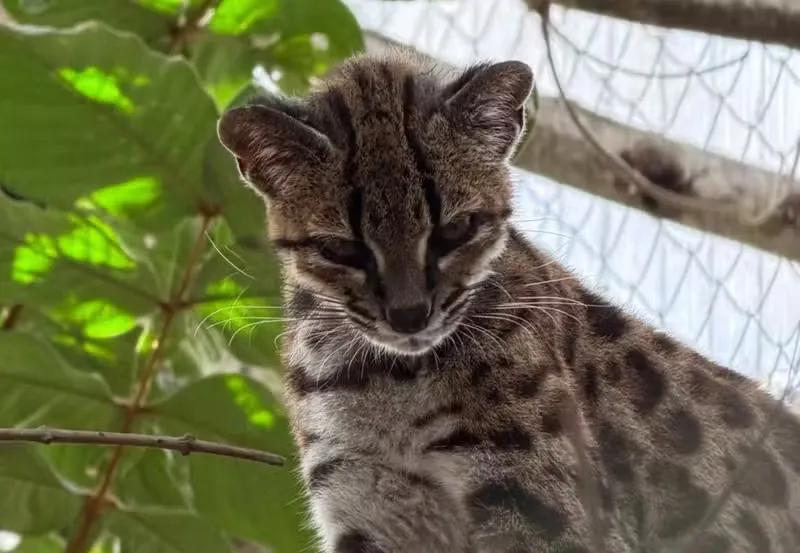
For years, it seemed to be just another small wild cat of Bolivia's mountain forests. It even had a nickname. But hidden in its genetics was a story that science did not yet know: it was a hitherto unknown species of cat.
The discovery was made by a team led by the Brazilian researcher Eduardo Eizirik, a professor at the School of Health and Life Sciences of the Pontifical Catholic University of Rio Grande do Sul (PUCRS). According to the study, this is the first new species of living, rather than fossil, cat described by science in more than 100 years.
The animal was given the scientific name Leopardus tilcayo. The research also revealed a new subspecies of cat found in the Yungas of Peru, named Leopardus tigrinus antisuyo.
Despite the similarity of their names, the two cats are not each other's closest relatives. They are, in fact, distinct branches of a complex evolutionary tree formed by South America's wild cats.
Published in the scientific journal Current Biology, the research also changes the understanding of the diversity of the little spotted cats. For a long time, the extremely similar appearance of these animals made it difficult to identify the differences between species.
“They are animals that look very similar, but are genetically different and have followed independent evolutionary histories for hundreds of thousands or even millions of years. This visual similarity meant that different species were, for a long time, confused with one another and classified as one,” explains Eizirik.
The story that led to the identification of Leopardus tilcayo began in 2016, when a local resident found a cub in the region of Nor Yungas, Bolivia, and took it to the animal refuge La Senda Verde.
At first sight, the small cat was believed to belong to the species Leopardus tigrinus. The genetics, however, told a different story. Analyses showed that the animal belonged to an evolutionarily distinct lineage hitherto unknown to science.
The discovery shows how even widely known groups of animals can still be hiding species yet to be identified.
“This is a study that shows how much there is still to discover about the planet's biodiversity. Even among charismatic and well-known animals such as cats, species can remain unknown for centuries,” says Eizirik.
Beyond the scientific impact, the identification of the new species has consequences for its conservation. Correctly knowing the different populations and lineages makes it possible to better understand the scale of the risks each one faces and to develop specific protection strategies.
The researchers warn that these cats are subject to several threats, among them habitat loss, hunting and diseases transmitted by domestic animals.
The discovery of Leopardus tilcayo thus reveals a reality that had remained hidden in the Bolivian mountains: in one of the most recognisable groups of mammals on the planet, there was still an entire species waiting to be identified.


