
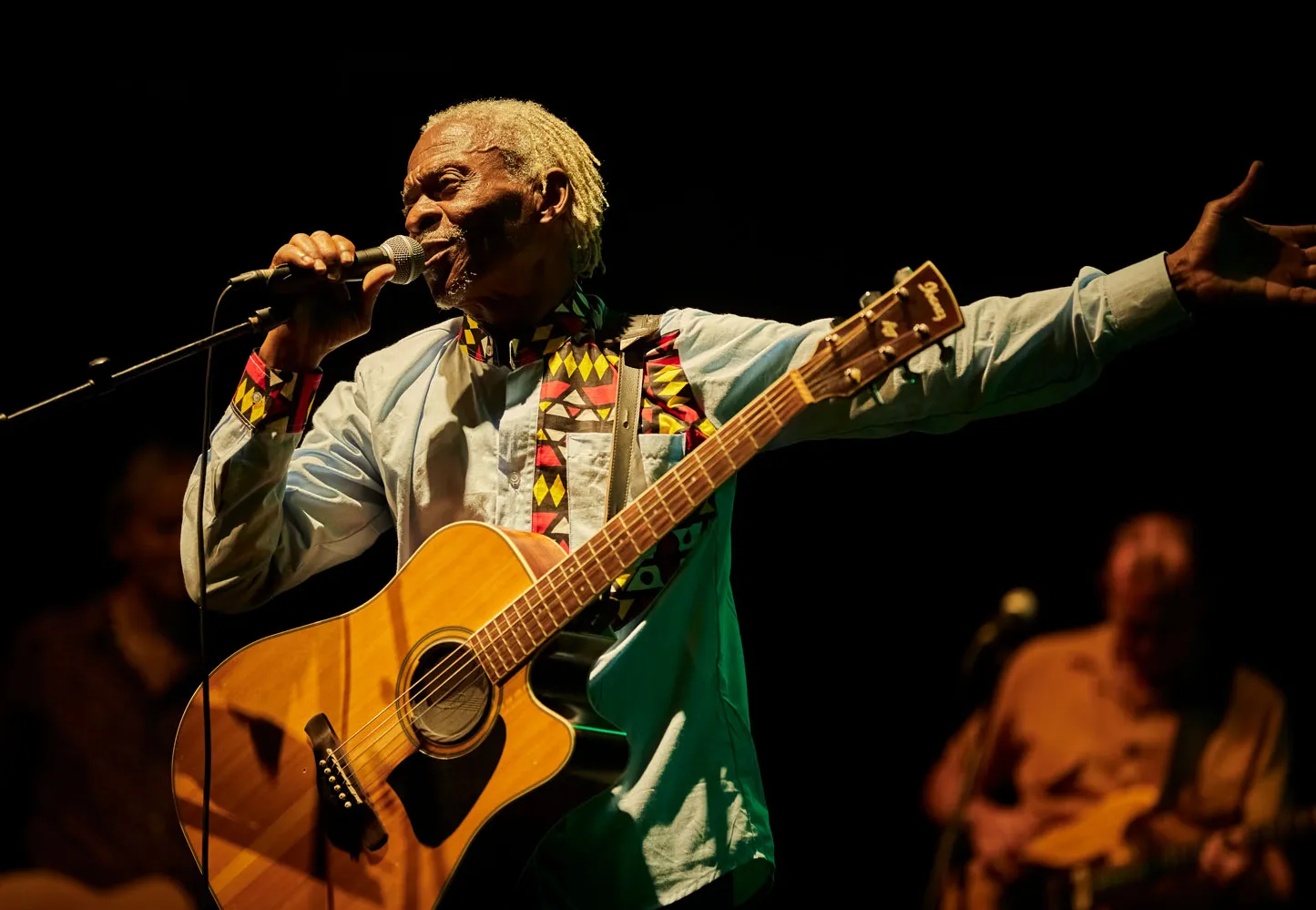
From life on the streets of the Mozambican capital (then Lourenço Marques) in the mid-1960s to the cells of a Portuguese colonial regime prison, before getting to know the boarding school where he grew into a man and became a musician who, through his art, has seen half the world. This is how the unmistakable Chico António describes himself, who, before all that, was a cattle herder. He is 64 years old, more than half of which have been devoted to music.
It sounds like fiction, but it is not. These are dramatic chapters of a true story lived by the Mozambican Chico António, who spoke to Xonguila about his renowned artistic career, and also about the next musical project in the pipeline with the Austrian band The Next.
Chico António’s life begins with an inciting incident, as in the films. At the age of six, the boy who was a cattle herder decided to run away from home, with no destination, afraid to face his father because he had lost half of the herd (20 sheep and goats) he was responsible for. This traumatic event in the life of the composer and performer, a native of Magude in Maputo province and author of popular songs in the 1980s and 1990s, dates from 1964. Chico lived on the street for two years before being picked up and put in the cells by the colonial police. In the same year, he was taken to an orphanage in Chihango and, later, put up for adoption because of his rebelliousness. His adoptive parents, a Portuguese couple, sent him to a religious boarding school, São José de Lhanguene, where he completed primary and secondary education. He trained in Chemistry at the Maputo Industrial School. In parallel, he learnt the art from which he lives today, music. He attended trumpet lessons and learnt to read music and sight-sing. At the age of nine he was already a chorister in a choir of 70 people at the São José Mission, where he grew into a man and an artist. In 1978 he joined the band ABC 78, at the invitation of the fellow musician Costa Neto.
Working with Chico is always a great pleasure. He is a humble person, an exemplary professional and a very well-structured composer. He works very well in the studio, has an interesting vision and, on stage, the way he improvises is impressive. He makes it look easy.– Roland Pick Mudungaze, of the band The Next
Chico António grew up in an artistic atmosphere, surrounded by the best artists in the country. He went from group to group, always as a trumpeter, until he joined Grupo RM in 1983, alongside great names of Mozambican popular music such as Wazimbo, Sox, José Guimarães, Mingas, Alípio Cruz, Zeca Tcheco, Alexandre Langa and Zevo, among others. The group had been created to support national musicians of recognised worth and to feed the broadcasts of Mozambican music on Rádio Moçambique. In 1992, Chico decided to pursue a solo career.
The connection with his roots
True to himself! Chico António’s authenticity lies not only in the striking appearance of his silver hair or in his simplicity. It lies precisely in what he does best, music, strongly influenced by Mozambican social and cultural reality. “I always try to explore traditional national rhythms, in which the country is rich, to be authentic in my compositions. I am not a big fan of computerised or digitised music or instruments, because they lack the feeling that only a musician can give,” explained the composer and performer, who has had hits such as “Mercandonga”, “Negra macua”, “Cachangage” and “Hantlissa Maria”. “National rhythms are vast and it is practically impossible to fuse them all. But I try to explore, whenever possible, a bit of everything there is in the regions across the country. Meanwhile, my vibe is mapiko, ngalanga, nganda, tufo and chigubo,” the artist added.
In 1990, Chico won the Descobertas competition prize from Radio France Internationale (RFI), with the song “Baila Maria”, performed as a duet with Mingas, when he was still part of Grupo RM. “Grupo RM was a true academy. Those were ten years of a great deal of learning. I was lucky to work surrounded by the country’s great musicians. That was decisive for my artistic growth. In the Group I lived the best years of [my] career,” he stressed. “Baila Maria” stood out from the other three thousand competing songs assessed by the jury. As a result of the prize, Chico went to the French capital (Paris) to study music, and specialised in basic piano techniques, musical arrangement, composition and music recording. “During my training in Paris, my tutor Manu Dibango advised me to finish my studies and return to Mozambique, to research traditional rhythms and encourage other national artists to excel in their roots. That helped me build my artistic tone, which was consolidated with the experiences I drew from respected artists on the continent and beyond,” he argued.
In France, he mixed with and shared the stage at music festivals with personalities such as Miriam Makeba, Salif Keita, Hugh Masekela, Youssou N’Dour, Peter Gabriel, Mori Kanté and Pierre Bianchi, among others. In 1991, Chico António recorded his first solo album, and the second, entitled ‘Memórias’, was released in 2014. The first (‘Cineta’, from 1991) he recorded in Paris, with Grupo RM, as part of the Descobertas competition prize, which, as well as a scholarship, included the recording of an album. With his music, the former street boy has seen half the world. Russia, Yugoslavia, the GDR, Romania, Hungary, Bulgaria, the Netherlands, Italy, England, France, Finland, Norway and Sweden are some of the European and Western countries where he has taken Mozambican culture to the stage. In Africa, he has travelled to Angola, Zimbabwe, South Africa, Cape Verde and Mali, among other countries.
The Next... the next step, not the last
“Chico António and The Next” is the musical project the artist is currently working on. Begun two years ago, this joint project between the musician and the Austrian band is being carried out in Inhambane province, at Studio Bom Dia, under the direction and co-production of Roland Pickl, an Austrian based in Mozambique who is also a member of the band.
The main names in the project are as follows: Chico António (vocals, guitar and flute), Kurt Toncar (bass), Bernd BB Kong Bogensberger (drums), Roland Pickl Mudungaze (guitar), Pierre Dufloo (saxophone), Mahu Mucamisa (tenor saxophone), Mario Avasani (trumpet), Nobina Morimoto (violin), Pietro Barone (guitar), Mark Mulholland (guitar) and Nico M’Sagarra (percussion). “The idea of Chico and The Next is to bring together different styles of music and the experiences of different national and foreign artists to produce a double album made up of new songs by Chico and the band,” explains the CEO of Studio Bom Dia, in Inhambane province, and the producer in charge of the project, which began in 2020. During lockdown, because of Covid-19, Chico recorded 20 new songs (with some re-creations) with the participation of local artists and foreign musicians with whom he is in contact and holds professional consultations.
In terms of genre, his mark can be found, but there are also influences from the band. “Chico’s compositions are a fusion of various rhythms. They have elements of African music, with mbira, flute, kora (an instrument from Mali) and the timbila from here in Mozambique; other elements are violin, guitars, blues, jazz, overdriven guitars and rock guitars, which is also a passion of Chico’s and mine,” said Roland, the executive producer in charge of the project, with no release date yet.
“Haste is the enemy of perfection. This is a project that involves many musicians, and that takes a lot of time in the studio. Besides, recording live music is expensive. There are many professionals involved, each with their own speciality,” said Chico. “None of the project’s songs has been released because we need more time to prepare the final mixes. That takes three to four weeks. At the moment, we are looking for partnerships to fund the recording work,” stressed Roland, who then showered praise on Chico, a fellow professional and long-time friend. “Working with Chico is always a great pleasure. He is a humble person, an exemplary professional and a very well-structured composer. He works very well in the studio, has an interesting vision and, on stage, the way he improvises is impressive. He makes it look easy,” said Roland – the first in the band to see him perform – acknowledging his enormous talent.
While the songs await release, Chico and the band The Next performed in concert at the Franco-Mozambican Cultural Centre in late May, presenting fans with a summary of the project, which will culminate in a double album of 20 songs performed by Chico António.
The band The Next was founded in 1998 and, in the same year, released its first album, entitled Unreal (‘Irreal’), which can be heard on digital platforms such as Spotify, Amazon and Beatcamp, or through the website www.studiobomdia.com. In 2004, the band went through a hiatus, the members parted and went to live in other countries, though they always stayed in touch and devoted to music, according to the producer based in Mozambique. The band got back together and made new music in 2009, in Mozambique. In 2021, it released its second album, Antagônica, which it intends to promote through collaborative work with Chico António, who is also going to release his second album, following Memórias, released in 2014. “The project with the band The Next will certainly not be the last project of my artistic career. As long as I have my health, I will keep making music, my life. I am an artist of projects and always open to new collaborations,” said the musician, who is also part of the group Trânsito, with Chude Mondlane, Edmundo and Nico Sandala.


