
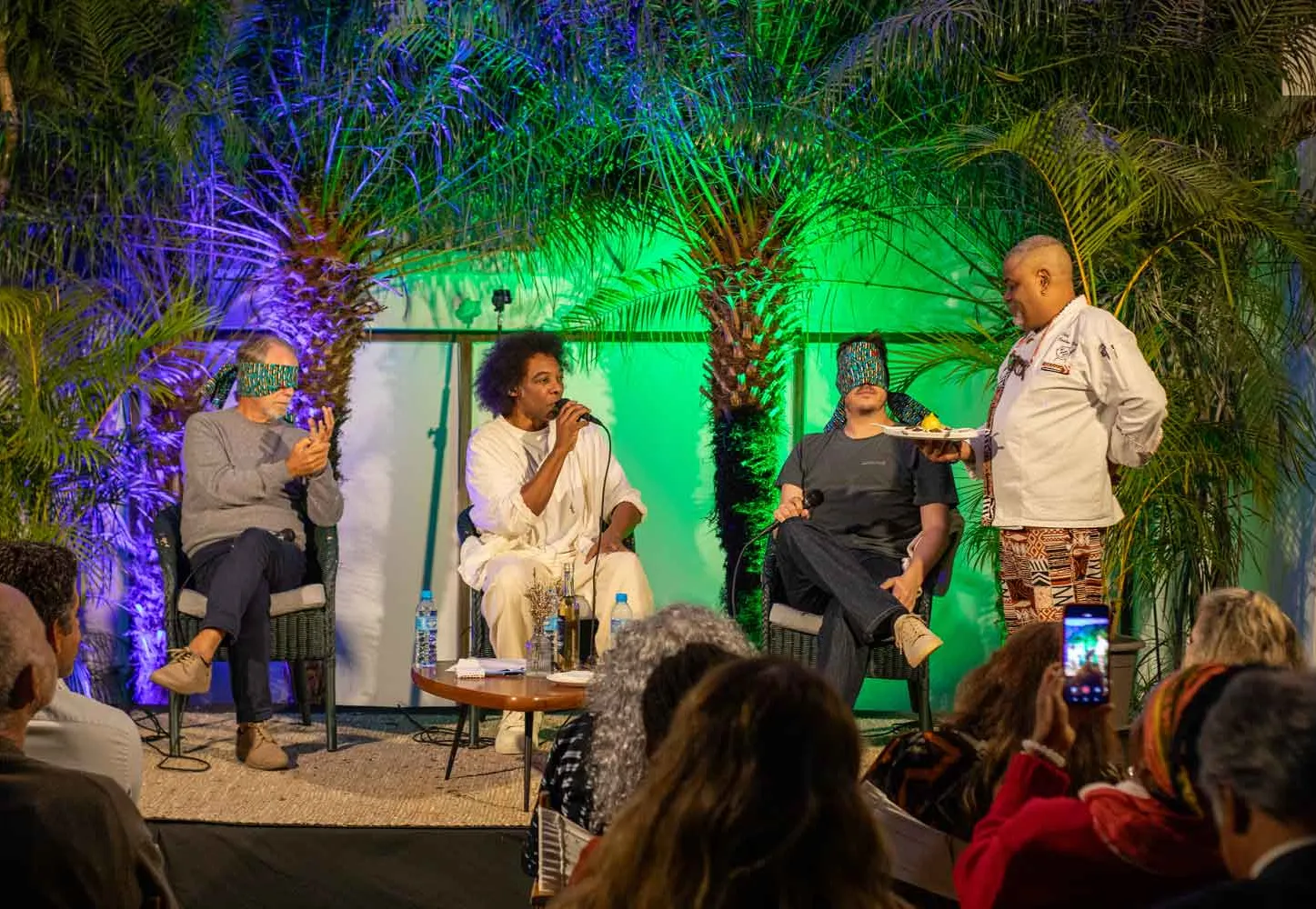
Bringing Mia Couto and Fábio Porchat to the same table is not, at first sight, an obvious combination. A writer known for the delicacy with which he reinvents words and stories, a comedian used to the speed of the punchline and the energy of the stage. It was precisely in this apparent distance that Stewart Sukuma found the raw material to create Conversafiada, a new concept that wants to make unlikely encounters a space for discovery.
The first edition brought the two guests together for a conversation that took in Mozambique and Brazil, literature, humour, culture, personal experiences and the relationship between the Portuguese-speaking countries. Along the way, there were questions from the audience, Mozambican food and moments when the conversation simply went its own way. The idea began with a suggestion. “Ana Girão was an accomplice in this crime. It was she who suggested a conversation with Fábio Porchat. From that idea, I designed the rest and thought: what if we brought Porchat together with Mia Couto?” says Stewart Sukuma. The combination struck him as unexpected enough to work. “It seemed to me an unlikely combination, and it was precisely that unlikeliness that interested me.” With the support of Zacarias Buque, who made Fábio Porchat's participation possible, the starting point was set for a format that Stewart intends to take further.
Between sharp talk and idle chat
The name itself helps to convey the spirit of the initiative. Conversafiada can be read in two ways: conversa afiada (sharp talk) and conversa fiada (idle chat). “The conversation can be intelligent, provocative, profound and sharp, but it can also simply be idle chat, that apparently unnecessary talk that often ends up being the most interesting.” There was, therefore, no intention of constructing a traditional interview or leading the guests through an overly predictable course. The proposal was to create the conditions for the conversation to find its own direction. “I wanted exactly that freedom: not knowing in advance where the conversation will end up.” And it was in this less controlled territory that the affinities between two apparently distant personalities began to emerge. “What surprised me was the ease with which two apparently such different universes found points of contact,” Stewart recalls. “Perhaps that is the greatest merit of a good conversation: discovering that what separates us is often less important than what we have in common.”
Two observers and a provocateur
For Stewart Sukuma, the contrast between Mia Couto and Fábio Porchat did not disappear during the encounter. On the contrary, it became one of its greatest strengths. “Mia is more reserved, almost silent, while Fábio is extroverted and fills the space with a very particular energy. Mia is an inventor of words, Fábio is an inventor of jokes.” Behind these differences, Stewart found a shared trait. “Both are great observers. They have different ways of looking at the world, but both have an enormous curiosity about human beings and about what surrounds them.” And where does Stewart place himself in this equation?
“I am the agent provocateur. My role was to create the meeting, strike the spark and then let the conversation happen.” It is a definition that may become central in upcoming editions of Conversafiada. Rather than taking on the conventional role of interviewer, Stewart intends to create the context, bring universes together and introduce enough stimuli for the guests to do the rest. “Perhaps that is the true formula of Conversafiada: two very different observers and a provocateur in the middle.”
A two-way Lusophony
Among the various paths the conversation took, the cultural relationship between the Portuguese-speaking countries took on particular relevance. For Stewart Sukuma, there is still an imbalance in the way this circulation happens. Countries such as Mozambique regularly consume Brazilian and Portuguese cultural output, but the movement in the opposite direction is still far from having the same scale. “Perhaps we have to start talking less about Lusophony as a concept and more about reciprocity among its members. ” This reciprocity, he argues, involves creating real opportunities for Mozambican artists and creators to reach other audiences. “We have to create the conditions for Mozambican creators to circulate too, to be seen, heard and read in the other Portuguese-speaking countries.” For Stewart, sharing a language is not enough for a cultural community truly to exist. “A cultural community only truly exists when there is exchange. It cannot be a one-way street.”
The audience talks too
Conversafiada also sought to break down the barrier between those on stage and those sitting in the audience. The audience had the opportunity to put questions to the protagonists and to enter directly into the conversation. Stewart admits, in fact, that he would have liked to see even greater participation. “I even thought there were few interventions. I was expecting more questions and more participation, but time was limited.” The intention is for this relationship to become increasingly important in the format. “The audience should not be there just to watch. They should be part of the conversation. Reciprocity is essential: we give the audience something, but the audience also has to give us something back.”
When food joins the conversation
The experience took on another dimension with the participation of Chef Graça, who was responsible for a blind tasting that brought Mozambican flavours to the guests and opened up space to talk about food, identity and memory. The choice was not a decorative element. For Stewart, it made sense for a conversation about culture to go beyond the most obvious territories. “Culture is not only in books, on stages or in museums. It is also in what we eat, in the flavours we recognise and in the memories those flavours awaken.” The blind tasting also brought a playful side to the event, allowing the food to be experienced and not merely discussed. “The blind tasting was a fun way of bringing Mozambican food into the conversation and, at the same time, creating an experience for the audience.” Literature, humour, music and food thus ended up sharing the same space, before the evening ended in a relaxed, convivial atmosphere.
A format that is here to stay
The first Conversafiada also served to test an idea that Stewart Sukuma already imagines beyond this edition. The aim is not to turn the concept into a succession of interviews in front of an audience, but to keep mixing people and languages. “I don't want Conversafiada to be just an interview with an audience. I want to cross people, languages and artistic expressions.” Literature, music, film, humour, food and the visual arts may be part of this universe. The rule, if there is one, seems to be to avoid what would be too predictable. “Contrast is important to me. It is precisely in contrast that something interesting is often born.” Stewart therefore confirms that the experience does not end with the meeting between Mia Couto and Fábio Porchat. “Conversafiada is here to stay.” Upcoming editions should continue to bring together national and international personalities, maintaining the logic of creative confrontation. “I want to keep betting on contrast: different people, different universes, different opinions. The less obvious the meeting, the more it interests me.” The date and the next protagonists remain, for now, a secret. Stewart leaves only one clue. “If the first was a conversation between Mia Couto and Fábio Porchat, you can expect the next to keep defying expectations.” Perhaps that is, after all, the best definition of Conversafiada: putting at the same table people whom nobody would think of bringing together and letting the conversation do the rest.


