
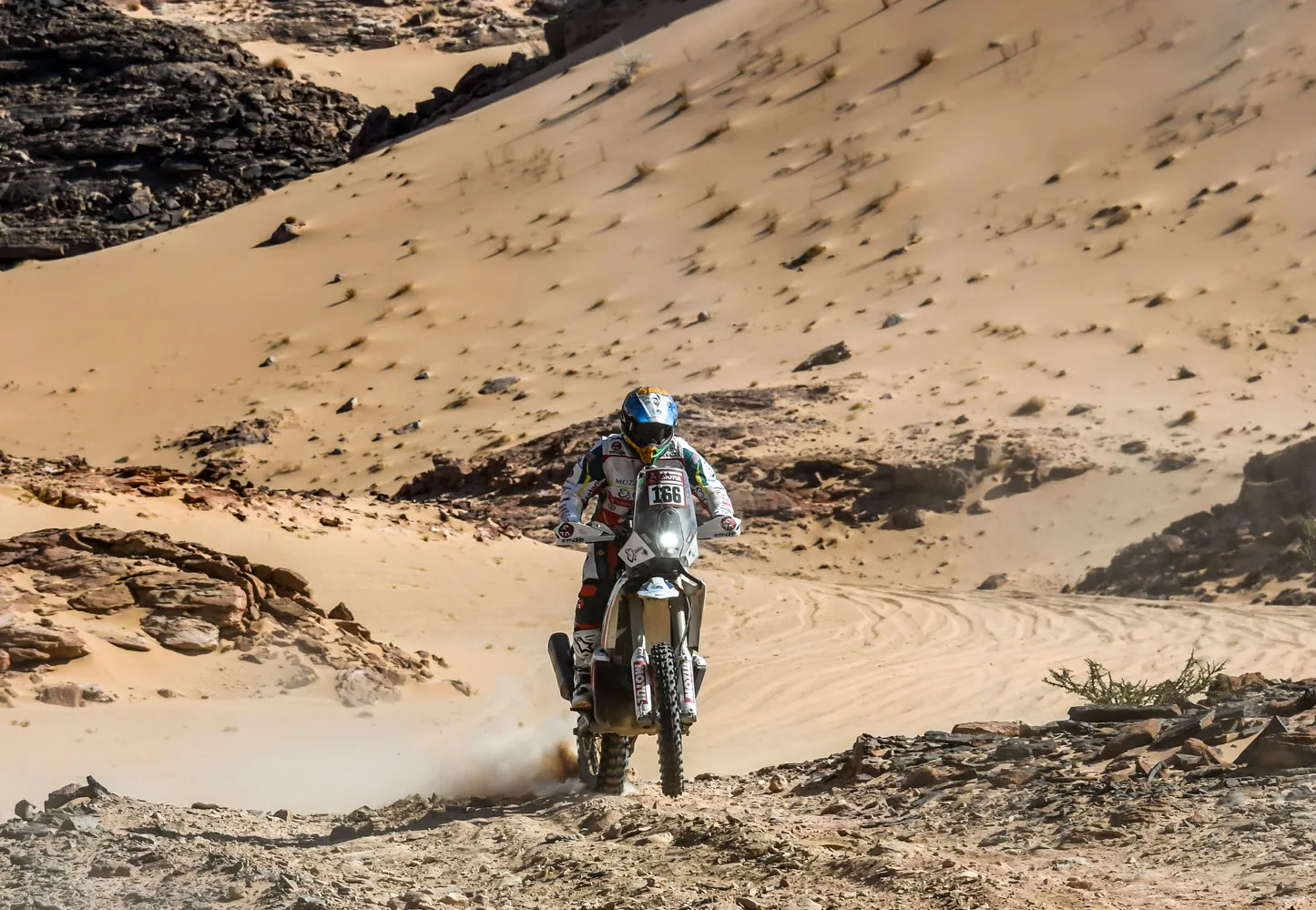
You were the first Mozambican rider to take part in this competition, which is a source of pride for our country. How would you define the Dakar Rally, and what does it mean to take part in the biggest motorsport event in the world?
The Dakar is the biggest off-road race in the world. It is not just a competition, it is a test of human perseverance. It is 15 days of pure adrenaline, with a great deal of physical effort, which we have to manage. That management also involves managing our emotions, frustrations and anxiety, in other words, managing the psychological side. Every off-road motorsport enthusiast dreams of the Dakar, and for me it was a dream that became possible.
In the near future, do you think there could be more Mozambicans in this competition?
I think so. The hardest part is done: we were there for the first time and opened the way. A lot of experience was gained that we can share. On the other hand, I think that with my project we managed to professionalise a rider/team and secure sponsors, without whom it would be much harder for us to be there. Companies now believe that it is possible to get a return on the investment they make in an athlete who does things properly.
How do you manage your relationship with the bike over so many hours of riding? How many times did you need assistance?
We spend around 10 to 12 hours a day on the bike, over 13 stages. We need to be very focused every day so that no accident happens. As well as extensive physical preparation, we have to be very strong psychologically. I had a very bad fall on stage 4, where I broke two ribs and lost consciousness for a moment, but I carried on with the race. Some very painful days followed, but the adrenaline and the medication helped. I was never assisted on the track, fortunately. Twice I had to stop to help two competitors, one who was stationary for mechanical reasons, and another after an accident.
When did you realise you had a knack for riding?
Since I was a boy I dreamed of riding motocross and enduro bikes, but it was only at 18 that I managed to buy my first bike; my parents were against the idea of my riding a motorbike. I started competing at 23, a little late for this sport.
What is your dream bike?
My dream bike is my own, the KTM RALLY REPLICA, which my idols also race. I am a fan of the KTM brand.
Did you experience any bizarre episode where you thought: “only at the Dakar”?
The Dakar is a long competition, and therefore full of episodes and incidents, with countless stories to tell.
Which one left the biggest mark on you at the event?
The one that left the biggest mark was stage 11, when the engine of my KTM gave out. I spent 8 hours alone in the desert, because I did not want to give up, and waited for assistance. I eventually arrived at the closed park at two in the morning. I handed the bike to the mechanic, Carlos Damião, and to Miguel Alberty – who, although not a mechanic, did everything he could and was a key element in my finishing this challenge –, and they stayed working on the bike. After sleeping for two hours, I went to see how the bike was, but it still had the same problem. We then took the decision that, if we wanted to finish the race, we would have to change the engine, and within an hour we had changed it. I set off on stage 12 an hour behind, but even so we still passed 10 competitors on the track and managed to finish. The joy of finishing was equal to that of the rider who won the race, Sam Sunderland of Gas Gas.
Was there any stage that made you wonder whether you would want to take part again? Did you ever think of giving up?
There are stages where, because of the effort, we think: what are we doing here? We think that we could be at home, on the sofa, following the competition on TV. But as soon as we finish that day, we get a second wind to face the next stage. The challenge is enormous, and so is the desire to finish.
Who is your favourite rider?
Mário Patrão, a friend of mine for a long time, who has always fought and believed that he could make a career in off-road racing, even though he did not have the means at the start of his career, and Toby Price, the KTM rider, for everything he has been through in his career. After a major accident, and at risk of being left paraplegic, he went on to win the Dakar twice.
Are you thinking of entering other competitions? What plans are there for the coming period?
We are putting together the sporting project for 2022. After recovering from the injuries sustained, we will meet with the sponsors and some institutions to see what we will do this year. There may be news soon.
How would you like to be remembered?
As someone who contributed to the development of motorsport in our country, both in competition and in representation.


