
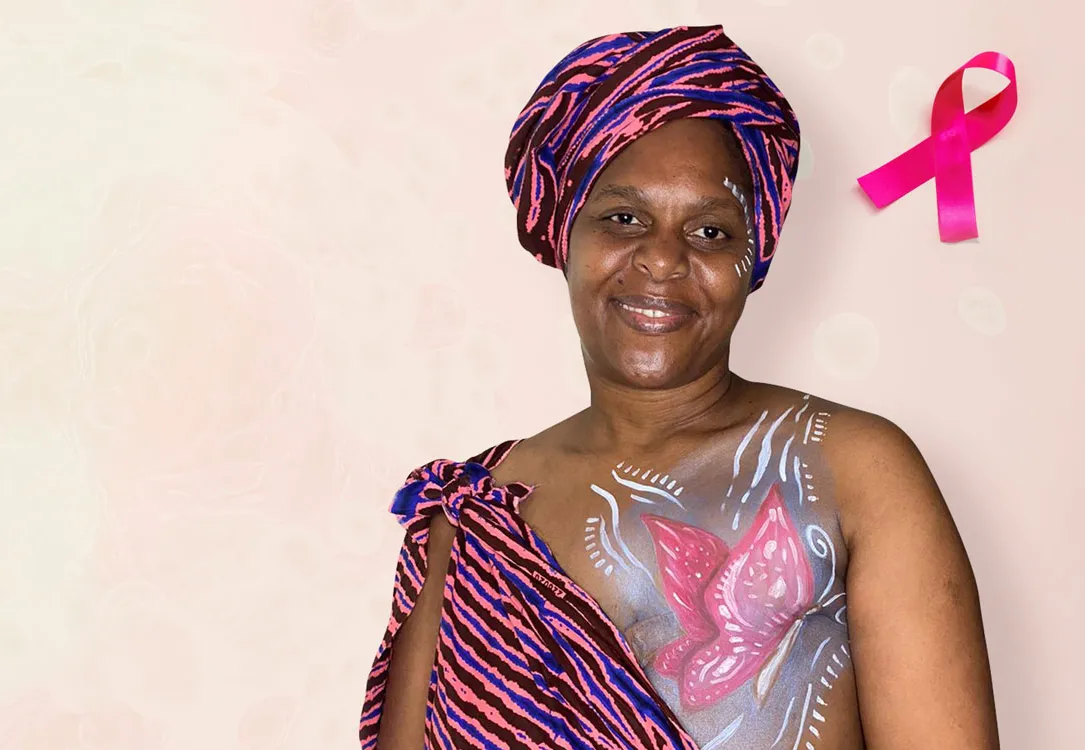
This October, the fight of Edite Dimene
Written by: Precidónio Silvério
Every year, in October, the world “marches” in an awareness campaign aimed at women and the population in general, on the importance of prevention and early diagnosis of breast cancer.
The initiative began in the United States of America in 1990, at an event called the “Race for the Cure”, and has been replicated by various countries, including Mozambique, in the now global movement known as “Pink October”. With or without a history of breast cancer, women and men, individuals and institutions, unite in a single voice to warn of the risks of this truly devastating disease and to call for its prevention.
Edite Dimene, aged 43, a resident of Matola, the second largest city in Mozambique, agreed to open up to tell her story, somewhat bitter but above all marked by overcoming adversity. She does not mind talking about her past with the disease, as she knows that her testimony will help dispel doubts about cancer that fill many people's minds.
For Edite, it all began in late 2016, when, little by little, she noticed some changes in her body. Touching her chest, she discovered that something was not right: her left breast had a lump, a discovery that did not leave her at ease in any way. It was enough for the horizon of her life to take another direction, not at all a pleasant one.
In Mozambique, in 2016, breast cancer was not much talked about publicly, and people often relegated it to the labyrinths of taboo. But Edite Dimene did not let herself be swayed, she did not fall for that. She decided to seek answers at a hospital, a visit to a health facility that would multiply into countless ones, of which she had little idea. Between consultations and diagnoses, still in late 2016, doctors confirmed what she feared most: breast cancer. “It was not easy at all to learn that I had cancer. It was a shock to know that a part of me was at risk of leaving my body,” she said. In a very short time, Edite had the misfortune of tasting a dark side of life, but she quickly made the fight against that pathological enemy her great cause.
With or without a history of breast cancer, women and men, individuals and institutions, unite in a single voice to warn of the risks of this disease and to call for its prevention
In 2017, Edite Dimene began the long treatment process at Maputo Central Hospital. She went through several medical consultations, many of them starting in the surgery department, where the lump was removed and tests were carried out that led to the conclusion that she did indeed have cancer. She then underwent eight chemotherapy sessions, of which the first four were the most decisive, because they involved eliminating the affected cells and combining those that did not put her at risk. At the beginning of 2018, Edite was told by the doctors that she would undergo surgery to remove her left breast, where the lump was found. “It was a whirlwind of feelings to see a part of my body being lost. It affected my vanity,” Edite told us. Her relatives were also shocked and saddened to see her plunged into suffering marked by dread and uncertainty.
A testimony for many women
Once the breast was removed, Edite did not stop fighting. She had to attend medical check-ups once a month, so that the doctors could analyse and monitor the situation. She now goes to these check-ups only every three months.
Anyone who thinks the reduced frequency of check-ups is a reason to celebrate victory is mistaken. Edite does not hide her doubts and her fear of what the doctor might say at the next appointment. “It is a suspense that will not go away any time soon. It remains worrying. There is always that doubt about whether or not the cancer has spread to another region of the breast,” she confided.
There are cases in which women with cancer are fortunate enough not to have the breast removed, but that was not the case for Edite Dimene, nor for many other women. Our interviewee felt, and continues to feel, the wounds of the scars that the malignant disease caused her. For that reason, she says time and again that she would not want any other woman to go through what she went through. “I tell all women about the need to know their bodies. To touch their chests more, because that can, in fact, save them.”


