
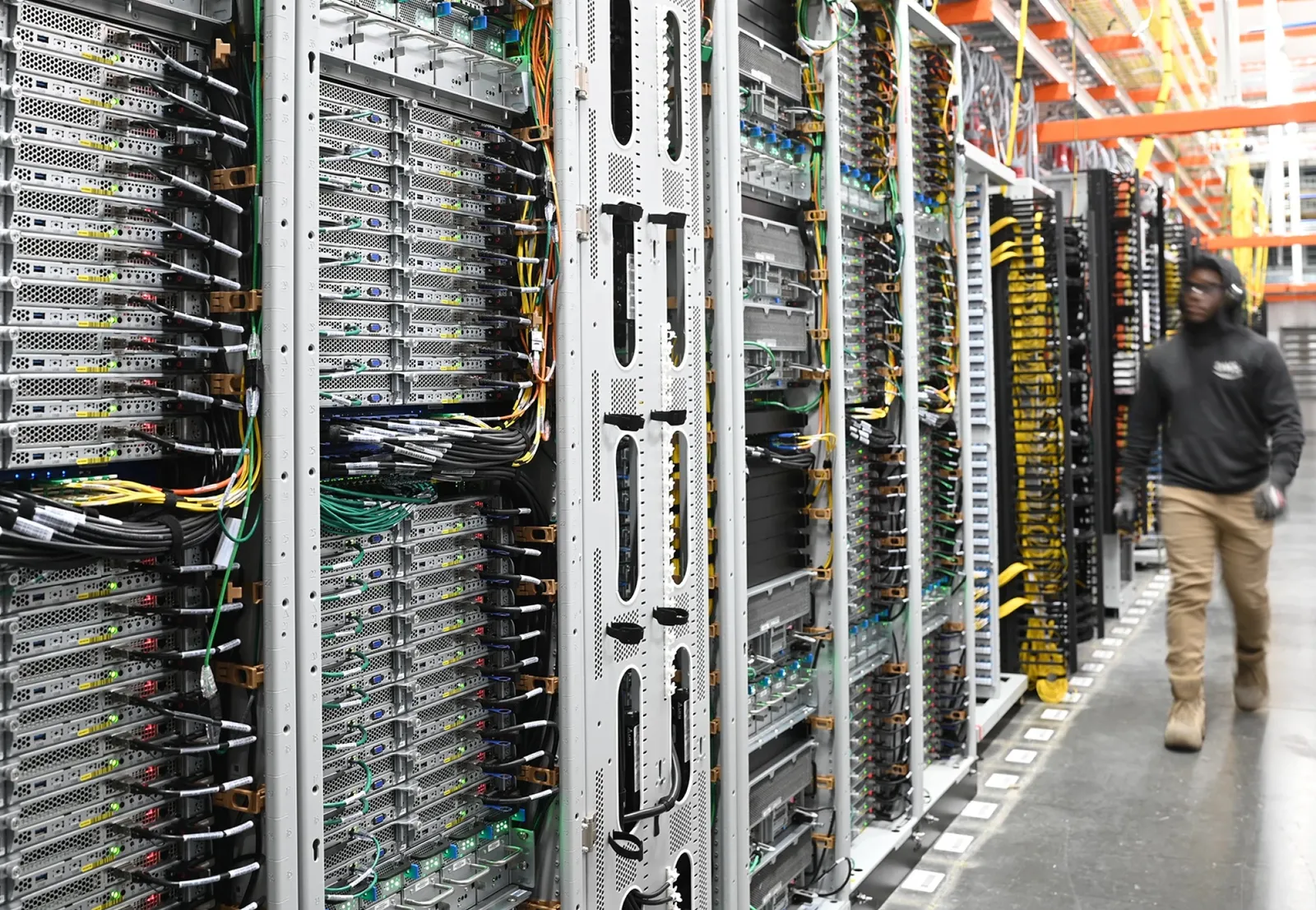
Artificial Intelligence is driving demand for data centres, with historic investments, rising energy consumption and a new digital geopolitics emerging.
The world is experiencing a new boom in digital infrastructure. Data centres – buildings designed to house servers and process gigantic volumes of information – have become strategic assets for governments, investment funds and tech giants. They are rapidly becoming the backbone of the new global economy, driven by the mass adoption of Artificial Intelligence (AI).
According to the consultancy McKinsey, global investment in this sector is expected to reach 5.8 trillion euros by 2030, three quarters of which will be driven directly by AI-related projects. The aim: to expand computing capacity exponentially, which, according to forecasts, will have to grow by 350% over the next five years.
The Big Tech race
Companies such as Meta, Microsoft, Amazon and Alphabet are the protagonists of this unprecedented race. Mark Zuckerberg announced, for 2025, an investment of 60 billion euros in new infrastructure, while Microsoft will almost double the amount invested the previous year, exceeding 70 billion euros. Sundar Pichai, of Alphabet, also revealed an increase of 65 billion, intended to power services such as Google Search and the Gemini AI model.
Amazon is not far behind: this year alone, it has gone ahead with three consecutive investments – 17.5 billion in Pennsylvania, 8 billion in North Carolina and 10 billion in Georgia. All with the aim of expanding its AI and cloud infrastructure.
The economics of computing
Demand for data centres is redrawing the map of global investment. This movement has not gone unnoticed by the financial sector. Funds such as Blackstone, KKR, Blue Owl and BlackRock are channelling astronomical sums into this sector. Blackstone alone has already invested 90 billion euros in under five years, surpassing all its investments in real estate or logistics over four decades.
The company Social Capital, led by Chamath Palihapitiya, a former Facebook executive, bought a plot of land in Arizona to build data centres in a project estimated at 22 billion euros. The scale of the sums involved is fuelling fears: is the world building more data centres than it really needs? Some analysts are already talking of a “potential bubble” in digital infrastructure.
Energy and environmental pressure
This growth comes at a cost. Data centres are voracious consumers of energy. Each facility houses thousands of servers which, besides running without interruption, require sophisticated cooling systems. According to the International Energy Agency, by 2030 these centres could consume as much electricity as Japan as a whole consumes today.
In the United States, the Energy Information Administration estimates that electricity consumption will reach a record 4.3 trillion kWh in 2026, largely driven by the expansion of these centres. And the pressure will be global: in Europe, the organisation Beyond Fossil Fuels warns of an increase of up to 160% in energy demand associated with data centres over the next five years.
Besides energy, the water used in cooling systems is another critical point. Some local communities in the US are already questioning the impact on quality of life and on water resources, forcing companies to adopt more sustainable and transparent policies.
A geopolitical game
Data centres have also become pieces of geopolitical strategy. In the United States, the Joe Biden administration accelerated the construction of mega data centres through executive orders authorising the use of federal land, demanding in return measures such as the purchase of locally produced semiconductors.
In the US Senate, the race with China for AI supremacy is debated with growing unease. In response, sales of Huawei AI chips were banned, while former president Donald Trump was signing strategic agreements in the Middle East, resulting in a new OpenAI data centre in the United Arab Emirates.
China, prevented from accessing essential components such as Nvidia chips, is now betting on developing its own infrastructure and on exporting subsidised technology to developing countries – a strategy similar to the one that led Huawei to dominate the telecommunications sector. Brad Smith, of Microsoft, warns of the risk of a “parallel digital ecosystem” led by Beijing.
The American response is to ensure that AI systems are hosted on infrastructure that meets the most demanding security standards, creating a new terrain of global contest: control of the physical foundation of artificial intelligence.


