
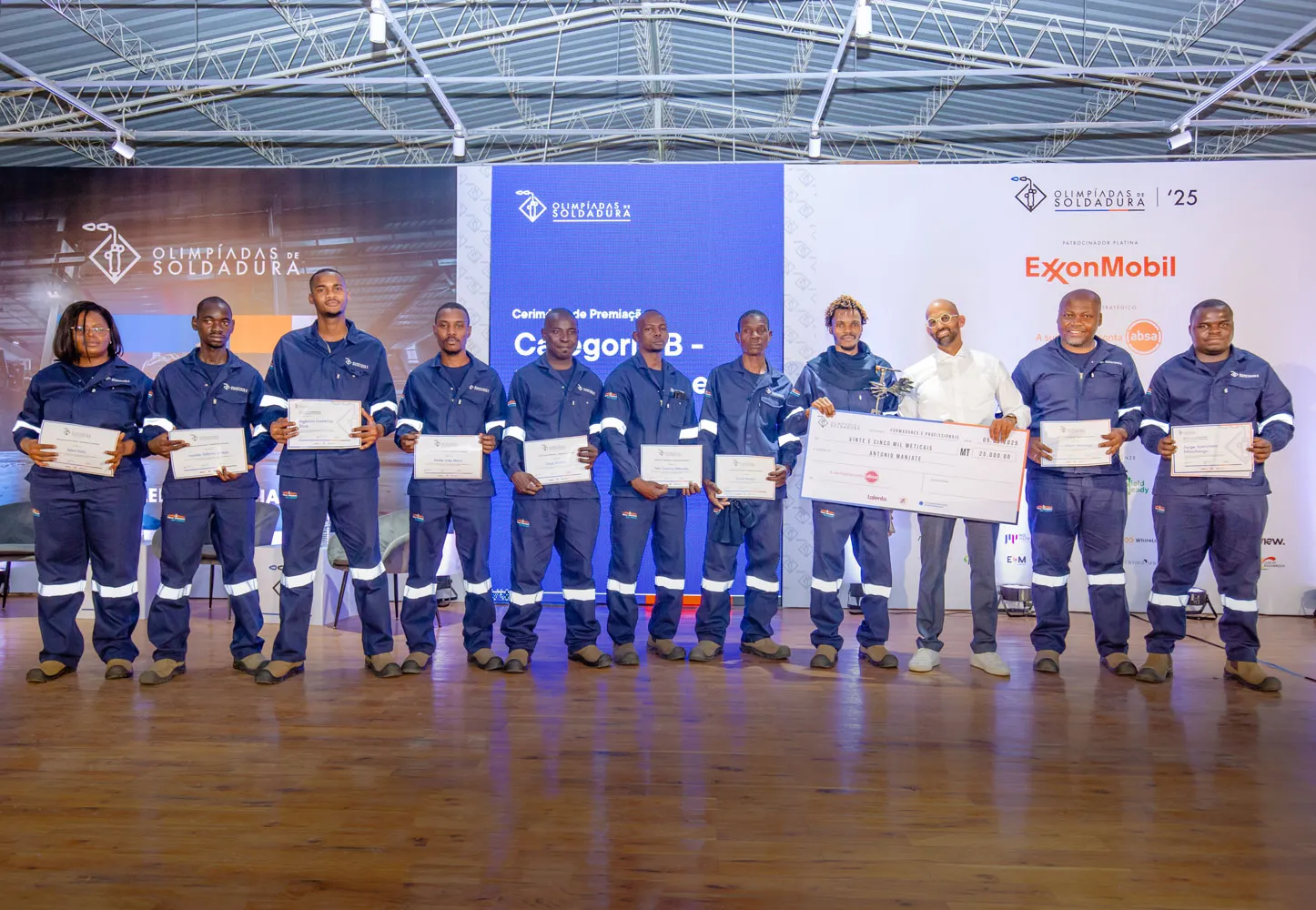
The company Talento organised the first edition of the Welding Olympics in Mozambique. On 5 September, the Matola Industrial and Commercial Institute (IICM) hosted an unprecedented moment in the country’s vocational training landscape, an initiative that aimed to bring students and trainers closer to the labour market while seeking to dignify technical-vocational education, so often seen as a second-rate option compared with higher education.
A competition to change mindsets
More than twenty participants, including trainees, professionals and trainers, put their skills to the test in techniques such as TIG, MIG/MAG and coated electrodes. The competition was not limited to practical dexterity: contestants were also assessed on interpreting drawings, complying with safety standards and time management, demonstrating the rigour and sophistication the profession requires. At the opening of the event, Frederico Silva, founder of Talento, argued that it is necessary to “demystify technical-vocational education and show young people that this path should be seen as a first choice”. He also stressed that Mozambique needs ready talent to sustain industrialisation and meet the challenges posed by the energy transition.
Industry and banks lead by example
The event was sponsored by Exxon Mobil Mozambique, whose managing director, Arne Gibbs, praised the relevance of welding to the development of the oil and gas sector. “These Olympics are a firm step in preparing the country to stand out in the energy transition,” he said. Absa bank also joined as a strategic partner. For Tânia Oliveira, head of Marketing and Corporate Relations, the bank’s support amounts to a clear investment in technical skills and in promoting employability: “It is a commitment to the future of young Mozambicans and to the communities where we operate.”
Rewarding talent, valuing inspiration
At the closing, the best were honoured in two main categories. Among trainers and professionals, the winners were Ingerino Sitoe, Jorge Nhachengo and António Manjate. In the trainee group, the prizewinners were Lúcia Uamusse, Flora Chau and António Muchanga. The top finishers in each category received a cheque for 25,000 meticais from Absa, as well as certifications, further training and complete kits to support their personal development and their activities. The jury also awarded the Inspirational Woman Prize to Flora Chau, a young woman who stood out for her remarkable path in a field traditionally dominated by men, showing that the industry’s future can – and must – be inclusive.
A platform for the future
The initiative was not limited to the competition. There was room for debates on “The Future of Welding in the Age of Gas and Industry”, networking sessions, a talent fair and the signing of memoranda of understanding with institutional partners such as the Industrial Association of Mozambique (AIMO), the Mozambique Local Content Association (ACLM), the IICM and Absa. These commitments aim to ensure that national talent is recognised and valued, not only domestically but also internationally. The first edition of the Welding Olympics made it clear that technical-vocational education can be an engine of development and a gateway to a more industrialised, competitive and inclusive future in Mozambique. And it also left a promise: the second edition is already being prepared, with the ambition of reaching more young people and consolidating this transformative vision.


