
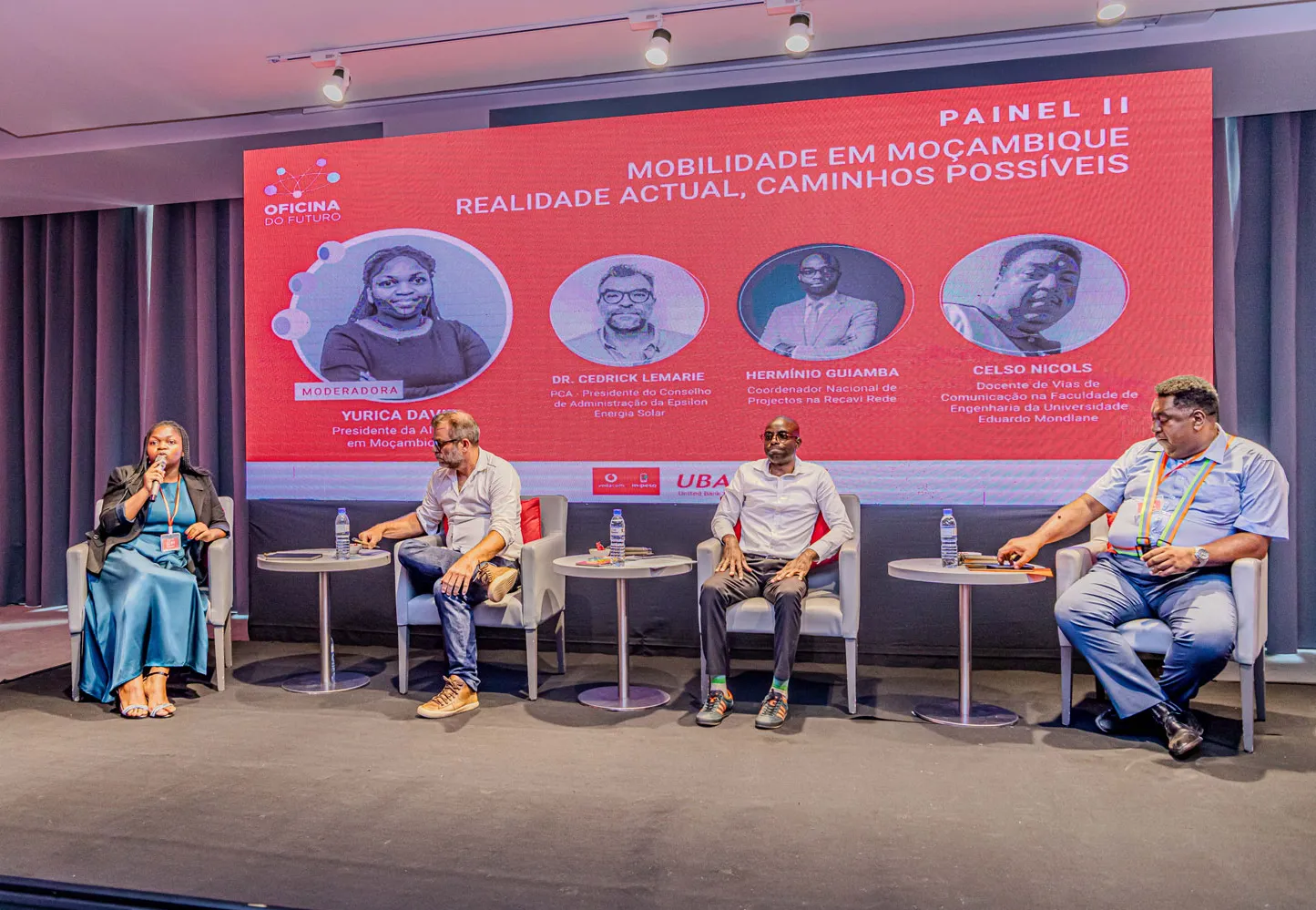
At a time when technological and urban challenges are becoming ever more present in the daily life of societies, Maputo has welcomed a new platform for reflection geared towards practical solutions. The first edition of Oficina do Futuro took place on 26 February at the Hotel Meliã Maputo Sky, bringing together experts, decision-makers, entrepreneurs and students around one central question: what could Mozambique look like in 2030 if ideas begin today to turn into concrete action?
The initiative arose with the aim of bringing strategic thinking closer to execution. In the opening session, Nuno Soares, director of Xonguila magazine and of the Connoisseur Prestige Club (CPC), the bodies responsible for organising the event, stressed the need to create spaces in which debate goes beyond theory and leads to solutions applicable to the national reality.
Under the theme “Mobility, digital and real solutions”, the event was structured around two main panels, focused on areas considered decisive for the country’s future.
The first debate focused on Mozambique’s digital challenge. Moderated by Sheila Victor Muianga of Girl Move Academy, it featured contributions from Luís Enoque of BCX, Carlos Jorge Araújo of Bravantic, and Rui Lousã of Vodacom. Over the course of the conversation, they addressed the opportunities of technology applied to the economy and the possible paths to broaden digital inclusion, in a context in which access to information and technological tools remains unequal.
The first edition of Oficina do Futuro brought together different sectors of society to think about concrete solutions to challenges that are already part of Mozambique’s present.
The second panel was devoted to urban mobility, a theme that is increasingly central in Mozambican cities. The moderator was Yurica David of AIESEC Mozambique. The participants were Dr Cedrick Lemarie of Epsilon Energia Solar, Hermínio Guiamba of Recavi, and Celso Nicols of the Faculty of Engineering at Eduardo Mondlane University. The speakers analysed existing constraints in transport and in the organisation of cities, also pointing to possible solutions that combine technological innovation, urban planning and sustainability.
Beyond the discussion panels, the event set aside space for concrete projects in the “Initiatives in focus” segment, in which different actors presented experiences geared towards social impact. Among the examples shared were Girafa Solar, presented by Ruben Morgado of the Carlos Morgado Foundation; technology education projects explained by Tim Vieira of Brave Generation Academy; the MAKOBO platform, described by Ruy Santos; and the digital solution LEO, presented by Cirilo Macanze of Banco UBA.
The first edition of Oficina do Futuro was sponsored by Banco UBA and Vodacom, and supported by Baía Mall and the Hotel Meliã Maputo Sky. The Digital Literacy Roadmap was also launched on the same occasion: an exhibition open to the public until 4 March, designed to bring technological subjects closer to the ordinary citizen.
The project is set to continue throughout the year. A second edition is planned for May, dedicated to information, influence and transformation in contemporary communication. A third meeting is due to take place in October, centred on education, human resources and technology.
With this sequential approach, Oficina do Futuro is establishing itself as a platform for applied reflection, seeking to bring together different sectors of society in building responses to the challenges Mozambique will face in the coming decades.


