
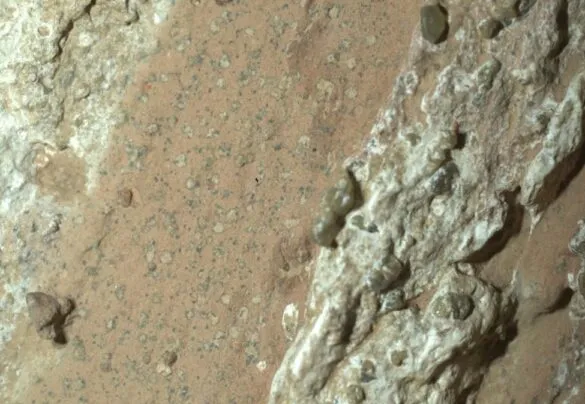
The latest discovery by the Perseverance Rover could be a milestone in the long search for the answer to one of humanity’s oldest questions: was there ever life on Mars? NASA revealed on Wednesday that samples collected from an ancient dry river channel in Jezero crater contain potential signs of ancient microscopic life.
The head of the science mission, Nicky Fox, said that, although this analysis is “certainly not the final answer”, it represents “the closest we have ever come to discovering ancient life on Mars”.
Perseverance, which has been travelling the Martian surface since 2021, is not capable of detecting life directly, but is equipped with a drill and titanium tubes to collect samples at the most promising sites — areas where, billions of years ago, water may have existed and, therefore, habitable conditions. However, the samples remain on Mars, awaiting a viable plan to transport them to Earth, which faces delays, budget cuts and technical challenges. Their return was scheduled for the early 2030s, but is now being pushed back to the 2040s, at an estimated cost of 11 billion dollars.
An exciting but inconclusive discovery
The findings were published in the prestigious journal Nature. The sample in question, collected last summer in the Bright Angel sedimentary formation, located in the Neretva Vallis channel, proved particularly promising. It consists of reddish, clay-rich mudstones — a combination that, on Earth, favours the preservation of biological signs.
According to Joel Hurowitz of Stony Brook University, the study’s lead researcher, this is the “most compelling” sample so far. But despite the enthusiasm, caution prevails: “We can’t go so far as to say ‘Aha, this is positive proof of life’. One possible explanation is microbial life, but there are other ways of producing these features.”
Among the compounds identified are organic carbon, phosphate and iron sulphide — substances that, on Earth, are often left behind by microorganisms that consume organic matter. However, scientists do not rule out the possibility that these elements originate from non-biological processes.
Janice Bishop of the SETI Institute and Mario Parente of the University of Massachusetts Amherst reinforced this point in an accompanying editorial: “If microorganisms existed on Mars, they could have reduced sulphate minerals to form sulphides, as happens in lakes on Earth.”
Between Earth and Mars: an uncertain path
Of the 30 samples collected so far, this was the 25th. Ten of them were deposited on the Martian surface as a safety reserve, in case those on board the Rover are compromised. NASA continues to study several options: from sending robots with advanced analysis technology to crewed missions that could collect the samples.
“All options are on the table”, said Sean Duffy, NASA’s acting administrator, acknowledging that budgets and schedules will determine the course.
Until the return of the samples to Earth is achieved, scientists will continue to rely on laboratory analyses carried out here and on comparison with terrestrial geological environments to try to decipher the secrets of the Martian past. Even if the answer is not life, it will certainly be a valuable lesson in how nature can imitate its own traces.


