
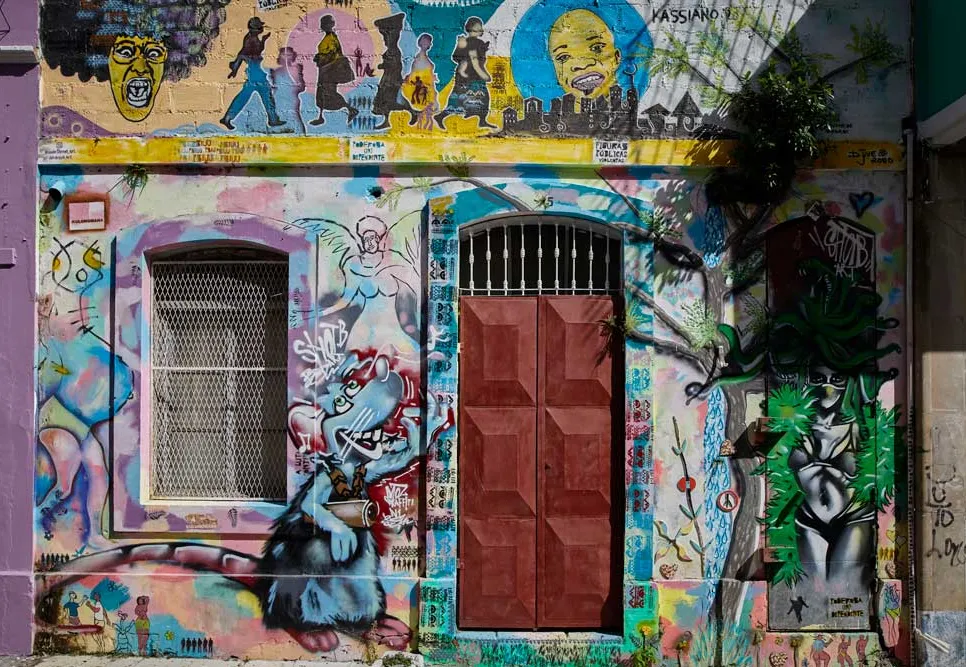
Maputo Street Art is a project by a group of young artists from various disciplines who came together to immortalise street culture. The group was founded between 2011 and 2012, the year in which the first artistic expressions emerged, and Afroivan, as he is known artistically, was the mentor of the initiative.
António Ivan Muhambe, 35 years old, single, a native of Cidade das Acácias, artist and multidisciplinary draughtsman, was the one who developed the idea and created the group. Speaking to Xonguila, he began by explaining that “Maputo Street Art” was the name that won unanimous approval from the outset, because the project was born in the nation’s capital.
“I have my roots here, and I chose this name because it makes a lot of sense as a way of marking out the territory of urban art. People from Maputo will always want to emphasise Maputo, people from Beira will certainly do the same [for their city], and so on. I looked at “Maputo” as the province that saw me born, and at “Street Art” as art of the street, which is the discipline I am most interested in and which appears in the midst of the search for freedom in my existence. In this sense, the creation of the group came about as a counter-version of the gallery-home, home-gallery culture,” explained Ivan Muhambe proudly, as he is also affectionately known.
The “Maputo Street Art” group has 12 members, seven men and five women, some of whom have already painted murals, while others have taken part in activities such as coordinating and drawing up the group’s plans. “This year we hope to have more women painting,” said Afroivan, who added: “We have more men than women perhaps because street art is easily embraced by boys, since they often work on the street and so are more familiar with it.”
Artists from various disciplines, such as photography, performance, theatre and video, among others, are part of the “Maputo Street Art” group. “We make street art in other contexts, because it is not limited to painting, graffiti or visual arts, speaking specifically of murals. We have street dancers, human statues, skaters, the people who do drifts and bicycle tricks. The idea is for everyone to come together, merging what each person knows how to do, and to occupy public space.”
In the hope of projecting and perpetuating the “Maputo Street Art” movement, a work made up of texts and illustrations, a true collection by various artists, was launched on 16 February of this year. “The idea is to create value and visibility,” said our source, who, along the same lines, stressed: “The work is not just illustrations. The book contains texts that explain the transition between the first manifestations of urban art in the context before and after Independence, in particular from the year 2000 onwards.”
“With the book we want to map the works of various independent artists, not only those involved in the “Maputo Street Art” project, but also all those working in the creative cultural industries, both well known and anonymous.”
For Afroivan, the idea is to bring everyone together in a single work that people can consult to find out who the artists currently active in the field of urban art are. By giving a general overview and creating a flow of opportunities, because urban art is far more voluntary than commissioned, the book will help artists sell more of their image and their work. “With this book we also want to create a study, a piece of research, a monetary as well as cultural valuation.”
In the view of the founder of the “Maputo Street Art” movement, documenting in book form artistic achievements, especially from an urban centre and periphery context, creates a balance between artistic events, since everything happens in the centre, never on the periphery, even though most art-makers come from the outlying neighbourhoods: “When we manage to create a balance between the dark and the light side of the matter, we easily realise that a person who lives on the periphery should not have to travel to the city just to see a dance, a graffiti piece, hear a song or the like.”
For the realisation of this project, which culminates in the launch of the first edition of the book “Maputo Street Art”, according to António Ivan Muhambe, the research and mapping of images, drawings and paintings, both known and unknown, was a great help in putting together the recently launched collection.
Although a major goal was achieved with the launch of the book, the founder of “Maputo Street Art” did not fail to point out one of the main challenges faced along the way, especially in the city: “Waiting for authorisation from the block leaders, permission from residents and the granting of licences by the municipality, not to mention all that bureaucracy! We do more work in the neighbourhoods because we have a positive interaction with the people. In the neighbourhood, we can kindly enter a house and ask to paint a wall, we have a lot of support at home, whereas in the city we have to meet the requirements for permission to use spaces. As for making street art in the outlying areas, it is more a matter of the accessibility of the works.”
As for future plans, Afroivan said that, still this year, he dreams of holding a street art festival in the field of urban art, dedicated not only to murals but also to photography, installation, film screenings, video, performance and theatre. “We are thinking of a mobile festival within the neighbourhoods, where people do not need to go out because the show comes to them. We want to invest in a physical address where people can buy our products, because, besides murals, we make tote bags, T-shirts, paintings, among other handicraft and artistic expressions.”
António Ivan Muhambe also said that the book was made to tight deadlines, so many disciplines were not included in this edition. “This work is specifically about murals in the city of Maputo; several other murals scattered across the provincial capitals are not part of this work. In the second edition, we plan to bring a broader version, with other content, which is why we are committed to doing more research.”
“In times gone by we had ‘gangs’ that made street art in the neighbourhoods and that have now disappeared, and we want to tell those kinds of stories. We also want to produce a broader mapping that covers not only Maputo but also other regions of the country, because in this edition we stuck only to Cidade das Acácias,” he continued.
The book is bilingual, the first part in Portuguese, the second in English, and runs to 203 pages. On 16 February of this year, the work was officially launched in Maputo, at the Mozambique-Germany Cultural Centre. On 3 March it was the turn of the city of Beira. The book is available in the main bookshops in both cities, and can also be bought in Portugal. It had the support of the Embassy of Spain, through Spanish Cooperation for Development, which was responsible for the printing.


