
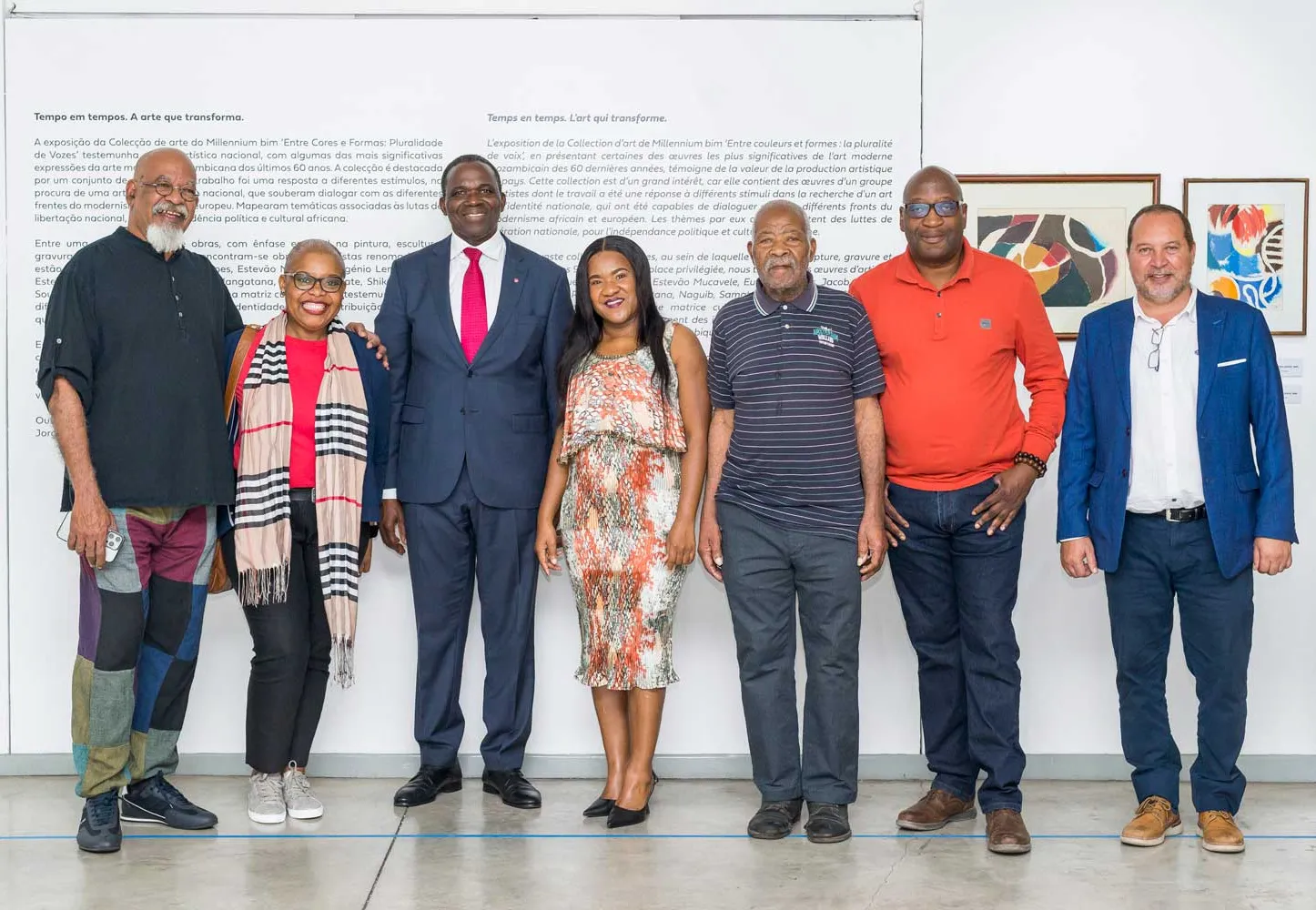
The city of Maputo has once again become an epicentre of celebration of Mozambican culture with the exhibition “Between Colours and Forms: Plurality of Voices”, which opened on 17 October at the Franco-Mozambican Cultural Centre (CCFM). Made up of fourteen works by eleven visual artists from Mozambique, this exhibition represents a visual encounter of different eras and styles, drawn from Millennium bim's art collection, a collection rarely shown to the public.
Curated by Jorge Dias, the exhibition brings to light works created at key moments in the country's history, particularly in the 1960s and 1970s, a period marked by the transition from European modernist aesthetics to the affirmation of African identity. The works on show bear witness to that time, when artists explored their individual aesthetic vision and the collective awareness of identity and liberation.
In the 29 years of its history, Millennium bim has invested heavily in promoting national culture. This exhibition follows the protocol signed in July this year between Millennium bim and the Franco-Mozambican Cultural Centre (CCFM), which reinforces the strategic partnership for promoting cultural initiatives in Mozambique, with the creation of a space for valuing Mozambican art, through exhibitions and events accessible to all communities, thus consolidating continued support for the visual arts and Mozambican culture.
Among the artists represented, the standouts include Malangatana, Bertina Lopes, Estêvão Mucavele, Naguib and Shikani, among others, whose creations have been widely praised both at home and abroad. Malangatana, with his intense colours and dynamic forms, expressed the social and political struggles of his time, capturing the essence of Mozambican suffering and resistance. Bertina Lopes challenged norms by integrating surrealism and abstractionism, creating a bridge between cultures. Estêvão Mucavele explored African spirituality, while Shikani united the traditional and the contemporary in a unique synthesis between African and European cultures.
With this exhibition, Millennium bim offers the public the opportunity to appreciate the aesthetic value of the creations, while paying tribute to the artists who contributed to shaping Mozambican cultural identity. The public also has the opportunity to enjoy creations by acclaimed names who are still alive, such as Naguib, who attended the event.
The works on show carry narratives about colonialism, resistance and independence. The bank's commitment to this legacy is reflected in the display of the works and in the preservation of national culture for future generations, a mission driven by figures such as Mário Machungo, the institution's former chairman.
Jorge Dias carefully chose the works to create a dialogue between past and present, highlighting the relevance of issues raised decades ago that still echo in today's society. Besides its historical and cultural value, the exhibition reflects how art can serve as a means of social cohesion, linking generations and communities through a universal language of colours and forms.
Open to the public until 9 November, the exhibition marks the start of an ongoing project that aims to foster knowledge and appreciation of the visual arts in Mozambique, and forms part of the Social Responsibility Programme, "Mais Moçambique pra Mim”, more specifically the culture pillar, whose mission is to promote cultural initiatives that contribute to preserving and strengthening Mozambican identity.
Millennium bim thus plays an essential role in cultural preservation, building bridges between the past and future generations of artists and lovers of Mozambican art.


