
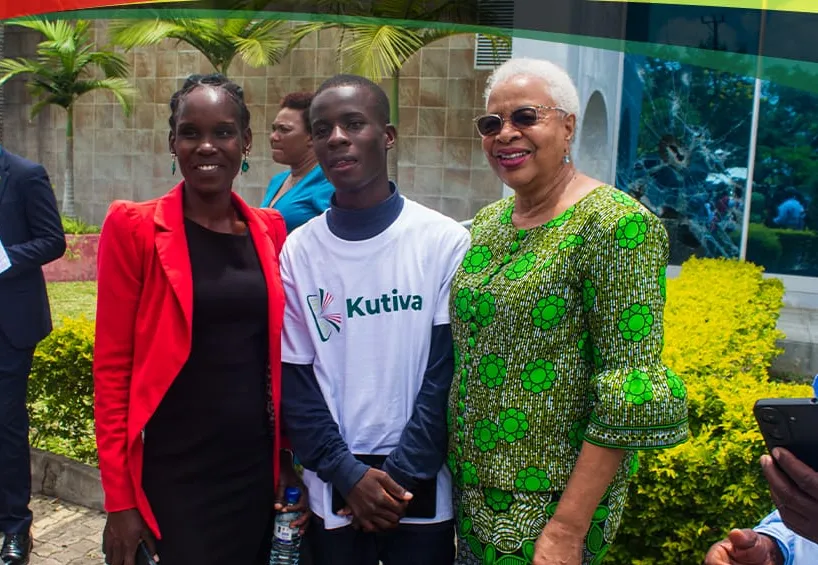
In a country where access to teaching materials remains one of the main challenges of the education system, especially in the public sector, innovation emerges, in a surprising and inspiring way, from the classrooms themselves. KUTIVA, the first Mozambican digital library created by students for students, is today one of the clearest examples of how technological empowerment can generate local solutions with real, immediate and sustainable impact.
The platform was born within the DiGi Project, an educational initiative run by the Machel Fidus Association, geared towards developing digital skills in public schools through online training. It was in this context that, in 2023, Inhamissa Secondary School, in Gaza province, became fertile ground for youth innovation. After receiving practical training in digital technologies and technology-assisted learning methodologies, an initial group of four students, two boys and two girls, later expanded to five members, identified a problem common to thousands of pupils across the country: the difficulty of accessing reliable, organised and easily searchable study materials.
The response to this challenge gave rise to the idea of creating a free digital library, led by the pupils themselves, with the support of the Information and Communication Technologies teacher. With no initial funding, relying only on the skills acquired in the DiGi Project, the group developed the first prototype of KUTIVA, a simple, intuitive and functional platform designed to make available books, worksheets, tests, exams and other resources from the national education system.
Uptake was immediate. In a short time, the academic community of Inhamissa Secondary School began using the platform regularly, and it quickly established itself as an essential resource in everyday school life. What began as a local solution gained scale and relevance, revealing a growth potential that went beyond the limits of the school and of the province itself.
Today, KUTIVA has recorded more than 10,000 visitors and has numerous active users, offering remote and unlimited access to educational content updated in real time. The impact is clear: students now consult daily materials that were previously scarce or inaccessible, reducing geographical and financial barriers and promoting greater equity in access to knowledge.
In view of this organic growth and the impact demonstrated, the Machel Fidus Association committed to supporting the platform’s technological development, ensuring conditions for scalability and sustainability, and integrating KUTIVA into a broader vision of modernising education in Mozambique. The initiative thus ceased to be merely a student project and established itself as a national solution capable of reducing educational inequalities, modernising study and teaching methods, creating opportunities for young technology creators and contributing to the digital transformation of the education sector.
The official launch of KUTIVA, held on 11 December at the Maluana Science and Technology Park, marked a structuring stage in this journey. More than a symbolic act, the moment represented the consolidation of a concept oriented towards impact, collaboration and the generation of value in the medium and long term. The platform now establishes itself as a strategic instrument capable of fostering institutional partnerships and building bridges between different players in the educational, social, economic and creative ecosystem.
KUTIVA is currently recognised as a digital educational platform with the potential for national reach, a benchmark of youth innovation in the education sector and an emerging, evolving pillar in the future of Mozambican public schools. Its journey demonstrates, unequivocally, the concrete impact of the DiGi Project in public schools and reinforces the importance of investing in young people’s technological empowerment as a driver of development.
The digital library is accessible on electronic and mobile devices, where it can be consulted through Google Play and at www.bibliotecakutiva.co.mz, inviting students, teachers and institutions to be part of a true digital revolution in education. KUTIVA is not just a platform; it is a symbol of how knowledge, when placed in the right hands, can transform realities and open paths to a fairer and more inclusive future.


