
Ecotourism, the bet of the Maputo Special Reserve
Written by: Mariano Silva
That Thursday afternoon, my anxiety gradually grew as the kilometres to the main gate of the Maputo Special Reserve (REM) dwindled. It would be my first time in the reserve, a place I had not yet had the chance to visit. Xonguila had been invited to do so by ANAC (the National Administration of Conservation Areas) and the Peace Parks Foundation (PPF) for the launch of the Membene camp, on the coast, reserved for the end of a 5-day visit. I decided to recount this adventure here as a personal story because, since it was my first time there, its impact was great and the result of a unique experience. This article is therefore subjective in nature, so readers, whether or not they have already visited the place, may hold a different opinion.
I arrived at the central offices, the agreed meeting point, an hour late, owing to some mishaps before leaving Maputo. The rest of the party were already settled in the Xinguiti camp, by the lagoon of the same name. We were still separated by 45 minutes of sandy road passable only by 4x4 vehicles. This too was new to me, driving on purely off-road tracks, and it was a very interesting experience, mainly because I did not know how the car would behave on that kind of road. My greatest fear was getting stuck in the sand but, fortunately, that did not happen. I divided my attention on the road with some animals that crossed our path, among them a young elephant feeding at the edge of the woodland, which quickly vanished into the dense foliage. The first signs of the Xinguiti camp's infrastructure appearing along the road hinted at an organised and well-planned space, expectations that were not to be disappointed on arrival.
A gap in the wall of trees gave a glimpse of a paradise scene around the Xinguiti lagoon, accompanied by a panoply of sounds from countless birds and hippos enjoying its bounty. After delighting in the landscape for a while, it was time to pitch tent at the camp. Yes, the purpose of the visit was to show the media the potential of ecotourism at various points of the REM, with the Xinguiti lagoon being one of the main destination hubs.
The site currently has 6 camping plots, each housing an ablution block equipped with two washbasins, a toilet and a hot-water shower. In addition, there is a double basin for washing dishes and 3 USB sockets for charging electronic equipment. Besides the ablution block, each plot has 3 to 4 pitches for setting up tents. Lighting at the camp is provided until 10 p.m., provisionally by a generator, which is located quite far away and causes no disturbance during sleep.
"A gap in the wall of trees gave a glimpse of a paradise scene around Lake Xinguiti"
In my view, this is an excellent opportunity for nature-loving Mozambicans to enjoy a first-rate spot little more than two hours' drive from Maputo, ideal for spending a weekend with family and friends and appreciating the magnificent landscapes that unfold around the Xinguiti lagoon. Even for those who do not feel comfortable sleeping in the midst of wild nature, it is an excellent opportunity for a day of socialising, at very affordable prices, with the particular feature of being able to rent a plot exclusively, with its ablution block, just for you and your family.
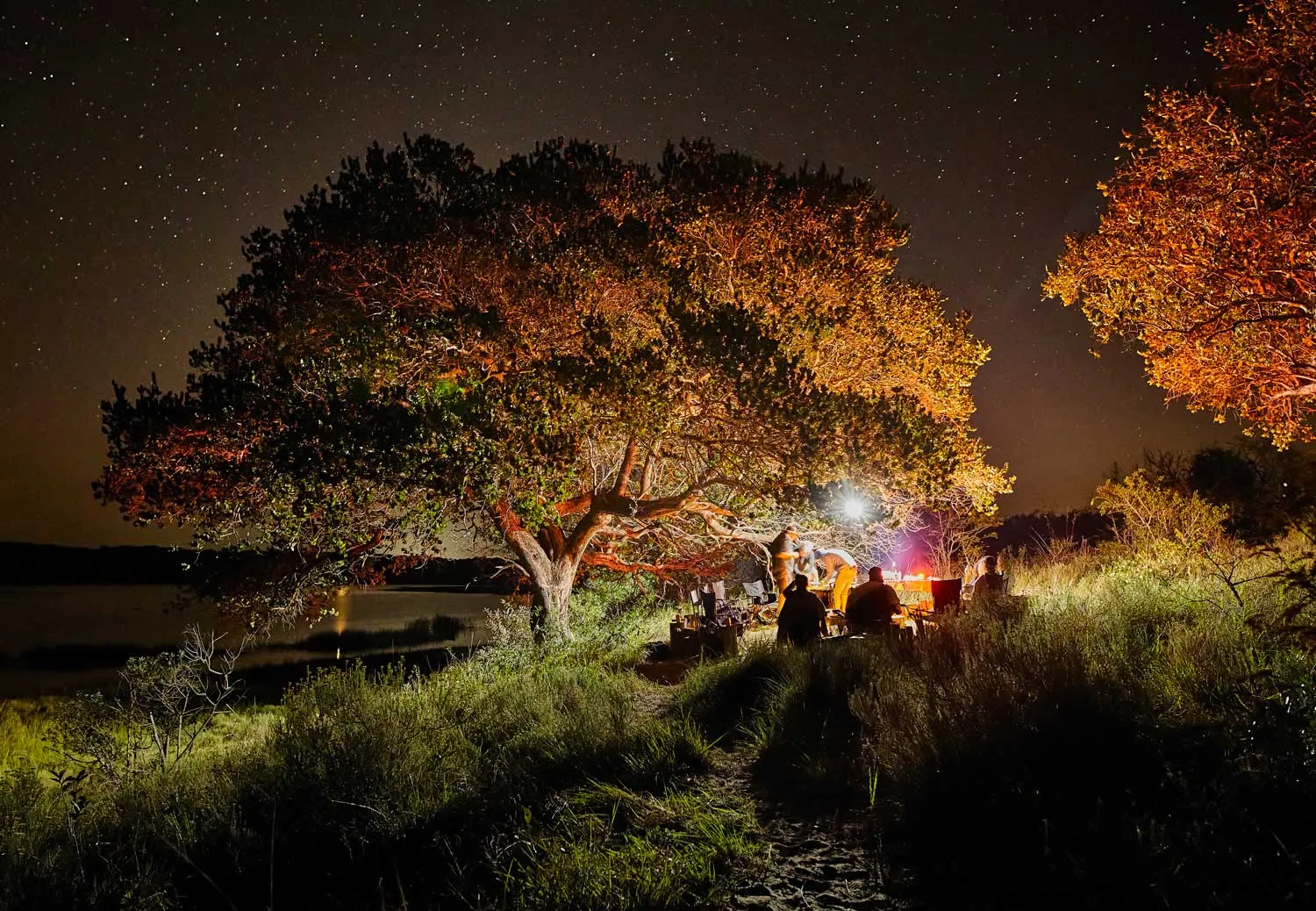
As night fell, we all gathered around the campfire and the guests began swapping experiences over a succulent barbecued steak prepared by the man responsible for designing the camp's current infrastructure, the South African architect Niel Crafford, who has vast experience in developing sustainable tourism infrastructure in nature reserves and parks across Southern Africa. We talked about a bit of everything, but the dominant subject was the Maputo Special Reserve's potential for attracting visitors, both Mozambican and from neighbouring South Africa, for ecotourism.
Dawn announced itself timidly, amid a thick fog that only cleared by late morning. The plan was to enjoy the landscape and wildlife until we reached the central office, where the administrator of the Maputo Special Reserve (REM) and the Ponta do Ouro Partial Marine Reserve (RMPPO), Miguel Gonçalves, would give a presentation on the REM and the RMPPO. The fog formed a barrier between us and the magnificent landscapes, but we still managed to glimpse spaces that were very attractive in terms of natural beauty, enhanced with a touch of mysticism because of the mist. Miguel Gonçalves (of ANAC) and Antony Alexander (of PPF) presented what the REM is at present and the plans for the future involving the integration of the RMPPO into the creation of a large national park that could have cross-border interaction with the adjacent reserves of neighbouring South Africa and Eswatini, which further cemented my view of the enormous tourism potential this region has to offer, a subject we expect to cover here soon. The plans to expand the facilities at the Xinguiti and Membene camps, to be carried out in the very near future, were also discussed. Both sites will see the construction of chalets and a restaurant. In Xinguiti's case, the chalets will have panoramic views, favouring an elevated view over the lagoon. In Membene, in turn, visitors will be able to enjoy an idyllic view of the adjacent beach. The plans of ANAC and PPF do not stop there. Several picnic spots and rustic camping sites are planned along almost 200 km of 4x4 trails, at strategic points for spotting wildlife.
After the visit to the central offices, we headed for the elephant plain. I expected to see plenty of these animals here, but unfortunately that was not possible. The REM currently has more than 400 elephants, 4 herds of buffalo (which sadly I never got to see), giraffes, zebras, and all the rest of the wildlife commonly seen in African nature parks, with the exception of lions, rhinos and cheetahs. Antony Alexander, PPF's head in Mozambique, revealed plans to release four cheetahs on the reserve's plains as early as next September. In March 2021, more animals of this species will be released here, so I immediately invited myself along to photograph what will be a historic milestone for the REM, and I hope to bring you those images soon too.
Back at the Xinguiti camp for our second night, we had the chance to see a wide range of birds out on the lagoon, including the fantastic African fish eagle, with its white neck quite distinct from that of other eagle species. Hippos and crocodiles were also within our reach. I advise anyone going there to bring a pair of binoculars to observe the wildlife better.
I was finally able to see the sunrise over Lake Xinguiti on Saturday morning. It is a breathtaking scene for those who appreciate nature in its wildest state. The blue of the lagoon, interwoven with the orange reflection of the rising sun, gave us an unrivalled spectacle of light.
We left the camp where we had spent two nights and our destination was now Lake Nela, though not before crossing extensive plains with animals among which herds of wildebeest stood out. I had the impression that the Maputo Special Reserve was relatively small, but I could not have been more wrong. It is a huge expanse of grasslands, woodland, hills, lakes and lagoons, and, with some luck, you can see some animals up close. ANAC and the Peace Parks Foundation gave us a unique opportunity, as we were able to drive trails that are normally closed to the public. On those excursions, I was amazed by the immensity of the plains when seen from the hills. I have no words to describe such natural beauty and I can say that photographs fall far short of its true essence. The much-awaited elephants finally showed themselves: a herd was grazing among tall grass beside a small pool. They were far away, but that was just as well; we did not disturb the serenity of the pachyderms with our strange presence.
To end this journey on the third day, an even more idyllic scene than all those we had seen hours before was still to come; we finally arrived at the Lake Nela camp. There we had basic facilities for camping, a toilet, a bucket shower and a sink. It is undoubtedly a camping spot for the more daring, but, by way of reward, the scenery is worthy of those who make the effort to get there and spend the night. The best was still to come. With the sunset and the wind against them, several animals came to the lagoon to quench their thirst. For many of them our presence went unnoticed, a little over a hundred metres away. Night fell quickly, and the light from the flames of the campfire struggled against the twinkling of the star-covered sky, a magnificent spectacle.
In the middle of the night, at about 03:30, I woke with a start at the "purring" of a herd of elephants that passed close by to replenish their water at the lagoon. I confess it was a tense moment for me; for the others, not so much, judging by the way they snored in their tents, as if they were competing with the elephants.
On the morning of the fourth day we would make the journey to the Membene camp, with a short foray to the reserve's largest lagoon, Lake Piti. The route proved very difficult, as we had been warned. It put the drivers' skill to the test because of the deep ruts in the road and loose sand, which had already claimed a few vehicles, stuck days earlier. I was a little apprehensive, but the convoy ended up covering the track without any mishap. Along the lagoon's shore we could observe some fishing activity, permitted only to certain members of the local communities to sustain their families.
The time I had available did not allow me to visit Ponta Dobela, said to be perhaps the only place in the world where you can see two of the planet's largest mammals, the elephant, on the plain, and the humpback whale, at sea. It is a question of probability, of course, and a small one, but that is precisely why this little piece of land is known and visited on purpose.
We finally reached Ponta Membene and its camp. I was surprised by what lay before me. On the mainland side of the primary dune was the camp, whose facilities were similar to those of the Lake Xinguiti camp, although Membene has the particular feature that on the other side of the dune there is a pristine white-sand beach, an immaculate landscape that seems to have come from a perfect imagination. Once again, the facilities available to visitors are fantastic for camping, perfectly integrated with the surrounding landscape. Here, more than anywhere else, there are reasons to come and spend a few days with family and friends in full harmony with nature, with a barbecue as the high point of the get-together. Unfortunately I could not spend the night here; I had to head for Maputo that same afternoon, but the two hours by 4x4 and one hour on normal roads to Maputo seem to me little for the wonders this place can offer anyone who visits.
We were thus made aware of the strong commitment of these two institutions (ANAC and PPF) to developing ecotourism in the Maputo Special Reserve, and I hope this short account has stirred the reader's curiosity, for, as I said earlier, it falls short of the true and majestic beauty of this well-preserved natural space, so close to the Mozambican capital.
If you do not respect nature, this place is not for you; do not destroy what many fought to achieve for the benefit and enjoyment of others. This space, like the whole reserve, is worthy only of those who live in harmony with nature. With each passing day we head towards an abyss of no return, because of disrespectful behaviour towards the world around us. We are left with these immaculate pieces of land that need to be protected so that those who destroy may realise how little is needed for what remains to come to an end, and for our presence on this planet to have been in vain.
(The Xonguila Magazine team would like to thank ANAC and the Peace Parks Foundation for the invitation and the opportunity, which made it possible to develop this feature).


