
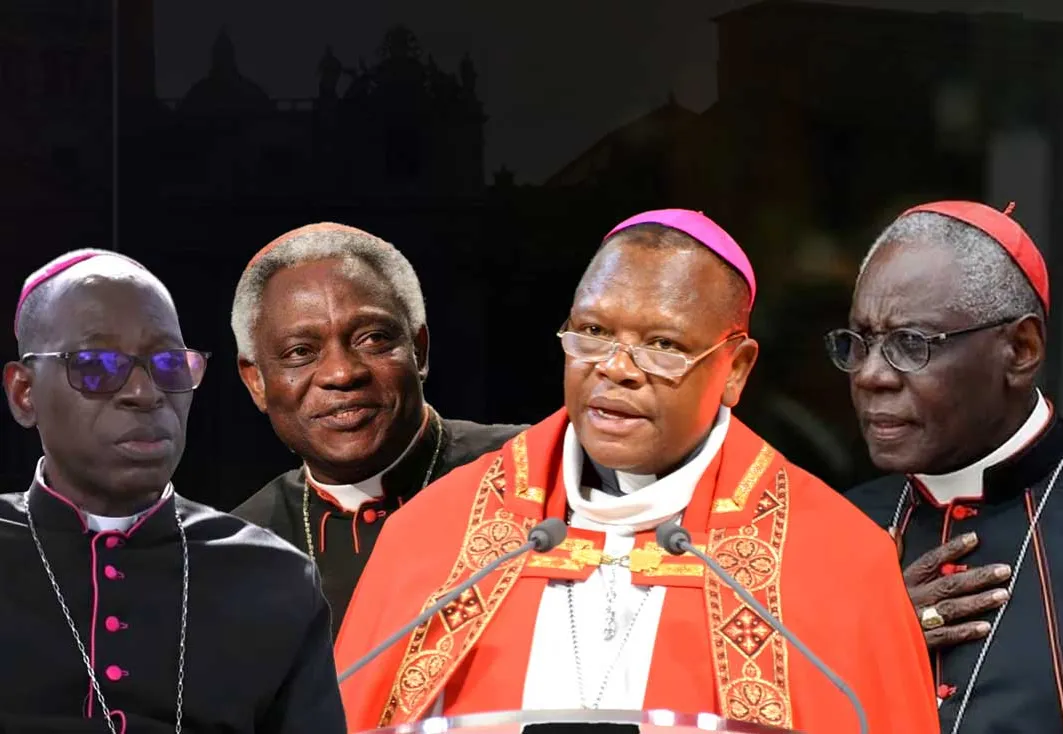
As the Catholic Church bids farewell to Pope Francis, who died on Monday aged 88, a new chapter is beginning to take shape, with discreet but meaningful murmurs. According to an article published by Reuters, in Africa, where faith is a living presence in public and private life, there is growing hope that, for the first time in modern history, a black pope might be elected. A possibility that, although remote, resonates deeply among millions of the faithful on a continent where Catholicism is not only growing, but flourishing.
According to figures recently released by the Vatican, Africa is today the region where Catholicism is growing fastest. In 2023, the continent already accounted for about 20% of the world's Catholics, with nine million new faithful recorded in that year alone.
In Ivory Coast, Father Charles Yapi, in Abidjan, gives voice to this longing: “Having a black pope would revitalise the Christian faith in Africa and change the global perception of our continent. It would be proof that an African can hold the highest office in the Church.”
Although sparsely detailed historical records suggest that some popes of the early centuries may have been of North African origin or even of African descent, there has not yet been a recognised black pope in the contemporary era.
Some African names have emerged among the quiet favourites for the papacy. However, according to internal Vatican sources, the public and ecclesiastical scrutiny faced by African cardinals is incomparably lower than that of their Western peers, a hindrance in a process as political as it is spiritual. Even so, the choice of the next pontiff is often unpredictable.
Among the most talked-about names are Ghanaian Cardinal Peter Kodwo Appiah Turkson, aged 76; Congolese Cardinal Fridolin Ambongo Besungu, 65, Archbishop of Kinshasa; and Ivorian Cardinal Ignace Bessi Dogbo, 63, recently elevated to the cardinalate in December 2024.
For Archbishop John Bonaventure Kwofie in Accra, who has known Turkson since the 1970s and was ordained bishop by him, the possible election of his compatriot would be a symbolic reward for African Catholic dynamism. “Although it is not a bet, since the cardinals will be guided by the Holy Spirit, it would be an enormous motivation for African bishops.”
But not all clergy share this view of representation. Congolese priest Josue-Misael Mobatila Kwilu sums up the feeling of many: “We pray that the Holy Spirit grants us a good shepherd, no matter where he comes from.”
Even so, the appointment of an African pope would be read by many as a continuation of the legacy of Francis, a defender of the marginalised, of migrants and of suffering peoples. One recalls, for example, the appeal Francis made in Kinshasa in 2023: “Hands off the Democratic Republic of Congo. Hands off Africa! Stop choking Africa: it is not a mine to be stripped or a terrain to be plundered.”
Words that, in the words of President Félix Tshisekedi, “will forever remain etched in the collective memory of the Congolese people”.
However, if the election of an African pope would symbolise change, his position on social issues could reveal differences with Francis's agenda, particularly regarding the blessing of same-sex couples, recently approved on a conditional basis by the Vatican. African cultural conservatism may not allow a future pope from the continent to follow those steps.
Cardinal Turkson, although aligned with Francis on issues such as social justice and climate change, caused controversy in 2013 by linking cases of clerical abuse to homosexuality. More recently, he has softened his tone, telling the BBC in 2023 that it was “time to start educating” on the subject, admitting that homosexuality “is not completely foreign to Ghanaian society”.
Ambongo, for his part, is a firm voice for peace in Congo, but he opposed blessings for same-sex couples, fearing they would expose the Church to scandal. Dogbo, of Ivory Coast, maintains that increased African representation reflects the true universality of the Church.
In a moment of mourning, the Church also faces the possibility of transformation. And as the faithful fill churches to pray for Francis, a quiet hope runs through Africa: that the time has come for Rome to speak with an African voice.


