
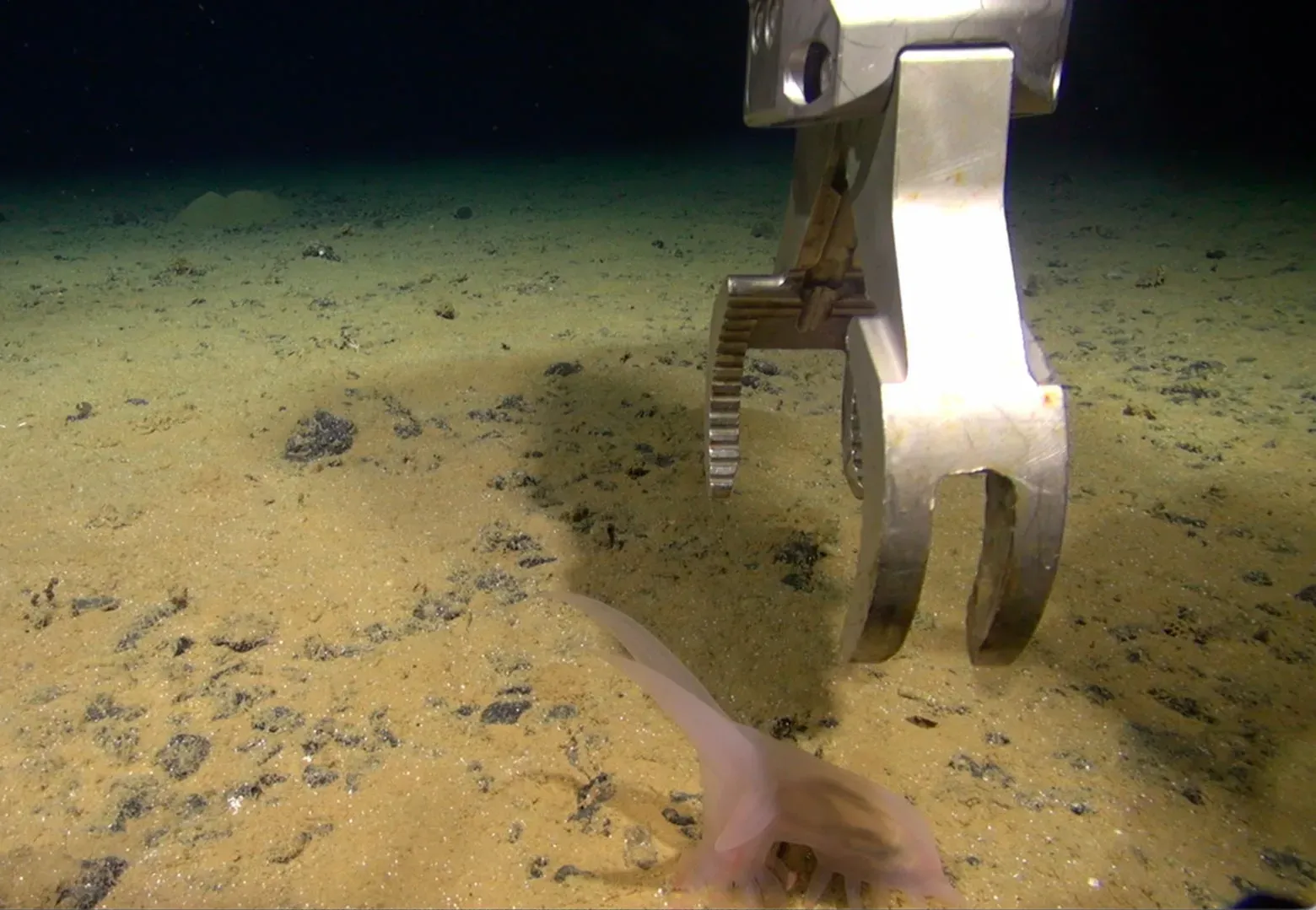
Hundreds of species hitherto unknown to science have been identified in a hidden world almost four thousand metres deep in the Pacific Ocean, in one of the most comprehensive investigations ever carried out into seabed ecosystems. The study comes at a time when global demand for critical metals is accelerating and deep-sea mining is ceasing to be merely a theoretical scenario and approaching reality.
Over five years and after 160 days at sea, an international team of scientists documented close to 800 species in the abyssal zone of the Pacific, many of them never described before. The results show that mining trials significantly reduced the abundance of animals and the diversity of species in the directly affected areas, although the overall impact was smaller than initially feared.
The growing need for essential metals for the energy transition has led several countries to consider exploiting the seabed. It is in this context that this scientific work emerges, concluding that, despite evident local damage, deep-sea mining may have more limited effects at regional scale than the most pessimistic forecasts suggested. Even so, in the areas crossed by extraction machinery, biological diversity fell by around a third.
One of the study's biggest surprises was the discovery of hundreds of unknown species living in an extreme environment, underlining how little is known about these remote and fragile ecosystems.
One of the least-known ecosystems on the planet
Marine biologists from several countries joined forces to study the Pacific seabed, one of the least explored regions of the Earth. The research, published in the journal Nature Ecology and Evolution, was also motivated by growing commercial and geopolitical interest in the area.
“Critical metals are indispensable for the green transition and are in short supply. Many of them exist in large quantities on the deep seabed, but until now nobody had demonstrated how they can be extracted or what the environmental impacts would be”, explains Thomas Dahlgren, a marine biologist who took part in the project together with Helena Wiklund, both from the University of Gothenburg.
Five years of work and 160 days at sea
The project followed the International Seabed Authority's guidelines for environmental baseline studies and impact assessment. Over five years, the researchers catalogued marine life and tested the effects of mining in the Clarion-Clipperton Zone, a vast region of the Pacific lying between Mexico and Hawaii.
The data reveal that the areas directly disturbed by the machinery recorded a 37% reduction in the number of animals and a 32% drop in species diversity.
“This work required 160 days at sea and five years of research. The results will be fundamental for the International Seabed Authority, which regulates the mining of minerals in international waters”, stresses Thomas Dahlgren.
Life four thousand metres down
The area studied lies about 4,000 metres below the surface, where sunlight does not reach and food is scarce. Here, sediment grows at an extremely slow rate: just one thousandth of a millimetre a year.
By comparison, a single sample from the bottom of the North Sea can contain up to 20,000 animals. On the deep Pacific floor, a similar sample contains a comparable number of species, but only about 200 individuals.
In total, 4,350 animals larger than 0.3 millimetres, living in the sediment or on its surface, were collected. From these samples, 788 species were identified, mainly polychaete worms, crustaceans and molluscs, such as snails and mussels. The team also identified a new solitary coral, described in a parallel study.
Unknown species and long-term risks
“I have worked in the Clarion-Clipperton Zone for more than 13 years and this is by far the largest study ever carried out. In Gothenburg, we led the identification of the polychaete worms. Since most of the species had never been described, molecular DNA data were essential for studying the biodiversity and ecology of the seabed”, explains Dahlgren.
Throughout the inventory, the scientists observed that deep-sea communities change naturally over time, probably in response to the amount of food reaching the ocean floor. However, it remains unknown to what extent these species are distributed in other deep regions of the Pacific.
“It is now crucial to try to predict the risk of biodiversity loss resulting from mining. For that, we need to investigate the biodiversity of the 30% of the Clarion-Clipperton Zone that is protected. At the moment, we practically do not know what lives in those areas”, warns Adrian Glover, senior author of the study and researcher at the Natural History Museum.
The work makes it clear that, before any definitive move towards large-scale mining, scientific knowledge of these ecosystems will have to be deepened — on pain of losing a biological heritage that is still invisible to the eyes of the world.


