
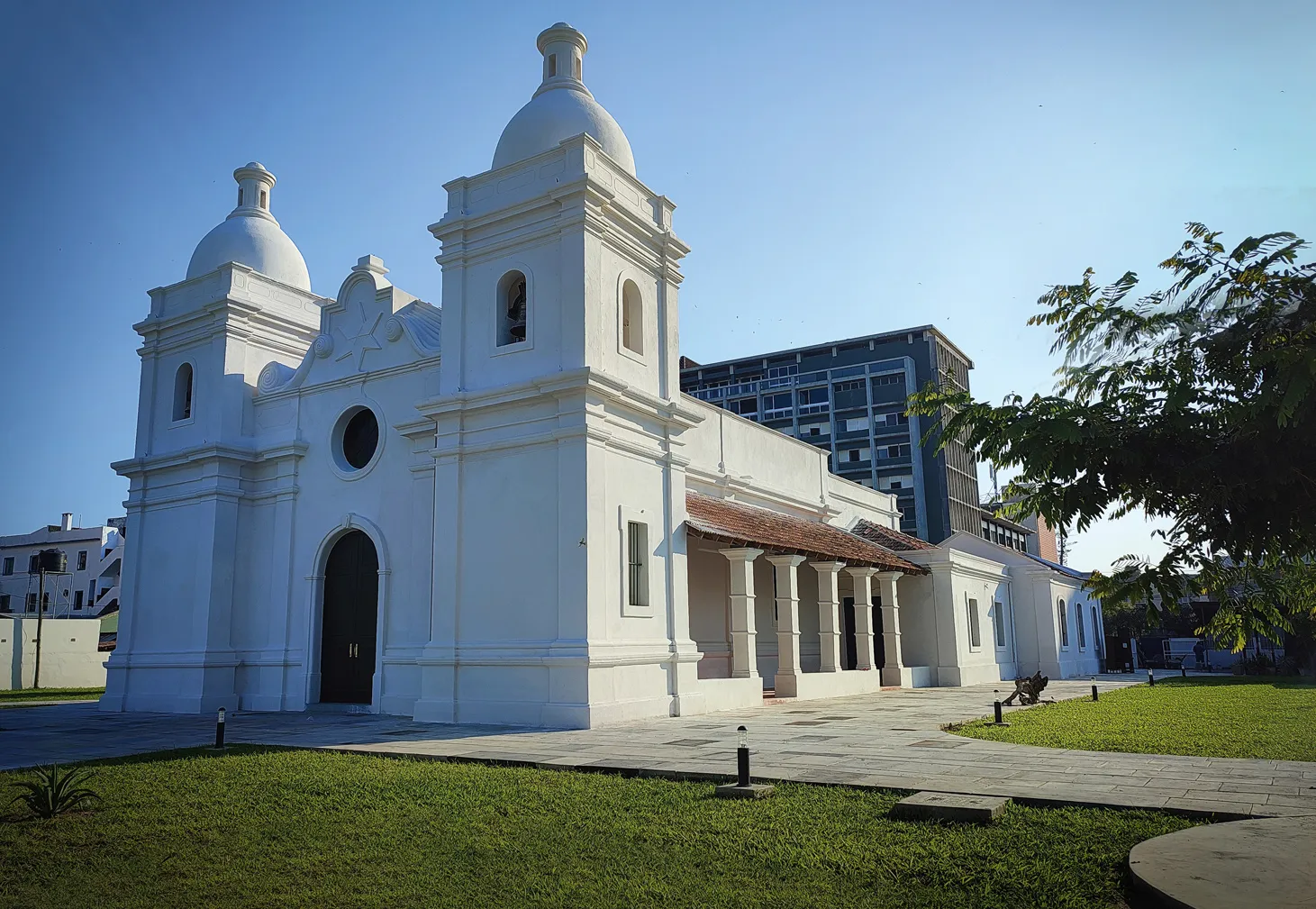
At last, after some attempts that for various reasons did not go ahead, the dream of countless people from Quelimane, other Zambezians and Mozambicans, and of a great many natives and friends of Mozambique scattered around the world has come true: the building of the former Church of Nossa Senhora do Livramento in Quelimane, the most valuable built historical heritage in Zambézia province, has been restored. From an abandoned building showing signs of total ruin, it is now a cultural and tourist centre that aims to be a benchmark in Mozambique: the Bons Sinais Cultural Centre.
It was a small group of friends who, seeing the risk of losing such important heritage, launched a broad movement to gather around them everyone who wanted to help save it
Located in a prime area beside the Rio dos Bons Sinais, and known as the Old Church of Quelimane, the former Church of Nossa Senhora do Livramento was built between 1776 and 1786. It represents one of the few eighteenth-century architectural expressions in Mozambique and is one of the most important testimonies to the Portuguese presence in the Zambezi valley, which is why it was proclaimed a national monument in 1943. Initially a parish church, it became a cathedral with the creation of the Diocese of Quelimane in 1954. In 1974, with the construction of the new Cathedral, also called the Church of Nossa Senhora do Livramento, it lost that status, eventually being abandoned and vandalised, a state in which it remained for decades.
The recent history of this imposing building began when a small group of friends with strong ties to Quelimane, seeing the risk of losing such important heritage, and aware that they belonged to one of the last generations that could save it, decided to launch a broad movement to bring together natives, residents and former residents of the city, friends and supporters of Zambézia province, as well as everyone else who was sensitive to the problem and wanted to contribute in some way to resolving it. Far from being a nostalgic or regionalist movement, however much Quelimane and Zambézia had marked the childhood and youth of the members of this small group of friends, it was the expression of a strong desire to preserve the history and heritage wealth of the place, while helping the authorities to improve the city and the lives of those who live there.
It was from this movement that the Associação dos Bons Sinais (ABS) was born, a non-profit body of social and cultural interest publicly announced five years ago, during the celebrations of the 75th anniversary of Quelimane’s elevation to city status. In the crowd that witnessed it, dozens of supporters of the cause were already present, some of whom were former residents of the city who had come from various corners of the world to attend the ceremony and the festivities. On their behalf, and immediately signalling its desire to support the city and the province, the Association offered, at a gathering held the next day on Zalala beach, scholarships for 75 children to attend primary school, books for the city’s libraries, medicines and surgical kits for the hospitals of Quelimane and Gurúe, as well as sports equipment for the 1º de Maio team, the only one in the province taking part in the national football championship. Notable on the occasion was the presence of Francisco Próspero dos Santos, a 97-year-old engineer who, after ninety years away, wanted to visit his native land.
A broad fundraising campaign followed, with appeals and letters to individuals, state institutions and Mozambican companies, embassies and other international bodies, as well as various initiatives promoted by members and supporters of the ABS. Seeing in the project a unique example of civil society action jointly set in motion by people of different religious beliefs and party affiliations, the Embassies of the Kingdom of Norway and the United States of America responded very positively to the appeals, eventually granting, in instalments, a total of approximately five hundred thousand dollars for the project. Among the members and supporters of the ABS, financial contributions were also significant, coming from various activities, such as individual and institutional donations of money, and the holding of dinners, an auction of artworks donated by the authors – Gemuce, Dino Jethá and Vista Alegre – a show in Portugal with the pro bono participation of various Mozambican and Portuguese artists, among them the well-known Rão Kyao and António Pinto Basto, a raffle sponsored by Shéu Han, a former Portuguese football star born in Mozambique, the placing of collection boxes at points around the city, the sale of T-shirts and other items bearing the Association’s logo, and, finally, a campaign entitled “Place a tile on the floor of the former Cathedral of Quelimane”. There were also many donations in kind from members and supporters, such as voluntary specialist work by engineers, architects and others, bags of cement, willingness to swap Marseille tiles (identical to the building’s original ones) for zinc sheets, the main door of the building, transport of some materials over long distances, publications dedicated to Quelimane and the project, among others.
Five years after that launch, the efforts made by the Associação dos Bons Sinais, which from the outset signed a Programme Contract with the Diocese of Quelimane, owner of the building, made it possible to open the Bons Sinais Cultural Centre on 21 August, the day on which the city celebrated 80 years of existence. The aim is for it to be a leading cultural and tourist centre in the city, open to everyone who lives in or visits it. It will no longer be a specific place of worship, but a place for everyone to enjoy, regardless of religious affiliation, whose mission will be to promote culture, preserve and publicise the history of the city and the region, and foster the fundamental values of peace and harmony among all.
Much remains to be done. The immediate challenges relate not only to the management, maintenance and security of the heritage, but also to its proper use, for which the Associação dos Bons Sinais hopes for the cooperation of the city’s inhabitants and of all individuals and collective bodies interested in the pursuit of the same ideals.


