
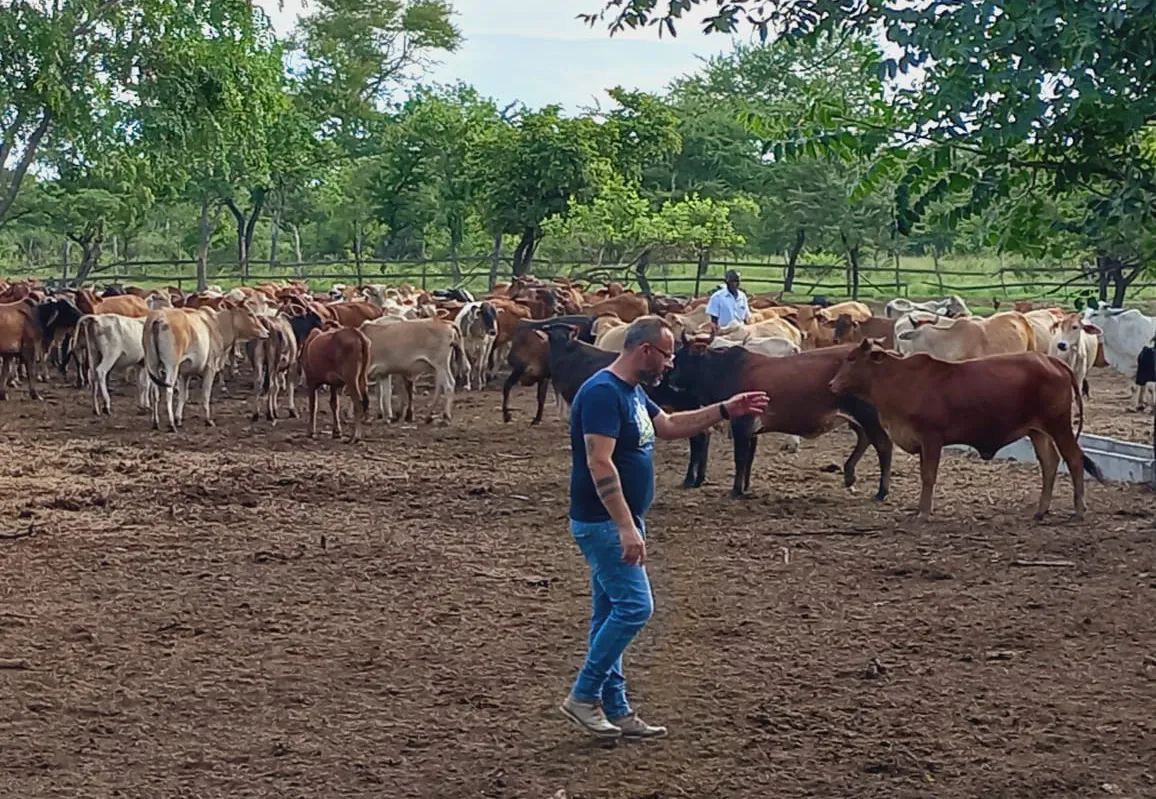
Beira Boi is a company in the agri-livestock sector, founded in 2008, dedicated mainly to producing beef cattle. In 2020, Frederico Carvalho acquired 63% of its share capital, a year later he increased his stake by 15% and, in 2022, with the help of friends and family, ended up acquiring the company outright, turning it into a family-owned business. This 42-year-old businessman from the motor trade acquired a completely undercapitalised company, on the brink of bankruptcy, which had to reinvent itself. The business opportunity turned into an enormous challenge, one that he still faces today, but which he has overcome with daring and, above all, a great deal of sacrifice. Beira Boi is currently recovering from the crisis, and remains steadfast in pursuing its goal: to be the leader in cattle farming in the central region of Mozambique.
Frederico Carvalho, a native of the city of Fafe, in the district of Braga, in northern Portugal, has lived in Mozambique for exactly a decade. He first came to the country in 2013, at the invitation of friends. A visit that turned into a discovery and in which he began a new page in his life, a page turned thousands of kilometres from home and family: “My friends sold me a rose-tinted dream. And, as I am someone who likes challenges, in 2013 I decided to come and get to know the country”.
Although he has yet to live that rose-tinted dream, Frederico fell in love with a sister country and decided to stay. “Home is where we feel good. Today I feel better in Mozambique than in Portugal. I raised my family here, so this is my home. I can say that, at the end of this decade, I feel more Mozambican than Portuguese,” the businessman, now the administrator of Beira Boi, told us. The company is located in the district of Nhamatanda, in the central region of the country, its main activity being beef cattle. Frederico took over its management in 2021 and saw his life change radically and unexpectedly. He swapped the mechanic's overalls for those of a farmer; he had few options left: it was the investment of a lifetime and he had no choice but to reinvent himself, every day, to save his recent acquisition.
General information about the company Beira Boi, Lda.:
Year established: 18 February 2008
Location: Chadeia, Nhamatanda district, Sofala province
Main activity: beef cattle and fattening
Area farmed: 11,000 hectares
Market/Customers: butchers and supermarkets
Livestock (herd): 1,400 head
Breeds: Brahman, Beefmaster, Boran and Landim (local breed)
Number of employees: 42 (including tractor drivers, agri-livestock technicians, herders, maintenance staff, fencing, security guards) and seasonal workers.
Reinvention after 40
The son of an architect and a pattern-maker, Frederico did not follow in his parents' footsteps; he stopped studying at 19 because he longed for financial independence. He began very early, as a salesman in the motor trade, and later acquired a car workshop, which he has devoted himself to ever since. At no point, until the age of 40, would he even have imagined working on a farm, let alone owning one. But life brings many surprises and, in 2020, he acquired the majority stake in Beira Boi, thus changing the focus of his activity. “I had known the company for some years; it was a company with a lot of potential. However, it had suffered a great deal, especially in terms of infrastructure, machinery, and even loss of animals with the passage of Cyclone Idai. When I bought the first portion of the shares, I found a practically obsolete company,” he described.
After Frederico's first acquisition, the company was forced to suspend operations for almost a year, more specifically 11 months, because of legal problems between the former partners. “It was an extremely turbulent period. Besides being taken by surprise by the situation, it was necessary to keep the whole operation of the company going, from treating and medicating the animals to the workers' salaries and all the other fixed operating costs, without, however, being able to operate to meet the expenses. Consequently, the money we had planned to reinvest and revitalise the company ended up being, of necessity, channelled into covering fixed operating costs, which delayed our growth, forcing us to redesign our strategies", the company's administrator recounted.
It was thanks to the support of his wife, relatives and friends, who lent money to the daring businessman, that Beira Boi overcame the difficulties it faced. “Although it was far too painful and arduous, I am sure that all the difficulties I went through will be valued in the future. Even in the most difficult situations, and there were quite a few, I never felt like giving up. It is not in my DNA or my essence to give up". To avoid a new crisis, Frederico was obliged to swap mechanics – repairing cars was what he did – for livestock farming, an area he knew absolutely nothing about, and the comfort of the city for the mud of the countryside. He reinvented himself after the age of 40, and became a farmer, not just at weekends, but full time, and boldly devotes himself 150% to the work.
“My life had never been linked to agriculture or livestock farming. I had always been in the motor trade. I found myself forced to leave the city, Maputo, and go to Cheadeia, in the locality of Tica, where I had to make many sacrifices. Used to city conditions, I had no choice but to adapt to country life, learn to wash with a bucket, live without electricity, and cover mile after mile on foot and by tractor. It was essential that I got to grips with the whole operation, so I accompanied the workers when they carried out assessments, looked for animals, counted the animals and treated them; it was the only way I had of learning the workings of agribusiness intensively,” he recalled, without failing to mention the unconditional support he has had from professionals in the field. “Despite the challenges, I recognise that I have managed to overcome a great deal thanks to the professional guidance and support I have received from Dr Américo da Conceição, National Director of Livestock, who is always available to guide us, steer us and, above all, share his knowledge and give us encouragement so that we can overcome, progress and develop the sector. People like him, with this spirit and dedication to the profession, are of extreme value. People like him are needed in this field.”
Beira Boi currently has a herd of around 1,400 head. The meat from this company is sold mostly in the central region, with butchers and supermarkets as its main customers.
The sky is the limit
According to Frederico, his long-term goal is to become the country's largest cattle breeder. “Beira Boi is an enormous challenge, I have no doubt about that; only I know what I have been through in these almost three years. Just as I have no doubt that we are on the right path, not because I am the person at the helm of Beira Boi, but because we have a clear goal we intend to achieve. I am aware that the road will be very long and arduous, as we want to become the largest breeders in the central region in the near future. But we do not want to stop there; the aim is to be the largest breeders in the country – that, indeed, is our great goal.” However, Frederico understands that, to get there, old stigmas relating to Mozambican meat still need to be broken. “There are several meat producers scattered across different parts of the country, from Maputo, Beira, Chimoio, Magude, Gaza, among others. We produce quality meat, which is no worse than meat produced in neighbouring South Africa. However, until we eliminate the stigma that quality meat is not produced in Mozambique, we Mozambican producers will continue to face difficulties”. Frederico argues that there should be a union of the production chain and a greater defence of the domestic product, thereby maintaining consistency of supply and an ever larger offering of quality meat, reversing the current scenario and people's opinion. “At the moment, all our new customers are extremely satisfied with the meat we produce; even some South Africans who sell meat say that ours is every bit as good as South African meat. And believe me, I spent eight months negotiating to make the first sale to a butcher's owned by a South African,” said the resilient and persistent producer, about his success after several failed attempts before securing a contract to supply meat to one of his main customers.
Beira Boi's strategic plan includes building a processing unit, with a view to having its own slaughter line. Frederico also shared that infrastructure is currently being built to host the Regional Agribusiness Fair, a Public-Private Partnership (PPP) with ADZ. The Fair is scheduled to take place between August and September, and will certainly invigorate and boost agribusiness in that region of the country.
Growing and making an impact in the community where it operates
Beira Boi is one of the largest meat producers in the central region. The company currently has a total workforce of 42, spread across the various areas inherent to its activity. From tractor drivers, agri-livestock technicians and herders to maintenance technicians, among others, as well as seasonal workers. Most of the staff are from the region, with a particular focus on young people and women. Frederico Carvalho says that Beira Boi's mission is to grow and create real impact in the local communities on and around the property, improving people's quality of life through social and inclusive projects. “For the company to develop sustainably, it is necessary to involve the community and create real value for it, impacting it positively. At the moment, we are creating a machamba project – an initiative that consists of allocating a piece of our land to the local community so that it can grow all kinds of crops, which we can then sell, thus generating income for the families. This initiative is very much geared towards women, as a way of including and empowering them”. Still in the context of the company's social work, Frederico assures us that, from this year, he intends to support pupils at the Alberto Chipande and Eduardo Mondlane schools, in Cheadea, in the district of Nhamatanda, by donating a school snack, thereby contributing a decent meal for these children, with the aim of ensuring, besides keeping pupils in school, greater concentration on learning and, consequently, on the education of the young people of the future.


