
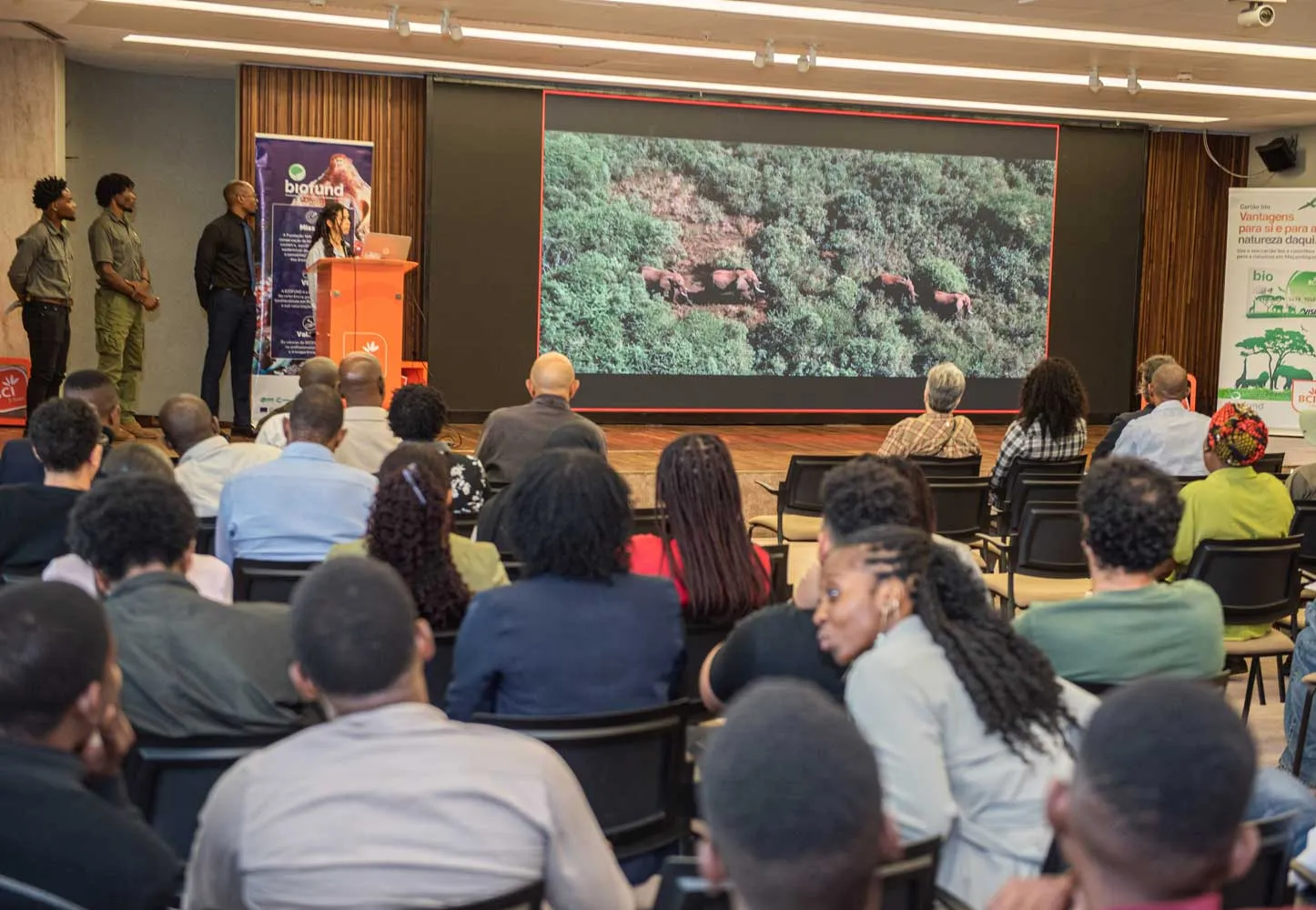
The closing event of the project “Vozes da Savana: Elefantes Monitorados, Comunidades Ouvidas” (“Voices of the Savannah: Elephants Monitored, Communities Heard”) was held in the BCI Auditorium in Maputo; its implementation marked significant progress in mitigating conflicts between communities and elephants in the districts of Moamba, Namaacha and Matutuíne.
The ceremony was one of celebration and inspiration, highlighting the partnership between BCI and BIOFUND. It included cultural moments, presentations and debates, a photographic exhibition on biodiversity and a screening of videos with authentic testimonies of the reality experienced on the ground.
Funded by the Bio Card, the project aimed to create an effective system for preventing and monitoring conflicts between people and animals, promoting peaceful coexistence. It was implemented by the Mozambique Wildlife Alliance (MWA), with support from ANAC, using satellites, electric fences, deterrent methods and community teams, in a participatory approach that valued listening to and involving communities.
Main results achieved
In 2024, the "Vozes da Savana" project recorded the successful resolution of more than 200 cases of conflict, ensuring the protection of local communities and their farms. Electric fences were installed in key areas of Moamba and Incomáti, and around 700 community members received training. The use of satellite collars on the elephants made it possible to predict movements and significantly reduce incidents, ensuring a preventive and innovative management of coexistence between communities and animals.
Rogério Lam, BCI Director, stressed at the closing session: “The Bio Card is a pioneering model that shows how financial instruments can be catalysts for positive social and environmental change. ‘Vozes da Savana’ is the concrete expression of that vision”. Lam also highlighted that, by June 2025, BCI had more than 43,000 active Bio Cards, whose transactions have generated substantial funds for conservation projects.
On the same occasion, Teresa Alves, of BIOFUND, argued that the partnership should be expanded to new geographies, replicating the results achieved in Moamba, Namaacha and Matutuíne. Rezia Cumbe, of ANAC, for her part, stressed: “This project combines science, technology and local knowledge. Its closure is, in fact, a starting point for consolidating and broadening good practices”.
Over eight years, BCI and BIOFUND have consolidated a strategic partnership that combines economic, social and environmental impact, responding effectively to the challenges of biodiversity conservation in the country.
A symbolic and transformative experience
As part of “Vozes da Savana”, after the closing event, the Chairman of BCI's Executive Committee (CEO), Francisco Costa, took part on 11 August in a monitoring operation in the Incomati Conservancy area, and fitted the last satellite collar on an elephant.
According to Francisco Costa, the experience of following the whole process, from capture to sedation and fitting the collar, was deeply moving: “Being close to a wild elephant awakened in me respect, admiration and responsibility, showing that it is possible to reconcile development, biodiversity protection and empathy”. The CEO also stressed the value of the Bio Card as a financial innovation that translates into concrete results, converting BCI's commitment into actions that regenerate nature, protect biodiversity and positively impact lives.
A model of financial innovation at the service of conservation
Launched on 8 December 2017, the Bio Card, made of biodegradable corn-based material, was the first of its kind in Mozambique. In addition to offering banking services, each transaction generates funds for conservation projects led by BIOFUND, at no additional cost to the user.
With the resources raised, several environmental actions have been carried out, such as the protection of rhinoceroses and sea turtles, the conservation of Raphia australis in the Bobole Botanical Reserve, the monitoring of turtle migration routes in the Primeiras and Segundas Islands, the revitalisation of the UEM Botanical Garden and activities in Banhine National Park, as well as in Cheringoma and Muanza, contributing to nature conservation and job creation.
With innovation, solid partnerships and continued investment, BCI reaffirms its commitment to inclusion and sustainability.


