
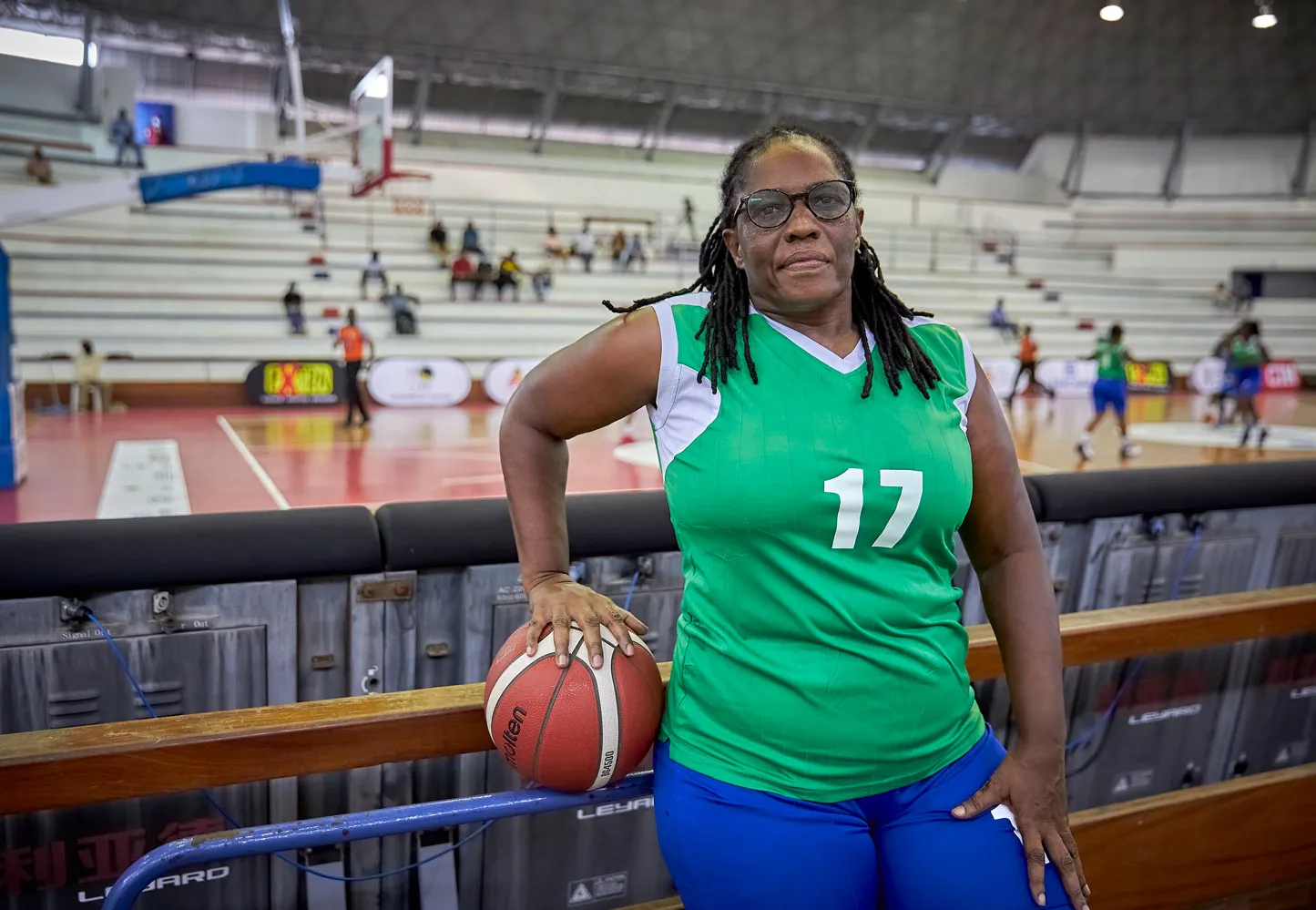
The oldest basketball player in the world may well be from Mozambique; she is 59 years old and her name is Ana Bela dos Reis Borges. Ana Bela is an example of sporting longevity. This mother, grandmother, businesswoman and player-president (of Desportivo) has proved that age is just a number, by competing at the highest level in the most recent women's National Basketball Championship, played in the city of Maputo (Sasol League 2022).
Ana represented the recreational team Mucopelinhas, from Nacala. The championship was won by the “canaries” (the nickname of Costa do Sol), who beat the “locomotive” side (the nickname of Ferroviário de Maputo), from the capital, in the final. The team for which our interviewee plays finished the competition in sixth place and was relegated, and will have to go through the qualifying play-offs to return to the top flight of national basketball. Ana Bela states categorically that the team “will return to the elite of national basketball” with her in charge, as she has no intention of retiring from the court any time soon. “I have no thought of stopping playing in the short term; in fact, I have no intention of stopping at all. I want to play until I am 70, if all goes well. Unless there is a regulation preventing it,” says the 59-year-old veteran, with the enthusiasm that characterises her, when asked about her retirement.
But who, after all, is “Dona Ana Bela” (as her teammates on court call her), who has become the biggest attraction of the Sasol League? “I am a Mozambican with Creole blood. I was born in Mozambique, but my parents are Cape Verdean. In 1985, I left Mozambique because of the civil war and went to live in Cape Verde. I only returned to the country in 1993, after the General Peace Accord, signed in Rome.” But her passion for sport existed long before the war and long before Ana Bela left. The veteran, now approaching 60, has been involved in sport since the age of six. She has taken part in two national championships (2019 - 2022). With a degree in Management and Accounting, she is a businesswoman, a mother of four, a player and the president of the team she plays for.
Breaking down stereotypes and prejudices
“Everyone is the age of their heart, of their experience, of their faith” (George Sand). Ana Bela is proof that age need not be a limitation for anything, much less for dreaming. Ana has overcome the age barrier, but acknowledges that prejudice persists on matters that “should even be a source of pride”. This warrior has become a symbol of resilience and courage in continuing to do what everyone should do, the thing that makes her feel most alive: sport, and basketball in particular. “Competing at my age has a positive side and a negative side. Because some people see it favourably, others unfavourably. I ask people not to condemn me, not to speak ill of me. I like playing, let me play, please,” asks the woman in her fifties of the basketball court, humbly. “Playing basketball in my province at my age is a very big challenge, because of age-related stereotypes. But what I want, what I wish for, is to play basketball. So I do not care what people think. If basketball, if sport does me good, I do not listen, and I do what is best for me; it has always been that way in my life,” she said. Ana Bela believes that sport is a component of women's visibility in society and in the public space. Many names that have stood out as sporting talents are the result of struggles over the years to win a place in this male-dominated space. “Sociocultural factors limit the involvement of women and girls here in Nacala, where most of the population is Muslim. This ends up influencing their development and their future. I wish to see more women and girls in my district embracing sport.”
Playing (also) for life
Ana Bela reveals that she does not play only to break down stereotypes and prejudices related to age; she plays for her very life. “I was born with asthma. For as long as I have known myself as Ana Bela, I have known that I am asthmatic. So I found in sport a way of expanding my lungs, and I have fewer asthma attacks each year,” she stressed, considering sport her salvation, her life. “I took a break for three years; the doctors in Nacala can confirm it, I was always in A&E. Since I started playing again, I have disappeared from A&E, and even the doctors ask how I am and I say I am great, that I am in the best phase of my life. For me, sport is therapy for my body and for my soul,” she said.
Dona Ana proved that age is no obstacle by taking part in the latest Women's National Basketball Championship at the age of 59. Her age did not stop her from competing at the highest level, rubbing shoulders with younger players. “At this age, to be training, to be competing at the same level as my younger teammates is a personal triumph. As long as my body allows it, as long as I have the energy to play, nothing and nobody will stop me,” she warns. “Basketball cannot die,” Ana predicts, and she asks the authorities and local businesses for support to develop the sport and to promote the empowerment of women and girls in the district where she lives, Nacala-Porto, in Nampula. “We are a new team, we do not yet have the means to have a court of our own. We borrow one, and we are often turned down.
With our willpower and commitment, sometimes we train in front of the church, sometimes we run along the roads of Nacala-Porto, we walk, we go to the beach, a whole effort not to let basketball die in Nacala, but we lack practically everything, from kit, balls and backboards to every kind of equipment needed to play basketball,” she stressed, lamenting the difficulties the team has faced over the years. Even so, the difficulties do not diminish her desire to keep fighting for the development of local sport. Ana dreams of one day seeing the provincial basketball championship, which takes place in Nampula, held in her district, and she asks local businesses and authorities for support to create the conditions to refurbish and build new courts that would allow the competition to take place. “That would hugely benefit the local tourism industry because it would bring many convoys with teams from every region of the country and would have the positive impact that sport is capable of delivering. Nacala would come out a winner, and so would sport,” she concluded.
Off the court, Ana Bela dos Reis Borges is a businesswoman in the agribusiness sector, and also serves as president of the team she plays for.


