
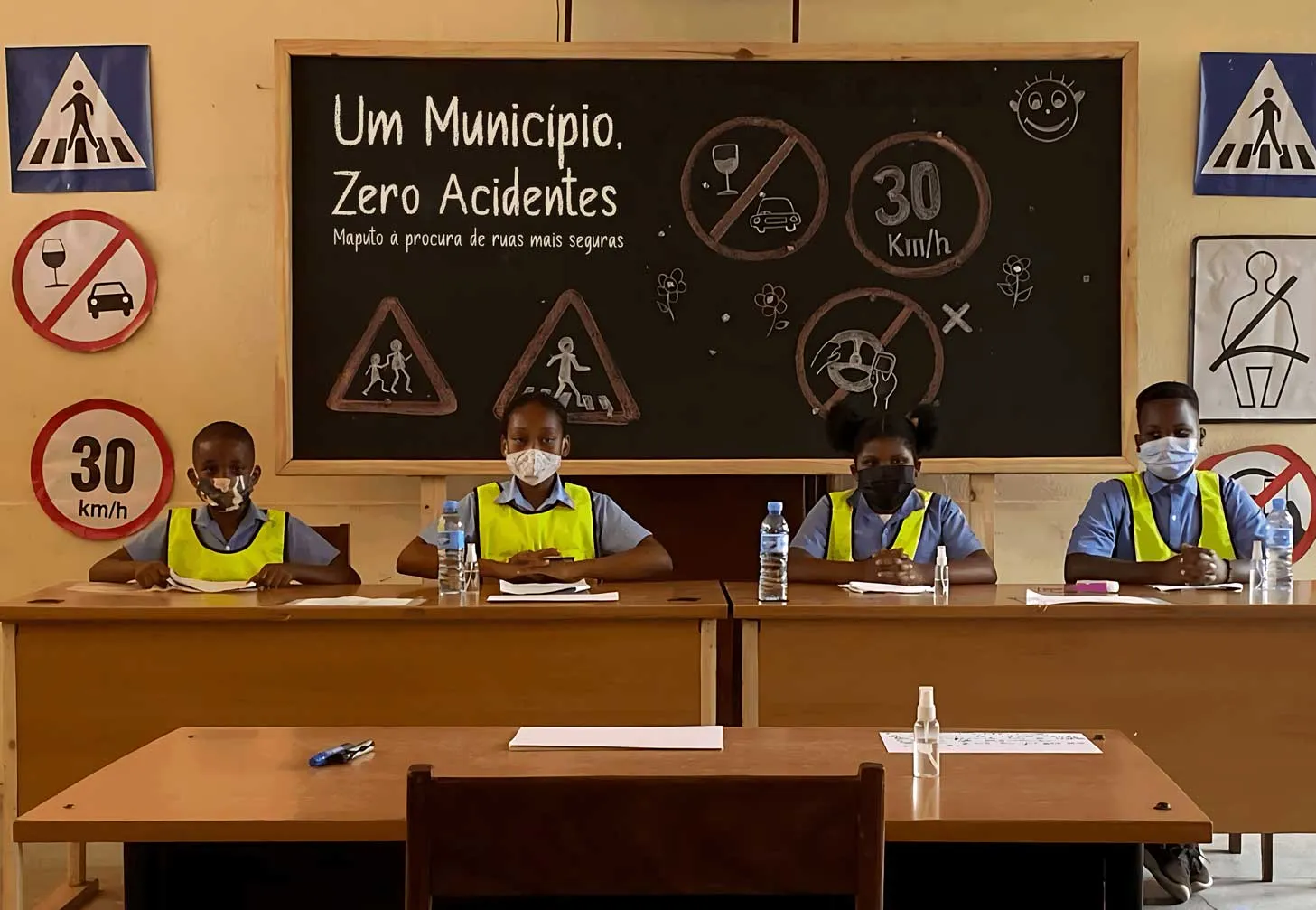
The city of Maputo, full of life and movement, also bears deep scars on its roads. Road casualties are a reality its inhabitants live with every day — a constant threat to the lives of pedestrians, drivers and, above all, children. Indeed, in recent years the city has seen a worrying number of road accidents, as shown by the fact that, between January and September of last year alone, Maputo province recorded 43 accidents, resulting in 47 deaths and 45 injured. It is estimated that more than 60% of fatalities involve pedestrians and cyclists. Among the worst affected are children, exposed to daily risks on the journey between home and school.
The Network Against Road Accidents and for Child Protection (RECAVI), based in the Alto-Maé neighbourhood, has stood out for its commitment to road safety and to protecting children. With a track record of community and educational work, the organisation has launched the project Um Município, Zero Acidentes (One Municipality, Zero Accidents), an initiative that seeks to transform citizens’ relationship with public space and contribute to reducing casualty rates.
RECAVI’s new project, scheduled to last 45 days, aims to intervene directly in the capital’s five urban districts, with a focus on areas identified as most vulnerable. Through community campaigns, training of activists and the installation of signage, the aim is to create a safer and more disciplined environment on public roads. These activists, trained to guide and regulate traffic, work in coordination with the Traffic Police, INATRO and other institutions. The plan also includes setting up an office to support accident victims and buying an ambulance for rapid response in emergencies.
RECAVI advocates an integrated approach that also values the reorganisation of urban space. The project includes a study of the routes most used by pedestrians and the adaptation of signage, with visible traffic lights and crossing times adjusted for children. The association stresses that road safety must begin in the design of the city and in the priorities it sets for its various users.
With the participation of community leaders, grassroots organisations and schools, road education comes to be seen as part of civic education. RECAVI also draws inspiration from school patrol models, in which pupils themselves help to ensure safe crossing in front of schools. The network’s educational proposal values the active involvement of citizens. Teachers, parents, activists and health professionals join forces in a strategy that brings together urban planning, civic responsibility and teaching. Alongside training, the project promotes the use of seat belts, respect for speed limits and awareness of the risks of drink-driving.
With Um Município, Zero Acidentes, RECAVI aims to reorganise traffic and strengthen a culture of responsibility on the roads. Urban space ceases to be dominated exclusively by vehicles and begins to welcome, more safely, those who travel on foot — especially the youngest. In this initiative, Maputo has the chance to become a benchmark in building a safer, more inclusive and more humane city.


