
An enigmatic signal from 1977 is now being re-examined with modern technology, revealing more precise data while the mystery of its extraterrestrial origin remains.
The iconic “Wow!” signal, picked up in 1977 and considered by many to be the most intriguing indication of possible extraterrestrial life, is back in the spotlight with a new analysis which, although technically revealing, leaves its mysterious character intact.
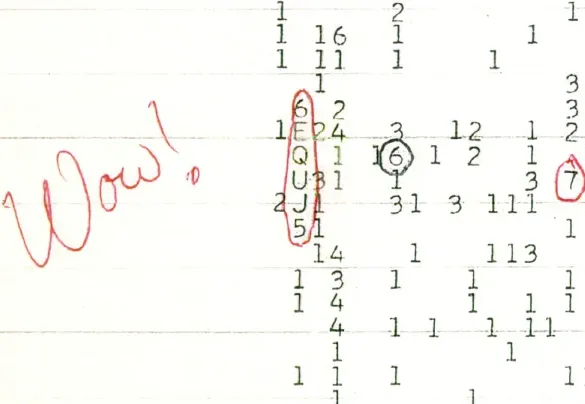
Detected on 15 August 1977 by the Big Ear radio telescope in Ohio (USA), the signal stood out for its intensity and for properties suggesting a non-terrestrial origin. Coming from the direction of the constellation Sagittarius, the phenomenon lasted 72 seconds and was recorded with the famous “Wow!” annotation handwritten by the astronomer Jerry R. Ehman – a gesture that gave it its name and fame.
Almost five decades later, a broad group of researchers and volunteers has shed new light on the enigma. Using modern optical character recognition (OCR) technology, more than 75,000 pages of original records from the Big Ear Observatory, closed in 1998, were digitised and manually validated. The digital processing allowed a more rigorous analysis of the data and corrected some earlier interpretations.
Among the updates, notable are the redefinition of the celestial area of origin, now narrower and with greater statistical certainty; a slight correction to the signal's frequency – from 1420.4556 MHz to 1420.726 MHz – implying a possible high-speed rotating source; and the revision of the signal's intensity to 250 Janskys, a value substantially higher than initially estimated, which ranged between 54 and 212 Janskys.
Minor errors were also identified, such as a 21-second offset in the recording clock and an incorrect calibration on one channel of the filter bank, which led to a more precise revision of the frequency.
Despite the advances, scientists continue to rule out immediate human or natural explanations. The signal does not coincide with known television broadcasts, was not reflected off the Moon, and is not linked to any solar activity recorded at the time. The hypothesis of a software error was also dismissed, given the Gaussian pattern observed.
The most viable explanation remains an astronomical one: a cloud of neutral atomic hydrogen (HI), which can emit similar signals. However, to this day, no cloud of that kind has been observed with an intensity comparable to that of the 1977 signal.
This review shows that, even with modern technology, the “Wow!” remains as enigmatic as the day it was picked up – stronger, more precise, but still without a definitive answer.
Who knows what else the old data still has to reveal?


