
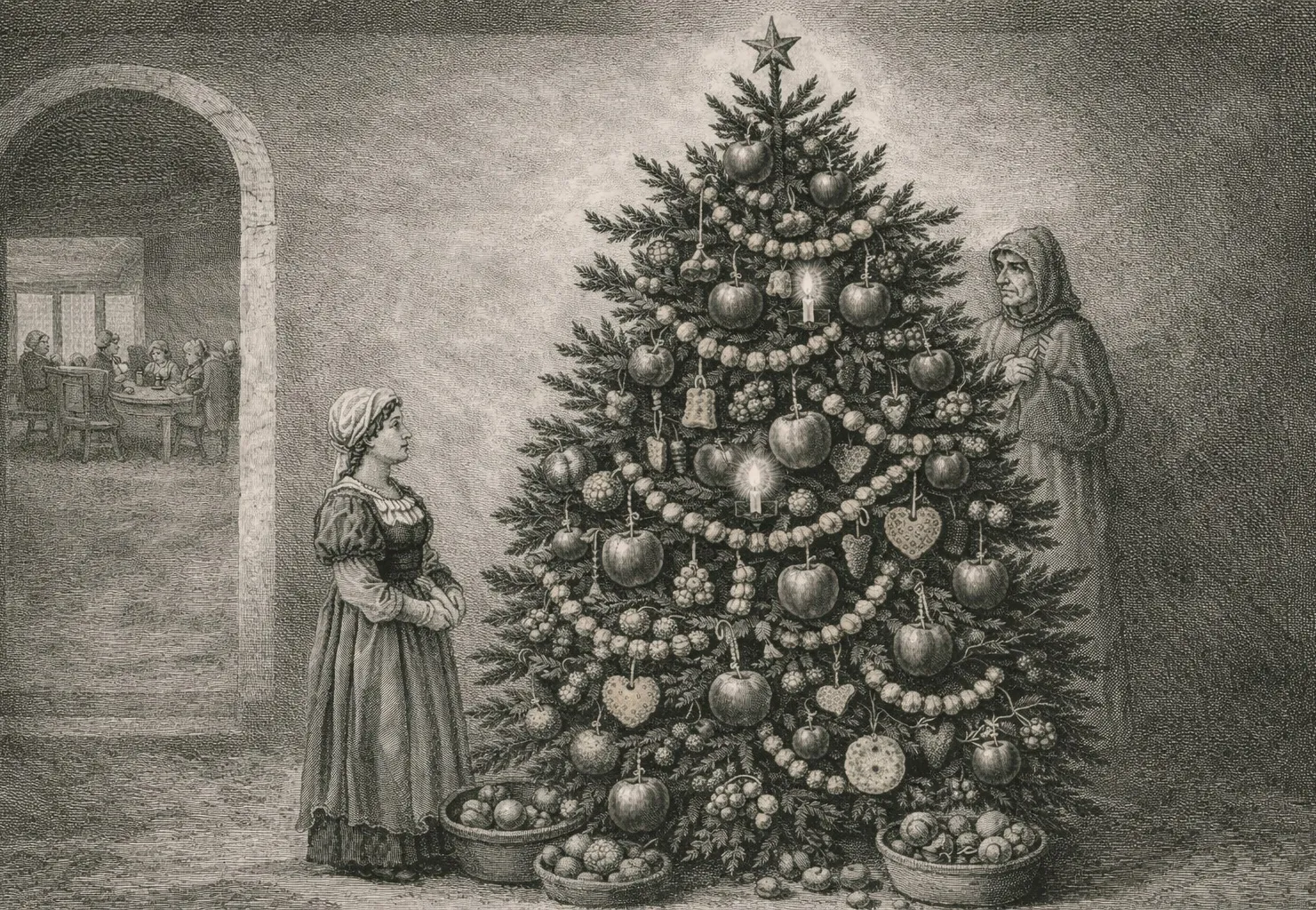
Long before Christmas decorations gained artificial sparkle, Christmas trees had a far more literal taste. They were decorated with food — and eaten. It is a tradition that goes back to medieval Europe, particularly Germany, where religious symbolism and community spirit met beneath the green boughs of a custom that endures today, albeit in another form.
Between the 15th and 16th centuries, the so-called “paradise trees” emerged, used in religious plays staged on 24 December. These performances, centred on the biblical story of Adam and Eve, used trees adorned with apples — evoking the forbidden fruit — as scenic elements. Over time, these trees left the stages and churches and settled into homes.
In the domestic sphere, the decoration took on a more practical and symbolic character. Affordable food items such as apples, nuts, dried fruit, breads and biscuits were used. They did not serve merely to beautify — they represented fertility, abundance and sharing, essential values of the Christmas season. In many families, the edible ornaments were eaten on Christmas Day itself, in a ritual especially enjoyed by children.
The aesthetic shift came in the 19th century, when German craftsmen began making glass baubles to replace natural fruit, which was too perishable. This innovation quickly gained popularity, giving rise to the modern Christmas tree, decorated with lasting, shiny and, above all, inedible elements.
This historical detail recovers an almost forgotten image: that of a more organic Christmas, where the decoration was part of the table and of faith, in a gesture of communion that mixed the sacred with flavour.


