
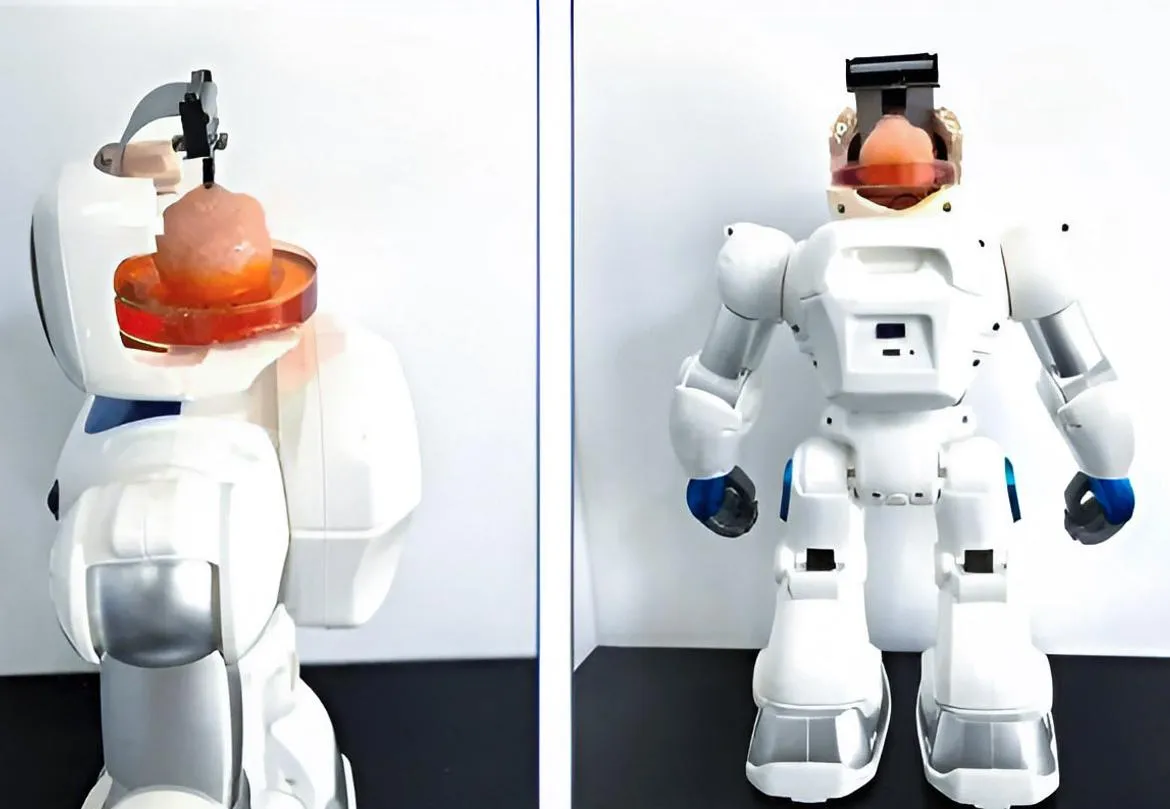
In an unprecedented scientific breakthrough, scientists have created brain organoids grown in the laboratory, biological structures that mimic some functions of the human brain and are already capable of controlling robots. This incredible innovation, developed by Tianjin University, through the Haihe Laboratory of Brain-Computer Interaction and Human-Computer Integration, and by the Southern University of Science and Technology, paves the way for a future in which biology and technology merge in ways that defy the imagination.
Brain organoids, created from human stem cells, represent a fusion of biological and artificial intelligence. Connected to electronic chips, these "mini-brains" were able to direct robots, helping them to navigate complex environments and even to grasp objects. This scientific milestone is seen as a revolutionary step towards the creation of a true hybrid intelligence.
Despite all their capabilities, these organoids are still far from being comparable to a complete human brain. They are small, have rudimentary neural networks and lack complex structures such as the cerebral cortex. Moreover, the scientists say there is no indication whatsoever that these structures possess consciousness. However, the fact that they display neural activity and interact with the outside world is already prompting ethical debates and expectations for the future.
The potential is vast. From the creation of intelligent biological machines to revolutionary treatments for neurological diseases such as strokes and Alzheimer’s, brain organoids promise to transform science and medicine. In a recent study, the researchers also showed that these structures can be stimulated by ultrasonic waves to speed up the growth of their neural networks, a discovery that could revolutionise the field of bioengineering.
But the advances also bring ethical challenges. As these structures become more complex, the question arises: how far should we go? Although there is currently no sign of consciousness, the rapid progress in creating organoids raises doubts about how to deal with future advances that could break down the barriers between humans and machines.
What once seemed impossible is now within science’s reach. Brain organoids are not just a research tool; they are the harbinger of a future in which the line between biology and technology becomes ever finer. The hybrid intelligence revolution.


