
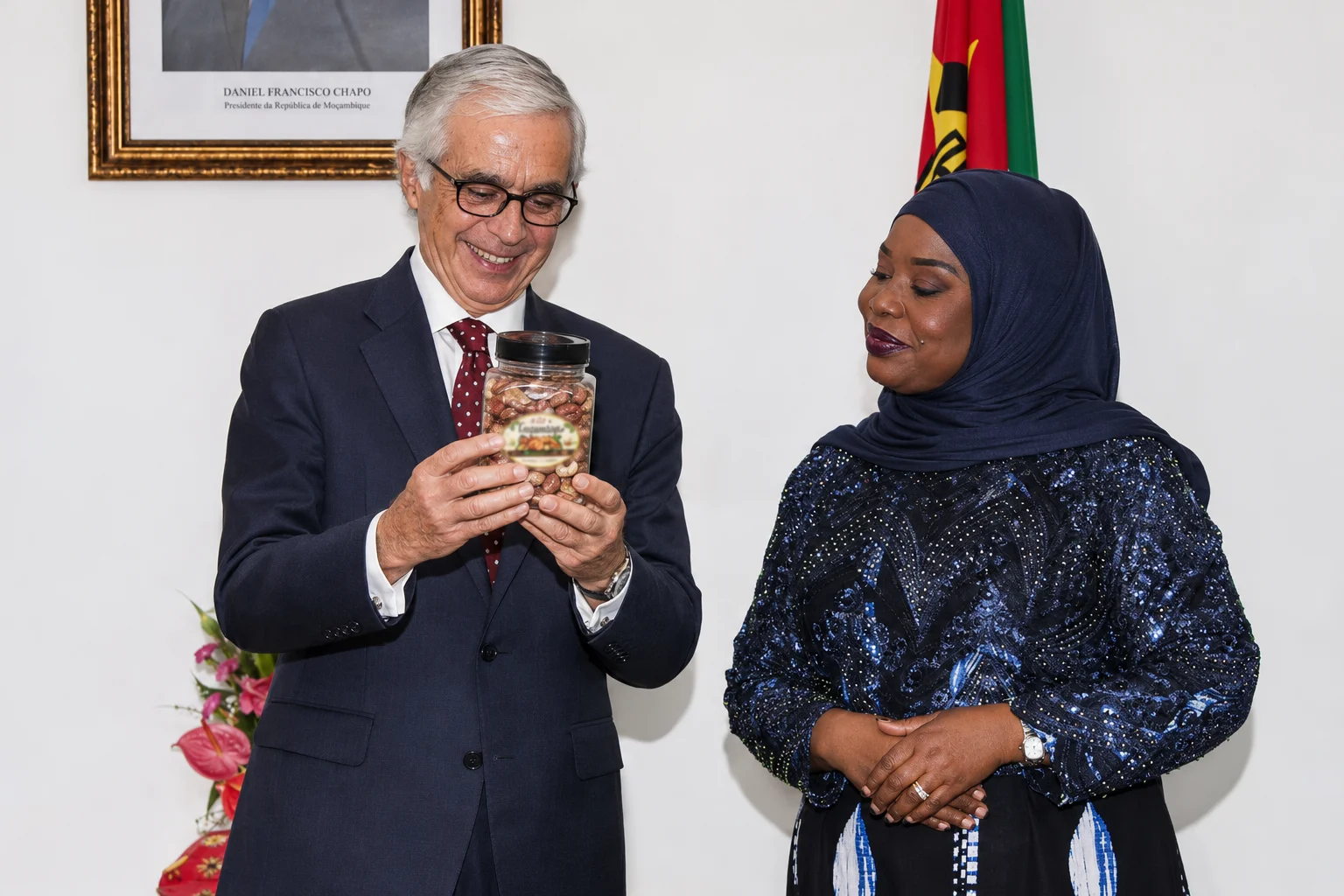
Cooperation between Portugal and Mozambique is entering a new phase, with the parliaments of both countries committing to intensifying political dialogue, strengthening technical training and expanding collaboration into strategic areas, including artificial intelligence and the security of digital archives.
The agreement was formalised in Maputo during an official visit by the President of Portugal’s Assembly of the Republic, José Pedro Aguiar-Branco, who met his Mozambican counterpart, Margarida Talapa, to consolidate a partnership that both regard as essential to deepening bilateral relations.
“Today marks a significant moment in the relationship between the Assemblies of the Republic of Portugal and Mozambique. It is another opportunity to strengthen a relationship that is already excellent,” Aguiar-Branco said following his meeting with the President of Mozambique’s parliament.
While acknowledging the strength of existing ties, the Portuguese parliamentary leader stressed that considerable potential for cooperation remains untapped, particularly in the economic, commercial and cultural sectors, where members of parliament and legislative institutions can play a decisive role.
“Whether in the economy, trade relations or culture, these are areas in which the Assemblies of the Republic and members of parliament can help consolidate exchanges between Portugal and Mozambique,” he emphasised.
This renewed commitment to closer relations took concrete form with the signing of a new interparliamentary cooperation protocol, establishing mechanisms for institutional coordination and paving the way for greater exchanges of knowledge and experience between the two legislative bodies.
The document, signed by Aguiar-Branco and Margarida Talapa, aims to “deepen and consolidate the bonds of culture, friendship, fraternity, solidarity and cooperation, and intensify the exchange of experiences within the framework of strengthening democracy and the rule of law”.
The commitments include bilateral meetings, regular consultations between parliamentary bodies, reciprocal visits by delegations, committees and parliamentary friendship groups, as well as the organisation of colloquiums, seminars and conferences on matters of mutual interest.
Cooperation will also extend to the exchange of information on parliamentary activities, legislative documents, studies and publications, alongside the development of joint initiatives involving the administrative services and specialised committees of both institutions.
One of the most significant new elements of the agreement is its technological dimension. Portugal and Mozambique intend to deepen their exchange of expertise in areas relating to the modernisation of legislative procedures, administrative and financial management, closer engagement between parliaments and citizens, and the use of new technologies.
In this context, the protocol provides for regular exchanges of technical missions involving parliamentary staff, with particular emphasis on professional development and the adoption of institutional best practices.
“A new protocol that also seeks to extend cooperation into areas that are, I would say, particularly important today, such as artificial intelligence, as well as archiving and the resilience of electronic archives and the digital infrastructure of our parliaments. These are new areas in which relations between Portugal and Mozambique will now expand,” Aguiar-Branco explained.
For Margarida Talapa, the visit by the President of Portugal’s Assembly of the Republic to Maputo, whose official programme includes an address to a parliamentary session, goes beyond diplomatic protocol and represents the continuation of a relationship built on shared historical and cultural foundations.
She described the visit as “an unequivocal expression of the deep historical, cultural and friendly ties” between Mozambique and Portugal, while also reflecting their shared determination to strengthen cooperation mechanisms between their respective legislative institutions.
According to Talapa, the newly signed agreement will facilitate more frequent exchanges of parliamentary delegations, including members of parliament, parliamentary committee members and staff, with a particular focus on training and improving technical capabilities.
“We have also just signed the protocol between the two parliaments, which is primarily intended to strengthen our interparliamentary cooperation through exchanges of delegations at the level of parliamentary committees, members of parliament and staff, particularly in the area of training, so that we can continue to improve our performance and fulfil our aspirations as parliamentarians,” she stated.
The President of Mozambique’s Assembly of the Republic also placed the strengthening of parliamentary cooperation within the broader context of diplomatic relations between the two countries, recalling that President Daniel Chapo has made three visits to Portugal since taking office in January 2025.
On the economic front, Talapa highlighted Aguiar-Branco’s expressed interest in continuing to work with the Portuguese Government to encourage a stronger Portuguese business presence in Mozambique, through exchanges of business delegations and the promotion of investment opportunities available in the country.
“During our meeting, the President of Portugal’s Assembly of the Republic said that he wanted to continue working with the Portuguese Government to ensure that Portuguese businesspeople continue to see Mozambique as a destination for investment, supporting this through exchanges of business delegations, while also encouraging them to regard the country as a safe destination in which to develop their business activities,” Margarida Talapa concluded.
The new protocol therefore establishes a cooperation agenda that combines stronger political relations with institutional modernisation, human resource development and the promotion of economic contacts, seeking to broaden the scope and impact of the partnership between the parliaments of Mozambique and Portugal.


