
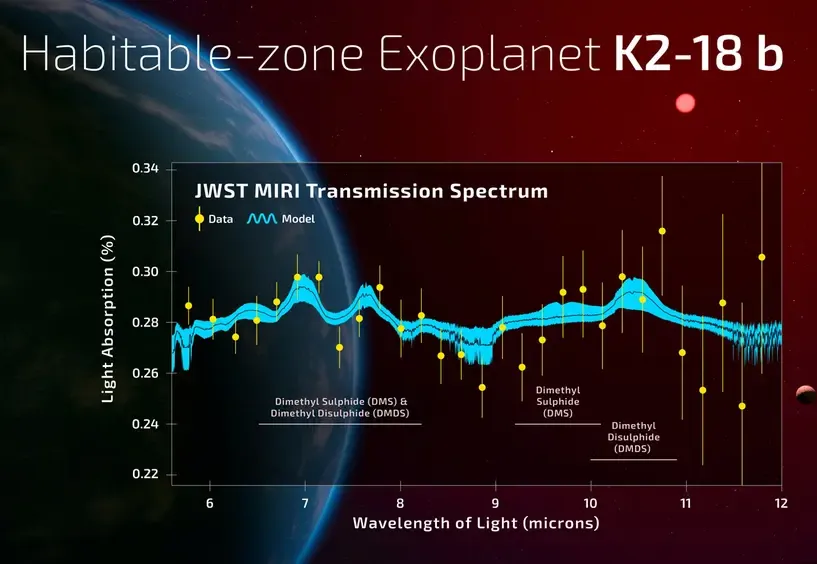
Some 124 light-years from Earth, in the distant silence of the constellation Leo, an exoplanet called K2-18b may have given the scientific world what for decades was only a speculative longing: concrete chemical evidence of life beyond the Solar System.
The signal, detected through the James Webb Space Telescope, is described as the “strongest indicator” of possible biological activity ever captured outside Earth. The research was published this week in the Astrophysical Journal Letters and on the Cornell University platform, and is signed by a team led by astrophysicist Nikku Madhusudhan of the University of Cambridge.
Fingerprints of life
The scientists identified in the atmosphere of K2-18b molecules that, on our planet, are exclusively associated with living organisms, namely marine phytoplankton and bacteria. The substances in question are dimethyl sulphide (DMS) and dimethyl disulphide (DMDS), both emitted by microbial life on Earth.
“The signal came back strong and clear,” Madhusudhan told the BBC. And he stressed: “This is the strongest evidence so far. Realistically, we could confirm this signal within one to two years”.
According to the team, the compounds were detected in concentrations “thousands of times higher than those recorded on Earth” and cannot be explained by known chemical processes without biological involvement.
A strange ocean planet
K2-18b, with 8.6 times the mass of Earth and about 2.6 times its diameter, orbits in the so-called “habitable zone” of a red dwarf star, a region where the temperature allows liquid water to exist on the surface. The planet is classified as a “Hycean”, that is, with hybrid characteristics between water worlds and hydrogen-rich atmospheres.
“Everything about this system is quite strange. We have nothing like it in the Solar System,” Mans Holmberg, co-author of the study, told the Washington Post. The observations also indicate the presence of methane and carbon dioxide, carbon-based molecules, reinforcing the atmosphere's habitability potential.
Scientific caution
Despite the excitement surrounding the discovery, scientists remain cautious. Madhusudhan and his team stress that they are not announcing the detection of life, but of a biosignature, a signal potentially produced by living beings.
“Life is one hypothesis, but it is only one among many,” warned Nora Hoenni, a chemist at the Institute of Physics at the University of Bern, recalling that molecules such as DMS have already been detected in icy, lifeless bodies such as comets.
Holmberg, for his part, puts the question directly: “Either we are observing a new, still unknown chemical process or we are facing the first unequivocal signs of life outside Earth”.
Astrobiology in a new era
The study marks a turning point in space science, in an era when technology allows, for the first time, detailed analysis of exoplanet atmospheres. As Madhusudhan sums it up, “we are entering the era of observational astrobiology”.
If the data are confirmed, the implication is monumental: “If the association with life is real, this planet will be teeming with life... and that would mean that life is, after all, common in the galaxy”.


