
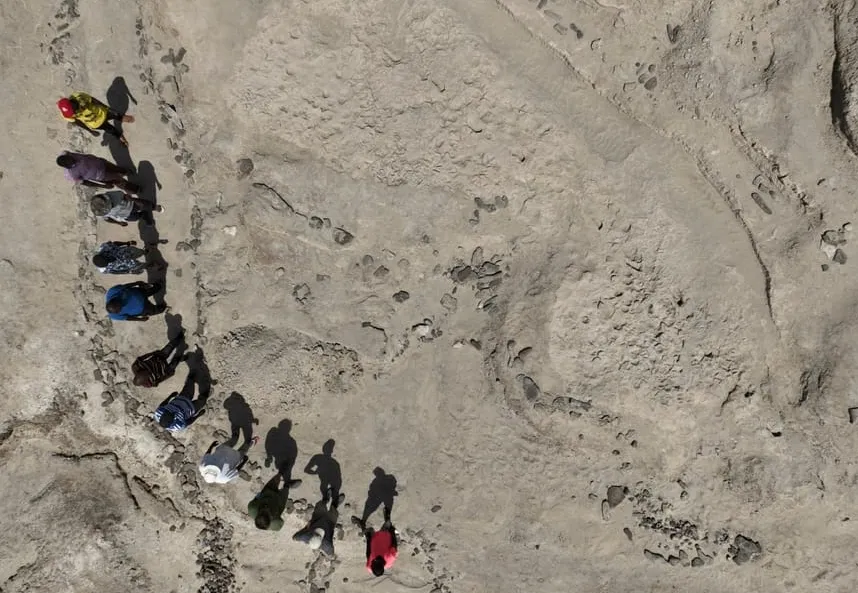
A set of fossilised footprints discovered at Koobi Fora, in Kenya, has brought new clues about humanity’s first steps. The marks, preserved in mud on the shore of Lake Turkana, suggest that two early human species, Homo erectus and Paranthropus boisei, coexisted and possibly interacted around 1.5 million years ago. The study, published in the journal Science, points to a close coexistence between these species, with profound implications for the understanding of human evolution.
The footprints were discovered in 2021, but only now have scientists been able to confirm their importance. "What we have here is a moment preserved in time. An incredible discovery", said the palaeontologist William Harcourt-Smith, of Lehman College and the American Museum of Natural History in New York.
According to Louise Leakey, co-author of the study and a researcher at Stony Brook University in the United States, the footprints belong to individuals who passed through the site hours or, at most, days apart. "Whether or not they shared the space at the same time, it is likely that these species knew about each other’s existence", added Kevin Hatala, a palaeoanthropologist at Chatham University in Pittsburgh, and also a co-author of the study.
Different steps, parallel paths
Analysis of the footprints made it possible to tell the two species apart thanks to their anatomy and locomotion mechanics. Homo erectus walked in a manner very similar to modern humans: first the heel touched the ground, followed by the transfer of weight to the sole of the foot and, finally, the push-off with the toes. Paranthropus boisei, on the other hand, had a unique walking style, with greater mobility in the big toe, a characteristic never before observed in other species.
"It is fascinating to realise that, even walking upright, Paranthropus boisei did so in a completely different way from anything we had already documented", explained Erin Marie Williams-Hatala, an evolutionary anatomist at Chatham University.
The findings underline that bipedalism – one of the distinguishing hallmarks of human evolution – was neither a linear nor a uniform transformation. On the contrary, it may have occurred in varied ways, with different species experimenting with walking mechanics adapted to their needs and environments.
Interactions and influences
Although there is no direct evidence of contact between the individuals, the temporal and spatial proximity of the footprints suggests that these species were aware of each other’s presence. "They probably saw each other, they probably influenced each other in some way", Hatala speculated.
The coexistence of two such distinct species reinforces the idea that the first human ancestors shared landscapes and resources, challenging the traditional view of a linear progression in the evolution of humankind.
The mud that kept history
Fossilised footprints are unique compared with traditional fossil records, such as bones or teeth. While the latter provide a broader view of evolution over thousands of years, footprints capture a specific instant, almost like a photograph of the past.
Scientists believe that, 1.5 million years ago, Lake Turkana, today an arid landscape, was an oasis with muddy banks, attracting a variety of living creatures. It was in this setting that the footsteps of Homo erectus and Paranthropus boisei were preserved, offering a rare glimpse of an era when the human genus was still shaping its path on Earth.
A new chapter in evolution
This study joins a growing body of research that challenges traditional perceptions about the origin of bipedalism. "Apparently, there is more than one way to be bipedal", concluded Harcourt-Smith.
The discovery at Koobi Fora not only sheds light on the behaviour and capabilities of early human species, but also reinforces the complexity of our evolution – a mosaic of adaptations that overlap, intertwine and, at times, coexist.


