
Manica is the province of Mozambique most associated with gold mining, that precious, shining metal that can hypnotise those who touch it, often personifying human greed and individualism. By contrast, projects are beginning to emerge in the same province that aim to foster women’s empowerment and community development. We are talking about coffee plantations that are flourishing around Manica and Sussundenga, a new “gold” that aims to change the current paradigm of subsistence farming for most of the region’s population.
But let us begin by recounting a little of the origin of the drink, which for many is indispensable for starting each day well. Legend has it that Khali, a shepherd in the mountains of Ethiopia, noticed how his goats became invigorated when they ate the leaves and fruit of the coffee plant. The news spread and, soon afterwards, a monk began to use an infusion of the fruit to fight off sleep during his prayers. The Arabian peninsula quickly succumbed to this drink, with important plantations appearing in the territory we now know as Yemen. The consumption of the infusion, coffee “tea”, naturally reached the whole Arab world as a way of awakening the spirit, as well as improving digestion. The roasting of the fruit first appeared in Persia in the 16th century, leading to a revolution in the paradigm of how the drink was prepared and consumed. From there it was a short step to conquering the whole world, driven by the expansion of Islam and the Age of Discovery
Here in Mozambique, at the top of the mountains of the Chimanimani range, the view reaches far beyond the border of the neighbouring country, Zimbabwe, where the population is intimately linked to coffee growing. Countless coffee plantations proliferate there, which has led many families from Mozambique’s border area to look for work on those farms. There are even those who grow coffee on Mozambican soil and then take it for processing in the neighbouring country. The Café de Manica and Café Vumba projects have created an opportunity that was plain for all to see: Mozambique has land available for cultivation and exploitation, as well as labour. Café de Manica is led by the partners Jenaro Lopez and Mandela Manuel, and Café Vumba by the entrepreneur Riana Ribeiro. Although they are distinct companies, they share the same philosophy and the same business model. Xonguila was invited to see the work undertaken in this region that aims to energise the agricultural economy around coffee, as well as to improve the living conditions of the families involved.
Based at the foot of the famous geological formation of the same name, Mount Vumba, the Café Vumba project’s premises enjoy a magnificent landscape that would be the envy of the finest tourist resort. There we came across the first coffee plants, arranged in neatly aligned beds at the mercy of sprinkler irrigation. Seedlings are being delivered twice a year, between February and April and between October and December, and the team was preparing to make a delivery to yet another community on the outskirts of the city of Manica.
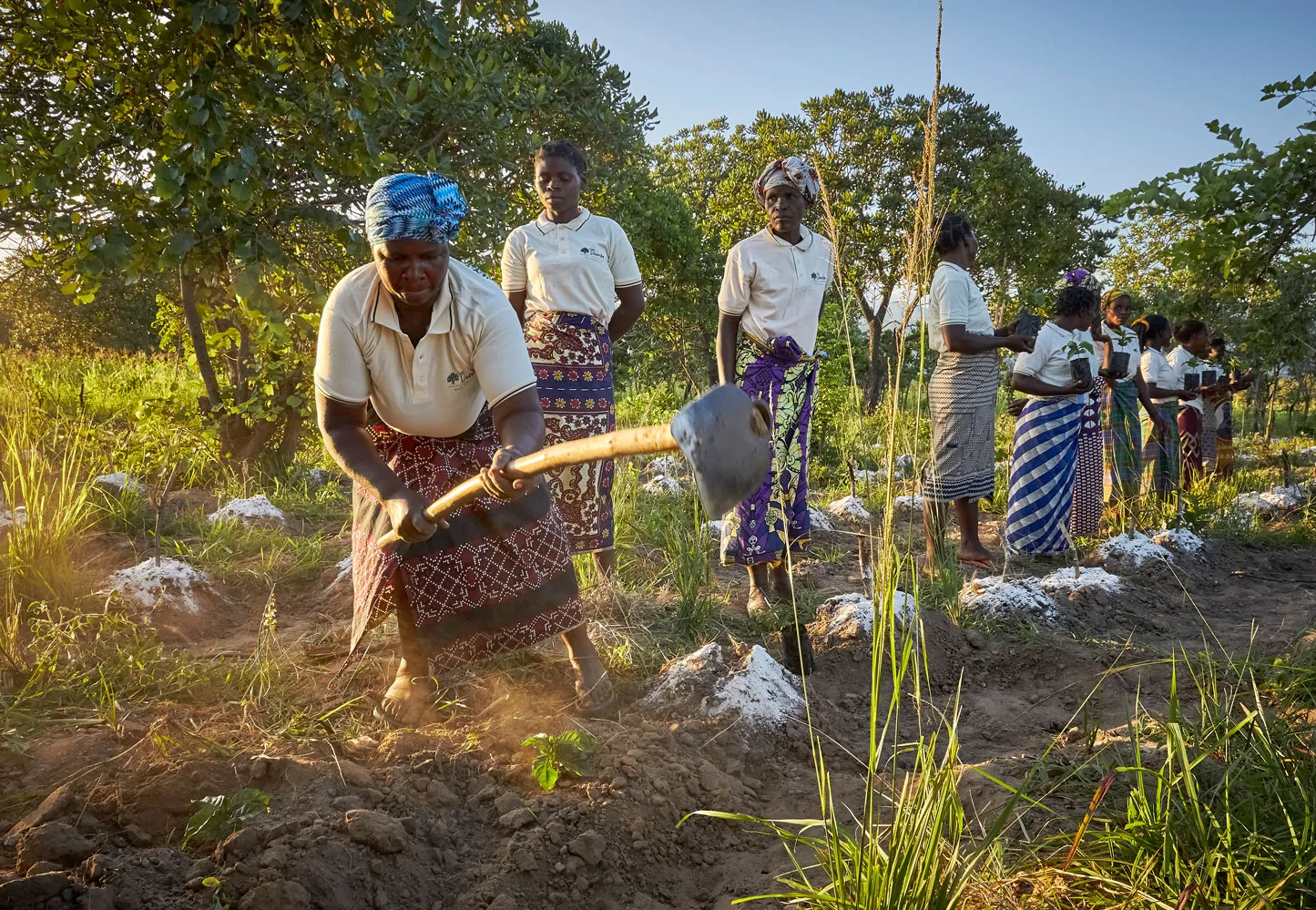
In Nhaconza we were greeted with songs of rejoicing and welcome by a generous group of women. The singing grew in intensity as soon as the tractor, loaded with boxes full of small plants, came into the group’s field of vision. Solomon, a young technician specialising in coffee growing, explained in detail to the beneficiaries how to plant that delicate plant and the care to take of it at this early stage of life. Emotion, some curiosity and, above all, close attention were visible as Solomon carefully handled a small coffee plant.
In conversation with one of the beneficiaries, we learnt that families have great expectations of coffee production. Someia Manuel, aged 22, who lives in the Nhaconza community, hopes that her living conditions will improve significantly, dreaming of being able to improve her home and send her children to the city to study. For his part, the community leader, Mr Moisés, aged 55, confided that he hopes this project (Café Vumba) will mean young people do not have to leave the community in search of better opportunities in the city. For these populations, coffee presents itself as a vehicle for keeping young people in the region.
The motto of both projects is inspiring: “One woman, one hectare!” According to Jenaro Lopez, the aim is to foster women’s empowerment in the countryside, because, besides being the ones who most devote themselves to work on the machamba (smallholding), women channel the income that comes from it into the development of the family itself. As a way of ensuring that this income actually goes to the beneficiaries, purchase and supply contracts are, with rare, duly justified exceptions, entered into exclusively with women.
The word travels on the wind and quickly reaches other communities. Day after day the number of requests for coffee seedlings grows. With these two projects, the populations hope to enjoy the same prosperity that is envied on the other side of the border. The interest is visible and very high; we could even say there is a veritable rush for “gold” in the Manica region. In total, these two projects have the joint target of delivering coffee seedlings to around 4,100 families.
At the moment, different varieties of coffee are being distributed to the populations. No chemical fertilisers will be used, because the aim is for the coffee produced by the resident population to be exclusively organic. To this end, a community composting centre will be set up in each locality, where vermicomposting will be done using worms to create organic fertilisers, which are among the important factors that contribute to coffee’s aroma and flavour. The aroma (what can be smelt) and the flavour (what we can sense on our palate) differ greatly between different production areas; slightly different climatic and geological conditions are enough to produce a quite distinct taste among beans of the same species. For this reason, micro-lots will be created in future as special and limited editions, each identified according to the community that gave rise to it. The populations will also have at their disposal the assistance of a technician who will accompany the growers closely, indicating the specific treatments and care that the plants should receive at each time of year.
Coffee growing does not aim to replace existing agriculture, but to complement it. Each hectare of land will receive about 2,500 plants, arranged in rows 4 metres apart, so as to allow the population to continue growing the crops they usually grow, such as maize, beans, sesame and cassava, among others. The dry matter left over from these crops will serve as fertiliser for the coffee plant itself throughout its 20-year life. Production maturity is expected to be reached between 4 and 5 years, with a yield of between 5 and 6 kilograms of coffee cherry (the name given to the plant’s ripe berries). This represents a household income of about 250,000 meticais, based on current market prices. One of the advantages of the coffee plant is that the coffee cherries ripen in the dry season, bringing an important financial return to families outside the usual harvest season. Communities that produce excellent coffee will benefit from incentives according to the quality of the coffee produced, thus motivating even greater dedication to this crop.
In the specific case of the Café de Manica project, its headquarters is located in the locality of Munhinga (Sussundenga district), on the access road to Chimanimani National Park. The park has recognised the project’s fundamental importance for the region, as it is being developed in the park’s buffer zone and extends as far as the Espungabera area, in Mossurize District. To this end, the project has benefited from the support of the FNDS (National Sustainable Development Fund), with World Bank funds for the purchase of seedlings and native plants for the population surrounding the Chimanimani park. In return, part of the profits from the coffee roasted by Café de Manica will go to the National Park and its partner Biofund, to support the preservation of biodiversity in the park. This agreement was signed last February in Maputo. By planting native trees, such as panga-panga and other species, the aim is to reforest the park’s buffer zone, which has been ravaged by a strong wave of illegal tree felling. In future, the new panga-pangas and others will allow shade-grown production, which will result in a better-quality berry, as it is more protected from the sun. Coffee production in the Chimanimani buffer zone will act as a deterrent to the illegal felling of native tree species.
It is expected that, by the middle of next year, the communities benefiting from the Café de Manica project will be able to enjoy their first income from coffee. In 2024 it will be the turn of the communities around Café Vumba to see the first return on their efforts in the field. In all, the two projects plan to plant 16 million seedlings over the next 6 years, with the aim of reaching a cultivation area of close to 5,500 hectares, of which only 20% will be under their direct control.
We at Xonguila aim to publicise the best that the country has to offer and to show. Over a week in the field and many kilometres travelled, we became convinced that coffee growing has a great deal to give Mozambique. If we continue to implement projects of this nature, in which the population is understood as a primary part of the business (note that, as we have reported here, the communities will be responsible for 80% of production!), we will be creating wealth on a large scale, we will be developing our Mozambique.


