
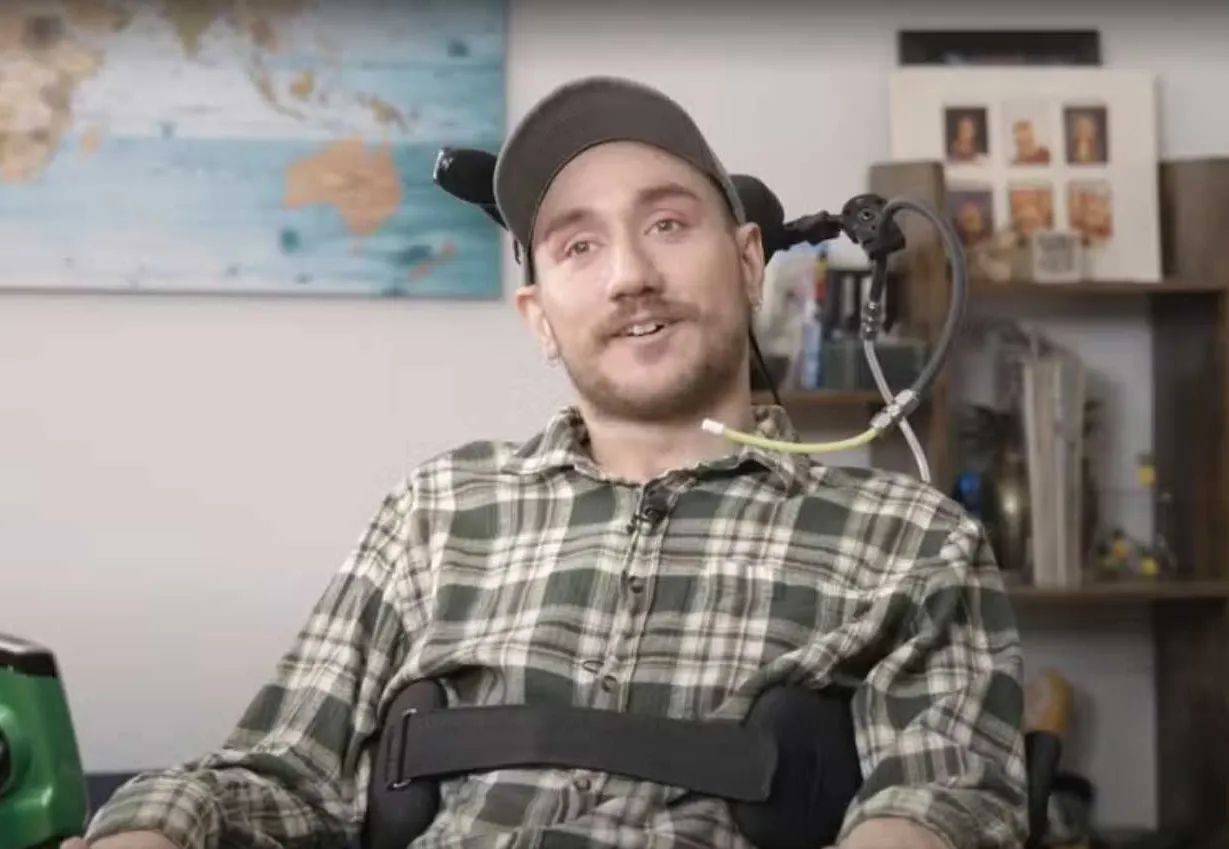
In 2016, Noland Arbaugh was 22 when he dived, quite literally, into a new chapter of his life. While supervising a summer camp on the outskirts of New York, he was pushed by a colleague and suffered a violent blow to the head. When he woke, the world he knew no longer existed: he could not breathe easily or move his body. His life was reduced to a wheelchair and constant dependence on carers. The injury was located between the fourth and fifth vertebrae, allowing him to move only his head and shoulders.
He moved to Arizona, where he lives with his mother, stepfather and half-brother. The loss of independence forced him to give up sport, music and university studies. But this story, which could be mistaken for so many others of resilience in adversity, took on unexpected contours when an unusual name crossed his path: Elon Musk.
From despair to the cutting edge
The turning point came a little over a year ago. Noland became the first human being to receive a brain chip from Neuralink, a company founded by Musk with the ambitious goal of merging the human brain with machines. The operation, performed by a robot in less than two hours, implanted a device just 3.5 millimetres across in his motor cortex.
This chip, named N1, reads electrical signals emitted by neurons and turns them into digital commands. In Noland's case, as a tetraplegic with fully active brain function, the device converts thoughts into movements on a computer, with no need for keyboards, mice or manual controls.
“Sometimes I even forget how impressive this is, because it is so natural to me,” he confessed to The Guardian. Even so, it was not an immediate process: it required months of training, persistence and initial frustration, especially when the battery ran out after five or six hours. The solution came in the form of a baseball cap with a coil, which charges the chip continuously.
Visions of the future
Elon Musk conceived this idea in 2016, the same year Noland had his accident. On a car ride, he shared with Tesla's then head of human resources, Sam Teller, his discomfort with the slowness of smartphones. “Imagine if we could think to the phone,” he said, in a vision that eight years later would become reality.
Noland is not the first to benefit from a brain-computer interface (BCI), but he is the first to take part in a human clinical trial of Neuralink technology, following FDA authorisation. The selection process was rigorous: three months of interviews, neurological examinations and psychological tests. Today, he devotes four hours a day to mental exercises with the chip.
After Noland, two more tetraplegic volunteers have already received more advanced versions of the same implant. Musk, for his part, anticipates that in the next two decades hundreds of thousands of people could be living with brain chips, transforming the way we interact with the digital world.
Between miracle and ethical dilemma
What seemed like science fiction is taking shape, with implications that are still barely understood. Replacing the fingers with thought is, for now, a blessing for those who have lost control of their bodies. But as the technology advances, there is no shortage of voices warning of the ethical, privacy and inequality risks.
For Noland, however, this is a rebirth. A young man who, after a tragic moment in a lake, found in a neural connection the bridge to a new freedom.


