
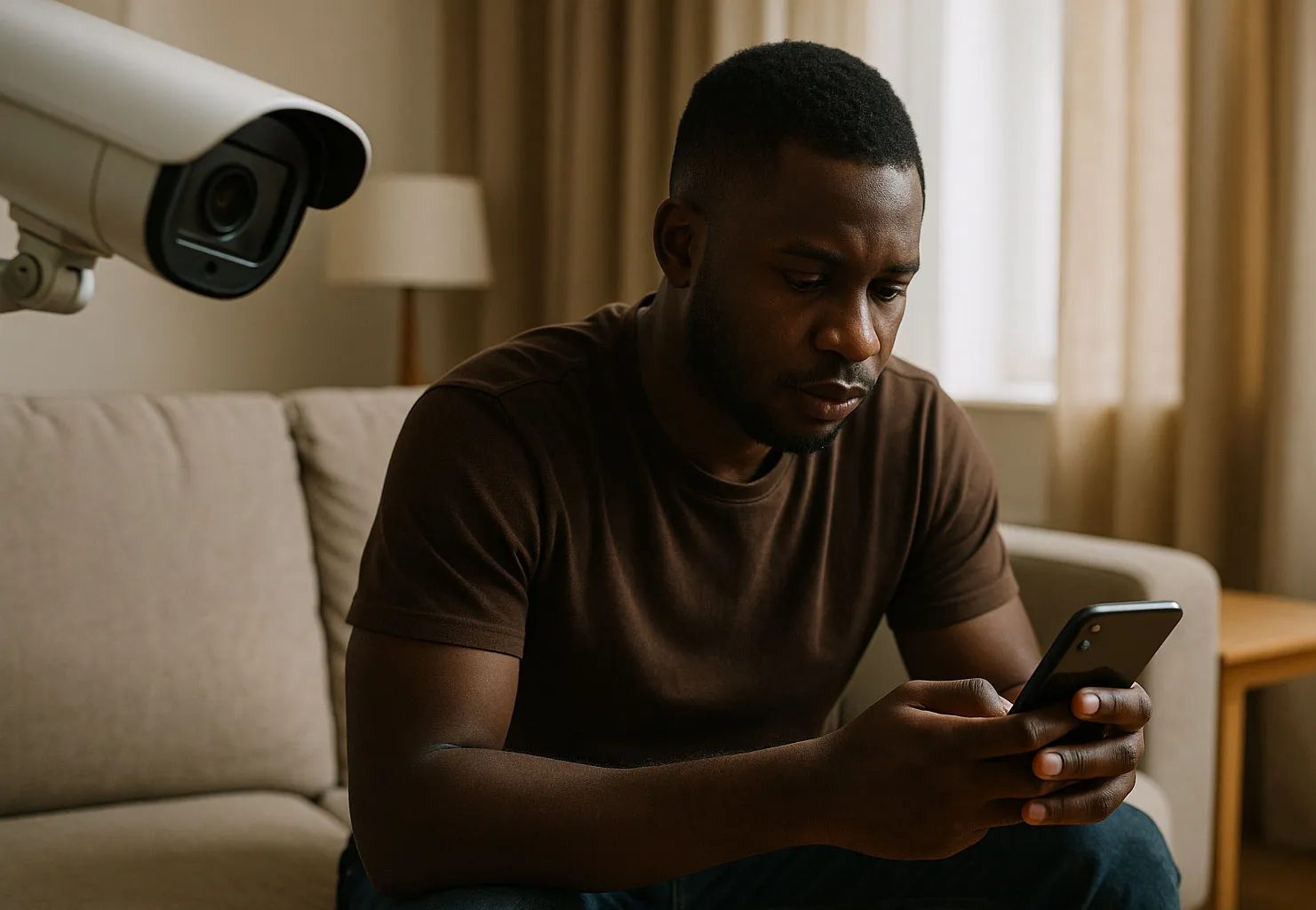
The maxim “I have nothing to hide” has become, in the digital age, a kind of resigned refrain. It is repeated in cafés, on social media and in comment forums as if it were a definitive argument. On the surface, it seems reasonable. But it is precisely that harmless appearance that makes it so dangerous.
Because what is at stake is not what one has to hide, but the right to keep something of our own, simply ours — without surveillance, without tracking, without prying eyes. Privacy is not a luxury for the guilty. It is freedom in its purest state.
And what if it were in your bedroom?
In the physical world, the limits are intuitive. Nobody would accept a camera installed in their bedroom by their employer. Nobody would tolerate the postman opening and reading their mail before delivering it. And yet, online, that degree of intrusion happens every day — and is accepted with an almost touching passivity.
Many of the communication tools we use are free, and paid for with an invisible price: our data. Some promise security with end-to-end encryption, but retain metadata — information about who spoke to whom, when, and for how long. That web of data, when cross-referenced with other fragments, reveals more than one imagines. Sometimes, more than we know about ourselves.
The choice of app is the first trench
Fortunately, there are alternatives designed with other principles — where the user is not the product, and privacy is the priority. Among them stand out Threema, Signal and Session, all world references in digital security.
Threema, developed in Switzerland, requires neither a telephone number nor an email address to register. From the outset, it eliminates one of the main gateways to tracking.
Session, more radical in its approach, operates through a decentralised network and does not even store metadata. Both reject the business model based on advertising or profiling — profit does not depend on surveillance.
Signal, widely used by journalists, activists and digital security specialists, offers open source code and gold-standard end-to-end encryption, and keeps no records of communications.
Adopting one of these tools is not just a technical choice. It is a deliberate, almost political gesture: that of rejecting the normalisation of surveillance and claiming the right to digital silence.
The myth of “irrelevant data”
Some believe that, because their data seems harmless, there is nothing to fear. It is a dangerous illusion. A location, a search, a taste in music — on their own, they seem trivial. But when aggregated, cross-referenced and processed by artificial intelligence, they become intimate portraits. They reflect behaviours, anticipate desires, expose vulnerabilities.
What was once invisible becomes transparent. And what was private is turned into a product.
The risk is not theoretical. It is real. And it is happening in real time.
Privacy and democracy: a vital link
Privacy is an essential condition for freedom of thought. When we know we are being watched, we change our behaviour. We filter what we say. We adapt what we search for. We avoid subjects, we avoid questions.
And a society that censors itself is not a free society — it is a democracy withering away.
Surveillance, even when silent, has the power to silence.
It is not about hiding. It is about protecting.
To insinuate that anyone who cares about privacy has something to hide is lazy reasoning. It confuses introspection with guilt. Privacy is not there to cover up crimes — it is there to preserve everyone’s dignity, autonomy and living space.
Because the right question is not “What do you have to hide?”.
It is: “What do you have to lose if you stop having privacy?”
The choice is personal. But the impact is collective.
In the end, it all comes down to choices. The tools we use shape the world we inhabit. Choosing apps such as Threema, Signal or Session is to resist, serenely but determinedly, the idea that everything in us can be captured, processed and sold.
It is to remember that, even when we have nothing to hide, we have everything to protect.


