
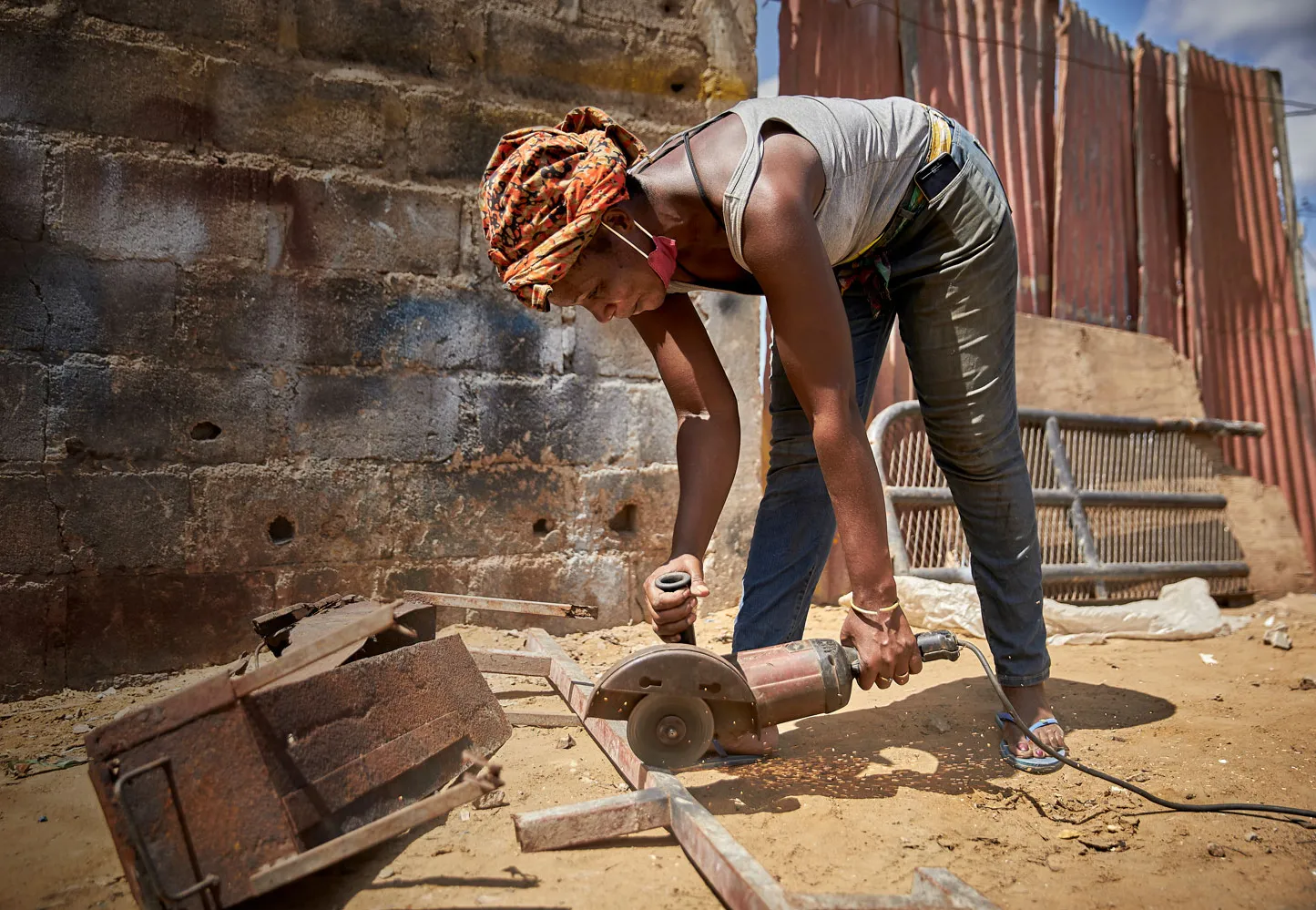
In this month in which International Workers’ Day is celebrated, Xonguila magazine spoke with two women of fibre, inner strength, dedication and selflessness, women who get up early every day and go out to fight, two women who overcome prejudice in search of a living for themselves and their families. One is a minibus taxi (“chapa”) driver, while the other is devoted to buying and selling scrap metal, amid adversities of various kinds. The mere fact of being women doing jobs usually done by men is already a great challenge, and crossing the roads of the Mozambican capital, Maputo, as their livelihood, come rain, cold or heat, is always a battle. At the end of each working day, it is with a look of relief and a sense of duty done that they look back. With or without success, what mattered was that they took part in the fight and “made” the day. After all, life is like that, full of bitter and sweet moments.
Suzete Nguenha and Célia Matosse are our two warriors, who make those who know them proud. They have never lost faith or hope, and it is this determination and grit that makes them special women.
With a serene look and a broad smile, Suzete Nguenha sits behind the wheel to begin her working day. She drives a shared passenger minibus, commonly known as a “chapa-100”. She operates on the route between Praça dos Combatentes, the famous Xiquelene terminal, and Costa do Sol. Aged 49, and the mother of a 17-year-old boy, she has been in the profession, that of chapa driver, since 2000. When she started out, she operated on the Praça dos Combatentes – Manhiça route. As she tells us, she worked on that route for two to three years, but unforeseen events forced her to make changes. “I had to reinvent myself when the chapa I worked in had mechanical problems, that is, a serious breakdown, and I was forced to stay at home, with no means of survival. After two years without doing absolutely anything, I thought about looking for new ways to save money and buy my own minibus. The following year, I managed to scrape the money together and bought my own vehicle,” she said.
“When I started, there were few of us, we didn’t even sell scrap as such; we bought batteries, basins and broken chairs and resold them, but these days the number of people doing this kind of work has exploded.” – Célia Matosse, the “Queen of Scrap”.
Because of the distance between the City of Maputo and Manhiça District, Suzete chose to change route. “I was always tired and had no time for anything. I currently work on the Praça dos Combatentes – Costa do Sol route. At weekends I don’t usually work, because I take the vehicle in for servicing.” And she confides: “Driving a chapa is not easy here in the city of Maputo. Besides the problems of traffic congestion, caused mainly by the high and growing number of cars and chapas, vehicle maintenance is inadequate, and drivers make dangerous manoeuvres under the impassive gaze of the regulatory authorities.” According to our driver, this is one of the main problems of working within the city. Suzete’s heart beats for many lives when she takes the wheel, and the anxiety of reaching the destination is enormous, but she always opts for careful, defensive driving.
Célia Matosse, the other hard-working woman, is 38 years old and the mother of 5 boys. The eldest son, aged 19, had to leave school and emigrate to South Africa in search of better living conditions, seeking to help his parents, both self-employed, with everyday expenses. While the mother is devoted to buying and selling scrap, the father is a painter and car panel beater. The brothers continue to attend school thanks to the few coins their parents manage to save to give them a decent education.
Célia Matosse has had her business since 2008. With what she earns, she helps her husband support the family. “I don’t earn much, but what I do get is enough for us to get by,” says this Queen of Scrap, as she is affectionately known. Although she knows very well the risk she runs when she picks up the angle grinder, she can find no way out of her arduous work. She considers that the cost of living tends to rise with every passing day, but, even so, there have been times when she was invoicing relatively well and the business was profitable. “Handling this product has had its peak moments,” she stresses, continuing, with a note of nostalgia: “When I started, there were few of us, we didn’t even sell scrap as such; we bought batteries, basins and broken chairs and resold them, but these days the number of people doing this kind of work has exploded.”
Matosse reveals that one of her greatest dreams is to get a welding machine, to take her activity in a new direction, since nowadays the scrap business is no longer profitable: “If I had a welding machine, things would be different. With the machine, I could make stoves and sell them to increase the household income.” Lately Célia has been buying very badly damaged cars in an obsolete condition. The equipment she uses to cut the iron is rented, and with its help she breaks the car apart and salvages the odd part. The rest she resells at the Vulcano market, where one of the biggest scrap buyers in the Mozambican capital is based.
Suzete Nguenha and Célia Matosse, two truly inspiring women for never giving up in their constant struggle to overcome life’s challenges and adversities.


