
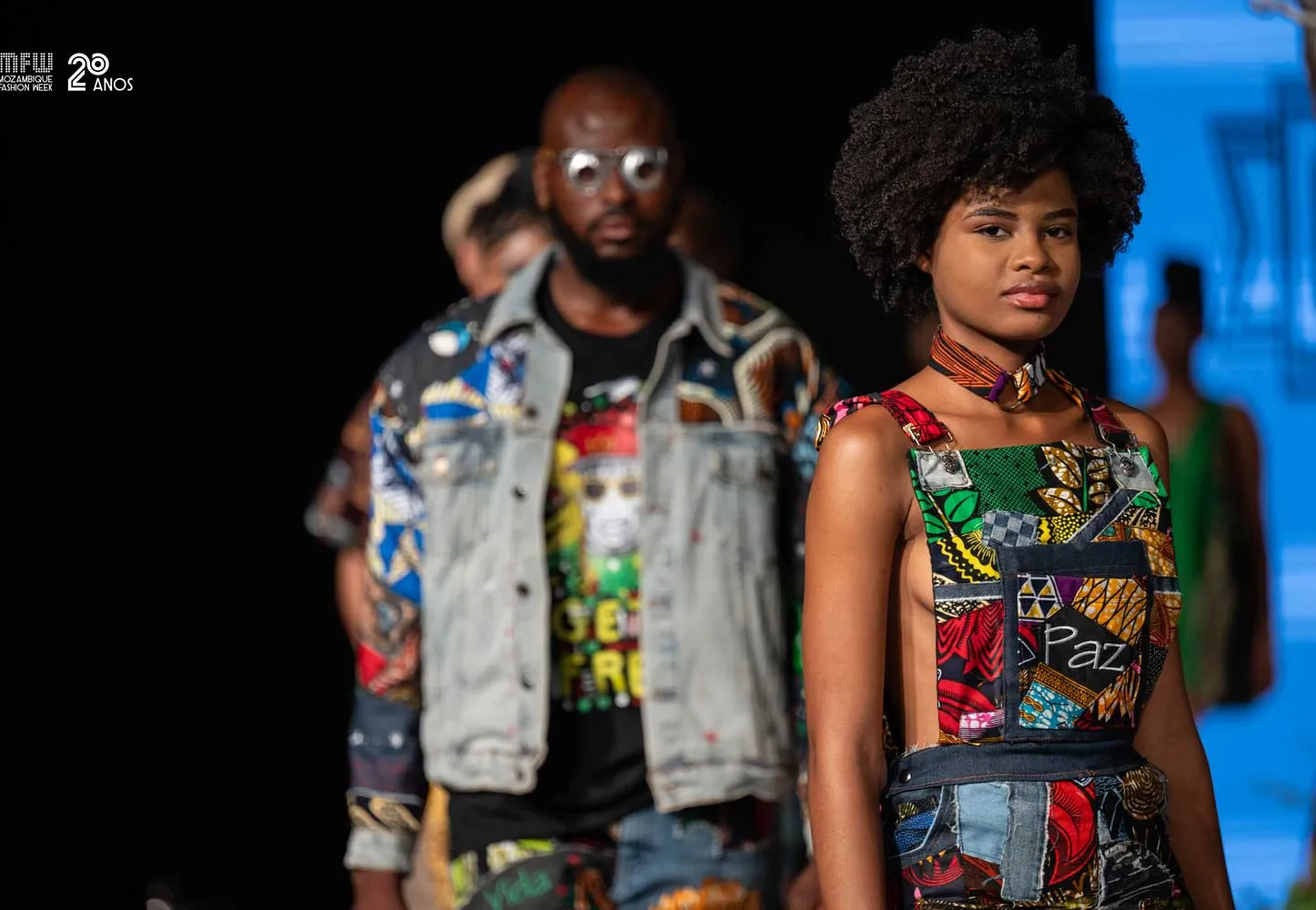
Some projects begin as events and end up becoming movements. Mozambique Fashion Week, which celebrated twenty years in existence in 2025, is one of those rare cases in which fashion goes beyond aesthetics and asserts itself as a cultural, social and economic force. Founded in 2005 by Vasco Rocha, MFW has helped to reveal talent, create opportunities and lay the foundations of a sector that was practically non-existent in the country.
When Vasco Rocha recalls the first edition, the image that comes to him is still striking. “I see a kind of silence full of possibilities,” he says, describing a country “without fashion schools, without a modern textile industry, without suitable materials, but with a raw talent that was almost impossible to ignore”. Everything was improvised, from the lighting to the sound, from the costumes to the catwalk, but there was an absolute conviction that something irreversible was beginning. “We were opening a door that would never close again.”
That beginning, marked by a lack of institutional support and an uncertain outcome, became the foundation of a platform that would go on to transform lives. Vasco Rocha realised that MFW had ceased to be merely an event when concrete stories of change began to emerge. Aimless young people found their first professional opportunity there, designers bought their first equipment with the income earned at the event, and models built identity, self-esteem and independence in a country where that path simply did not exist. “When a cultural event withstands storms that shake the entire country, we understand that it is not just a spectacle, it is a collective need,” Vasco stresses. Over these two decades, the founder’s view of fashion has changed profoundly. What began as creative expression proved to be a complex ecosystem. “At the beginning, I thought we were working with beauty and creativity. Today I know we were building an entire economic, social and cultural sector,” he says. Fashion came to be understood as agriculture, starting with cotton; as industry; as a space for young people to assert themselves; as identity; and as a tool for development. In a country like Mozambique, it has become synonymous with inclusion, civic education, sustainability and the creative economy.
The story of MFW is also made up of unexpected turning points. Designers who worked in conditions of extreme scarcity presented collections with international impact. Performances turned the catwalk into a social manifesto, a denunciation and a celebration. “These were moments when circumstance met courage,” recalls Vasco Rocha. “They proved that Mozambican fashion has a soul of its own, resilient, creative and disruptive.” The new generation of designers, models and creatives grew up practically in a vacuum, without formal schools, training centres, structured agencies or specialist literature. Even so, it flourished. “They grew up in a vacuum and still survived,” he says, describing this generation as a “silent miracle”. Over the years, MFW has sought to fill the gaps through bootcamps, training sessions, creative residencies and international partnerships with institutions such as CNA Federmoda and South Africa Fashion Week.
From early on, the event took on a clear social dimension. The catwalk became a reflection of the country and, often, an engine of progress. MFW was a pioneer in giving the LGBTQ+ community visibility with dignity, and in addressing subjects such as domestic violence, child marriage, breast cancer and gender equality, in a context where there were hardly any platforms for that debate. Fashion thus became an accessible language of civic education and contemporary self-assertion.
Sustaining this journey was not simple. Artistic coherence in an environment without resources, operational instability without guaranteed funding and the absence of national institutions capable of ensuring continuity were constant challenges. Even so, the project withstood economic crises, political instability and even the pandemic. In 2020, when many international events were cancelled, MFW held an in-person edition, safely. “It was an act of cultural resistance,” the founder stresses.
Among the moments that best symbolise the spirit of Mozambique Fashion Week, Vasco Rocha highlights two. Maputo Central Station, where history became a stage, and Maputo International Airport, the setting for a unique show in which the airstrip became a metaphor for a country ready to take flight. “MFW is not just creativity, it is boldness, vision and the ability to turn the improbable into something iconic.”
The commemorative 2025 edition, held from 1 to 6 December at the Mozambique–China Cultural Centre, marked this journey with a special programme that comprised Mozambique Fashion Week, the Mozambique Fashion Forum and the Mozambique Fashion Awards. More than a celebration, it was the affirmation of a project that looks to the future with ambition.
Vasco Rocha imagines the coming years with MFW establishing itself as an institution, linked to the cotton value chain, with ongoing training, academic exchanges, a presence at international fairs and a strong commitment to sustainable textiles. A genuine accelerator of the creative economy, capable of creating jobs, exporting talent and strengthening Mozambican cultural identity. After twenty years, what continues to surprise him is the country’s capacity to create despite scarcity. “It surprises me that young people without formal training present work of an international standard,” he says. “The ability of the Mozambican people to create beauty amid adversity is one of the most moving things I have witnessed.” As for the legacy, Vasco Rocha is clear. He wants the public to understand that fashion is much more than a ten-minute show. It is an entire chain in motion, made up of farmers, seamstresses, designers, artists and young people who found their first opportunity there. “Fashion in Mozambique is not just a spectacle. It is a movement. It is resistance. It is the future.”
Twenty years on, Mozambique Fashion Week stands as a collective work, built against all the odds. A story that proves that, even in adverse circumstances, creativity can become structure, identity and horizon.


