
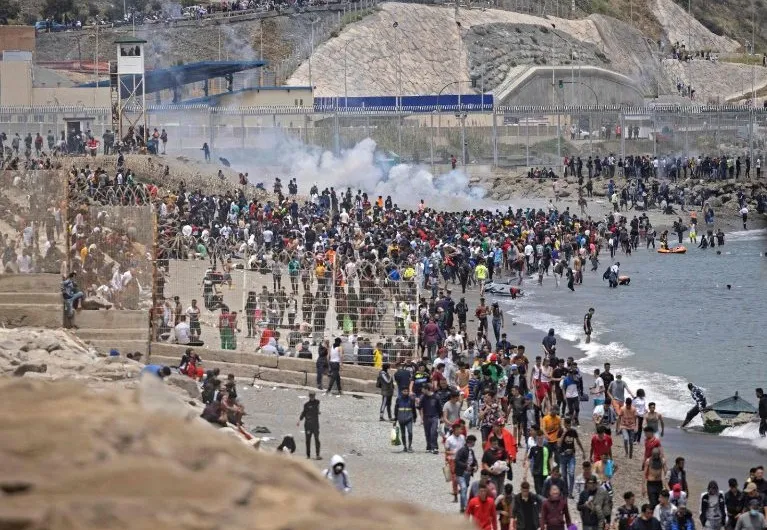
The Spanish autonomous city of Ceuta is facing one of the most serious migration crises in recent years, after thousands of migrants crossed the border from Morocco in an unprecedented surge that has already caused dozens of deaths, forced the deployment of soldiers and police forces and brought reception services to the brink of collapse.
Since the early hours of Thursday, thousands of people have gathered in the border area of Fnideq, on Moroccan territory, seeking to reach Ceuta by any means. While some forced their way across by land, many chose to get around the border barriers by swimming, braving dangerous sea currents in a desperate attempt to enter Spanish territory.
The Spanish authorities estimate that between 2,000 and 3,000 migrants managed to enter Ceuta during the first hours of the operation, although other media outlets report significantly higher figures, suggesting that the total number of entries may be in the tens of thousands. The exact scale of the surge, however, remains to be officially confirmed.
The crossing had tragic consequences. At least 18 people died while trying to reach Ceuta, most by drowning, while emergency teams continue search and rescue operations in the border waters.
Faced with the worsening situation, the Spanish Government ordered military and police reinforcements to support the Civil Guard in controlling the border and managing the emergency. The Prime Minister, Pedro Sánchez, also travelled to the Spanish enclave to follow the authorities' response at first hand.
During the night, the atmosphere in the border area became even more tense. Groups of migrants remained gathered by the fence separating Morocco from Ceuta, while others continued to look for alternative routes along the coast. Clashes set fire to a bus and several vehicles, increasing instability in the region.
The crisis is also triggering fierce political debate in Spain. Several analysts link the increase in crossings to a recent ruling by the Spanish Supreme Court limiting the immediate return of migrants intercepted at sea, an interpretation that, according to various sources, may have been exploited by people-trafficking networks. Other experts stress, however, that economic and social factors and growing migratory pressure in Morocco continue to play a decisive role.
Meanwhile, reception facilities in Ceuta are under enormous strain, as the authorities try to respond simultaneously to the humanitarian crisis and to the tightening of security on one of the European Union's most sensitive external borders.


