
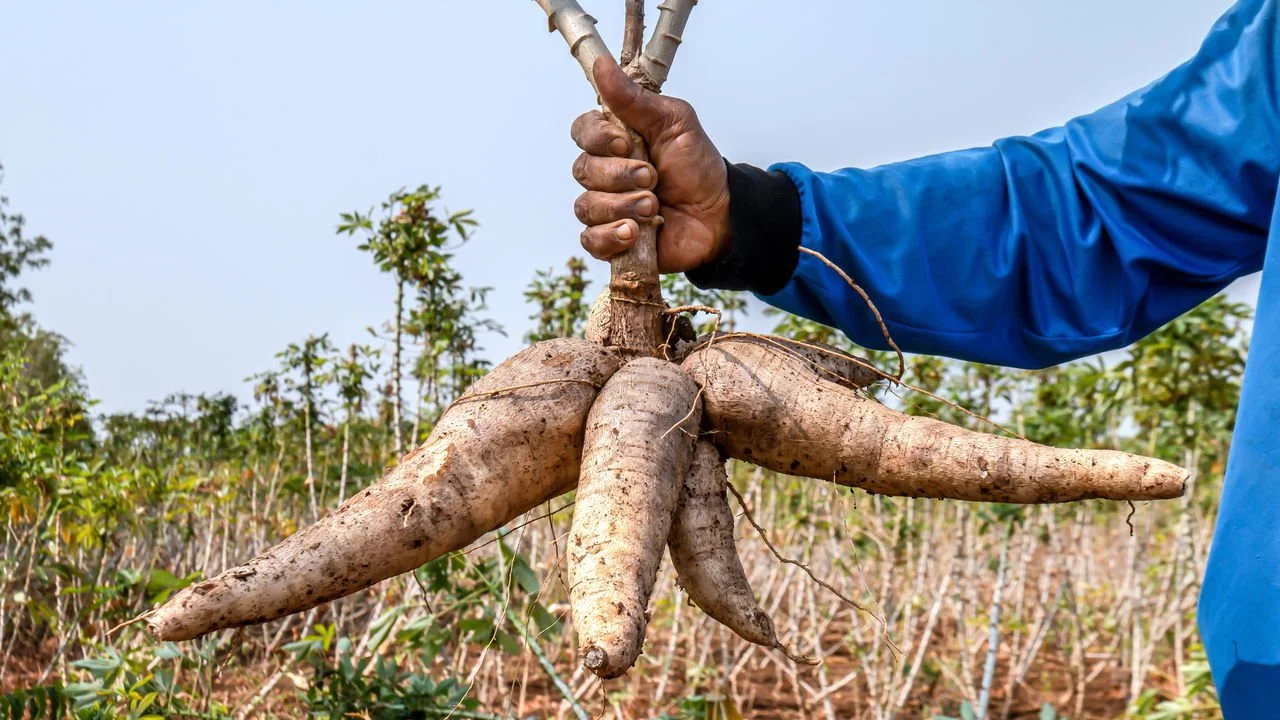
China buys cassava in quantities that do not fit into a pocket statistic. Mozambique wants a seat at that table, and it wants to sit there with product processed at home.
The numbers are heavy. Currently, China imports around four million tonnes of dried cassava chips a year, eight million tonnes of starch, 1.5 million tonnes of unprocessed cassava and more than 50,000 tonnes of flour. A market of this size does not pass unnoticed.
The Mozambican response began to take shape in Shenzhen. There, the Chamber of Commerce and Industry of Mozambique (CCMI) and Chinese business partners discussed how to put into practice the memorandum signed in Maputo on 1 October. The ambition is to organise the whole cassava chain, from the field to export: produce more, process the tuber in the country and take Mozambican products to the Chinese market in a sustainable way.
Gaza and Inhambane first
Thani Cabir, president of the Board of Directors of CCMI, and Fileu Pave, executive director of the Mozambique Chamber of Commerce (CCM), were at the meeting.
The first phase will take place in Gaza and Inhambane provinces, where the project covers production, industrial processing and marketing of the tuber.
On the ground, the work will run through producer cooperatives, business associations and private partners. Within this framework, the company Longrun Group plays a prominent role: it will support technology transfer, strengthen the capacity of smallholder farmers and create jobs in the communities involved.
Demand that drives the project
The design responds to strong Chinese demand for cassava derivatives. For Mozambique, this scale of consumption is a strategic opportunity: diversifying agricultural exports and expanding processing within the country.
Small producers and agro-industrial small and medium-sized enterprises (SMEs) in Gaza and Inhambane are thus placed to take an active part in supplying these volumes.
Communities at the centre of the chain
In the coming months, CCMI and CCM will mobilise local cooperatives and associations in both provinces. Set within a broader strategy, the project aims to diversify trade and deepen bilateral relations with China.
The idea is for communities to take part in every phase of implementation. With that presence, long-term sustainability is secured, and national producers consolidate their place at each step of the cassava value chain.


