
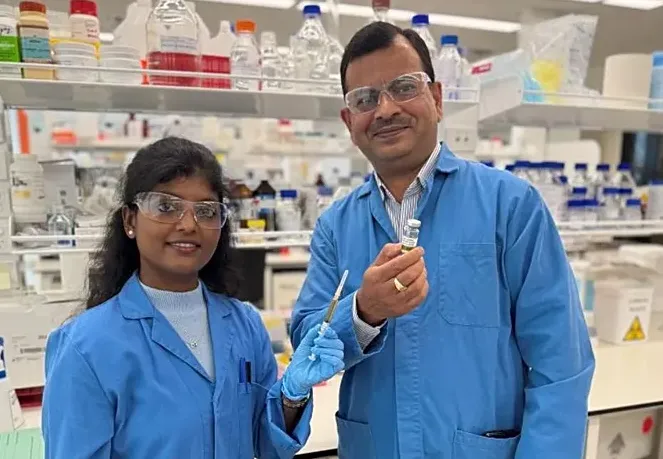
For years, the treatment of Parkinson’s disease has demanded a strict and exhausting daily medication regimen from patients. However, a team of researchers at the University of South Australia, linked to the University of Adelaide, has developed a long-acting injection that promises to radically transform this reality — and ease the daily burden of millions of people worldwide.
The new formula, still at the pre-clinical stage, combines the two drugs most widely used to combat the symptoms of the disease — Levodopa and Carbidopa — in a single injectable dose, capable of slowly releasing the medication over seven days.
“One injection will be enough for a week, compared with a patient taking three or four tablets every day”, explained Sanjay Garg, professor of pharmaceutical sciences at the University of South Australia.
The promise of a new paradigm in the treatment of the disease comes after more than two years of research and could represent a historic milestone in the fight against the second most common neurodegenerative disease globally, after Alzheimer’s. According to the Parkinson’s Foundation, more than 10 million people currently live with this condition, with men 1.5 times more likely to be diagnosed than women.
For those who face the disease day to day, managing medication is a constant challenge, as Deepa Nakmode, a researcher on the team, stresses. “Especially with elderly patients, they have to remember to take each medication on time. Even if they miss a single dose, they cannot carry out their day-to-day activities normally.”
Non-adherence to treatment is, in fact, a recurring problem. Garg reveals that “almost 50% of patients do not take the medicines recommended by their doctors, especially in the case of chronic diseases”.
The effectiveness of the drugs lies in their ability to control motor symptoms, such as tremors, muscle stiffness, slowness of movement and balance problems — the latter significantly increasing the risk of falls.
The chief executive of Parkinson’s Australia, Olivia Nassaris, does not hesitate to describe the breakthrough as “a game changer”. “It will reduce the risk of falls and allow people to take an active part in everyday life, for example in work, sport and volunteering.”
The research now enters a new phase, with animal tests planned for the coming months, before the transition to clinical trials in humans.
For patients such as Peter Willis, diagnosed a decade ago and currently dependent on four daily doses, the impact of a weekly injection would be profoundly transformative. “If you don’t take the tablet on time, you realise you can’t walk. You lose your energy, as if you’d run out of fuel. We take the tablet again and the energy comes back.”
Expectations are high, but the potential for improving quality of life is undeniable. If its effectiveness is confirmed in humans, this innovation could indeed mark a new era in the way Parkinson’s disease is fought.


