
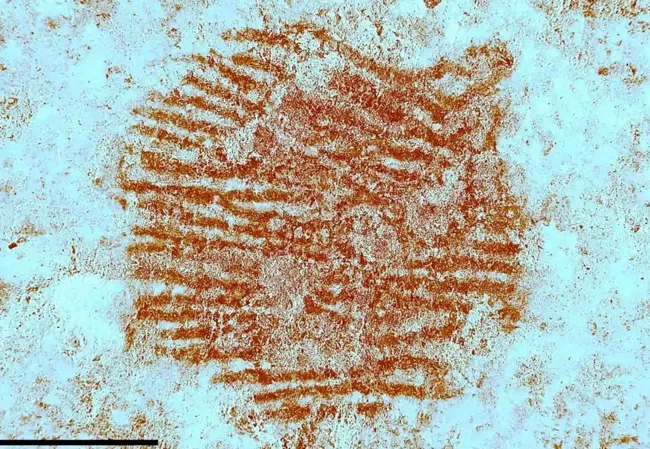
Segovia, Spain – A stone resembling a human face, marked by a strategically placed red dot, could rewrite part of the history of art. Spanish researchers believe they have found, in a rock cavity known as the San Lázaro Rock Shelter, the oldest complete human fingerprint on record – possibly made by a Neanderthal some 43,000 years ago.
The discovery was announced by scientists from the Complutense University of Madrid, who have been excavating the site for five years. In 2022, the team found the intriguing pebble at a depth of 1.5 metres, beneath layers of sediment attributed to Neanderthal groups. What caught their attention: a clearly visible red dot in the centre of the stone, giving it the appearance of a nose on a face sculpted by the rock’s natural fissures.
Symbolic art?
For María de Andrés-Herrero, a professor and co-author of the study, the discovery reinforces the idea that Neanderthals were capable of symbolic thought. "It is clear that this is a Neanderthal archaeological site", she told the BBC. The specialist adds that the pigment used – red ochre – does not occur naturally in the shelter, which indicates that it was intentionally brought there and applied deliberately.
The scientific team used multispectral analysis and the collaboration of the Spanish forensic police to confirm the presence of the fingerprint. The tests showed that the mark may belong to an adult male, although the absence of other similar records makes absolute confirmation difficult, according to David Álvarez Alonso, another co-author of the study.
A piece without parallel
Classified as the "only portable art object painted by Neanderthals" and the oldest of its kind discovered in Europe, the pebble adds to the debate about these hominids’ capacity for artistic expression. At the press conference presenting it, the region’s culture minister, Gonzalo Santonja, stressed the cultural and archaeological importance of the discovery.
The red mark was placed in a non-utilitarian context, the researchers point out, which suggests an artistic, symbolic rather than functional manifestation. "The stone drew attention because of its fissures, and the Neanderthal intentionally left his mark with ochre pigment in the centre of the object", Alonso explained to Europa Press.
The study was published in the scientific journal Archaeological and Anthropological Sciences, where the authors argue that the pebble has exceptional characteristics, classifying it as "a visual symbol", a possible piece of portable art – a rare find, and of enormous historical value.


