
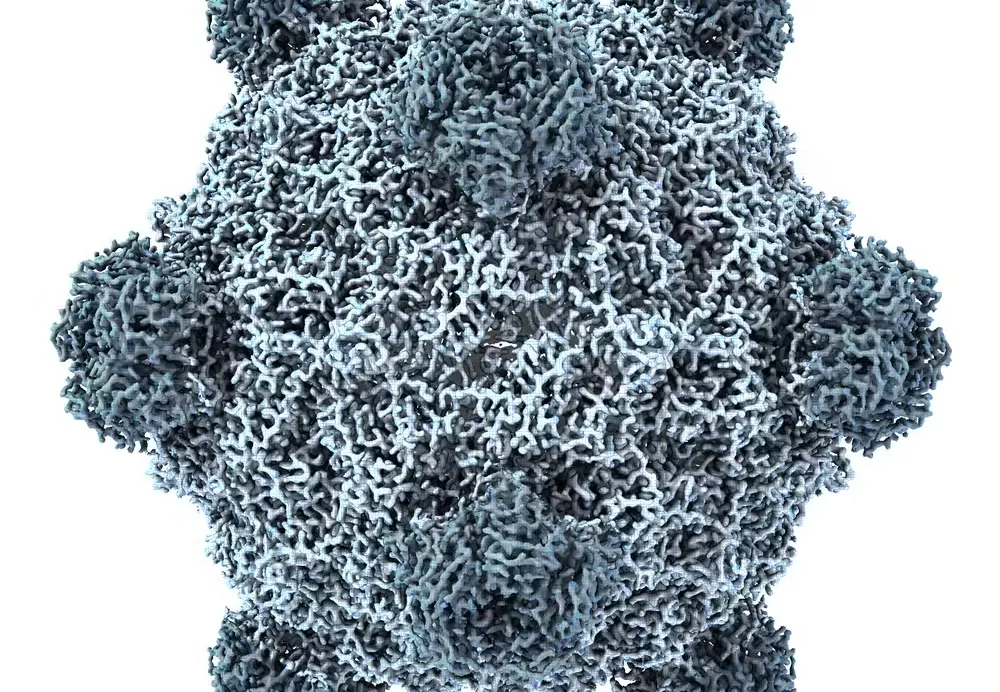
For millions of years, the viruses circulating on the planet were shaped by evolution. Now, for the first time, an artificial intelligence has entered that process and designed complete virus genomes that never existed in nature.
Scientists managed to get an AI system to create not just an isolated gene, but the entire set of genetic instructions needed for a virus to function, reproduce and infect a host.
The study, published this Thursday (6) in the prestigious scientific journal Science, was conducted by researchers at the Arc Institute and Stanford University in the United States, and represents a milestone in the field of so-called synthetic biology.
At the centre of the experiment is an artificial intelligence system called Evo. It works on logic similar to that used by ChatGPT and other large language models, but with a fundamental difference: instead of learning to predict the next word in a sentence, Evo was trained to anticipate the sequence of “letters” that make up DNA — the bases A, C, G and T of the genetic code.
To acquire this ability, the system was fed genetic material from millions of bacteria, plants, animals and viruses.
After training, the scientists gave it a specific mission: to create genomes of bacteriophages, viruses that specialise in infecting only bacteria and are harmless to humans.
As a reference, the team chose ΦX174, a small virus that has been studied in depth by science. Its genome contains approximately 5,400 letters, a small size compared with the roughly 500,000 letters in the genome of the simplest bacterium and even further from the approximately 3 billion letters that make up human DNA.
The principle can be understood by imagining DNA as a gigantic instruction manual. Different organisms are not distinguished by the “letters” available, but mainly by the sequence in which those letters are arranged. The genome corresponds to the complete set of these instructions, including the regions responsible for determining when and how each component should be used.
It was from this logic that the artificial intelligence began to create.
Evo produced hundreds of thousands of genome proposals. Faced with this enormous universe of possibilities, the researchers selected those they considered most promising and ordered laboratory synthesis of almost 300 sequences.
Then came the decisive test.
The synthesised genomes were placed in front of E. coli bacteria to determine whether the constructs designed by the computer could really function as viruses.
Sixteen did.
These viruses proved viable: they were able to multiply and destroy the bacteria, reproducing in practice the expected behaviour of a virus found in nature.
Some were even able to overcome the resistance shown by strains of E. coli, showing that artificial intelligence can explore genetic solutions that are not simply a reproduction of known viruses.
The advance does not mean, however, that scientists have created artificial life from nothing. Nor were any viruses produced to infect humans. The experiment focused on bacteriophages, organisms that attack bacteria.
Even so, the result opens a new scientific frontier. By demonstrating that an artificial intelligence can design complete genomes able to function biologically after being synthesised in a laboratory, the study points to new possibilities in synthetic biology — while at the same time reinforcing the need to monitor carefully the risks associated with AI's growing ability to design biological systems.


