
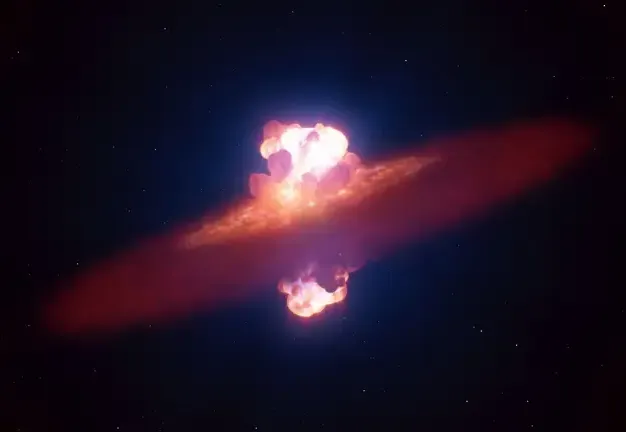
For the first time, an international team of astronomers has captured the shape of a supernova at the exact moment of its explosion. The star, a red supergiant located 22 million light-years from Earth, in the galaxy NGC 3621, was caught in an extremely rare phase of the phenomenon: its initial geometry resembled the shape of an olive.
The unprecedented observation was made possible by the Very Large Telescope (VLT) of the European Southern Observatory (ESO) in Chile. The supernova, designated SN 2024ggi, was detected on 10 April 2024. Twelve hours later, the astronomer Yi Yang, of Tsinghua University in China, was urgently requesting observation of the phenomenon. In under 26 hours, the VLT was already pointed at the target, responding with remarkable speed to such a fleeting event.
According to the researchers, the explosion originated in a star with 12 to 15 times the mass of the Sun and an estimated radius 500 times greater than that of our star. The moment captured reveals the rupture of stellar matter at the surface, in an initial elliptical shape that quickly flattened as it collided with the surrounding material.
“For a few hours, the geometry of the star and its explosion could be, and were, observed together,” stressed Dietrich Baade of ESO. The study, published in the journal Science Advances, used spectropolarimetry — an optical technique that makes it possible to decipher the geometry of celestial bodies too distant to be seen clearly.
Lifan Wang, of Texas A&M University, explained that “although the star appears as a point, the polarisation of its light contains clues about its geometry”.
The axially symmetric shape observed suggests, according to Yi Yang, the existence of a common physical mechanism in the explosions of massive stars. This information is crucial for refining the theoretical models that explain the collapse and destruction of these stars — phenomena that sometimes give rise to black holes or neutron stars.
“This discovery not only reshapes our understanding of stellar explosions, but also demonstrates what can be achieved when science transcends borders,” concluded Ferdinando Patat, an ESO astronomer.


