
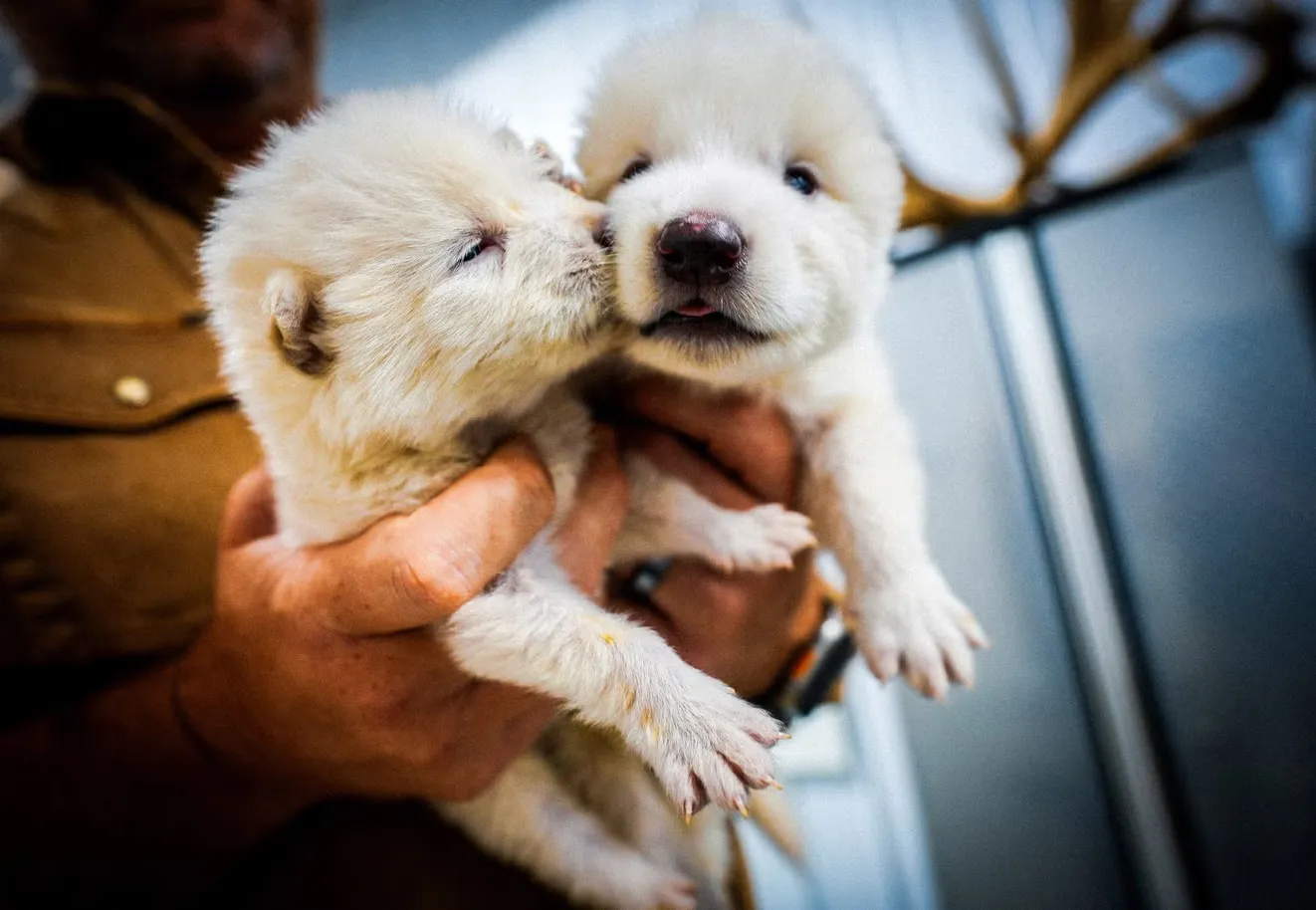
The Dallas-based biotechnology company Colossal has announced the birth of three pups with the genetic signatures of the dire wolf, a predator extinct for more than 10,000 years, immortalised in popular culture through the series Game of Thrones. Named Romulus, Remus and Khaleesi, the newborn wolves interweave mythology and fiction in a narrative that combines cutting-edge science with the allure of the collective imagination.
Romulus and Remus pay tribute to the legendary twins who founded Rome, suckled by a she-wolf. Khaleesi, for her part, refers directly to the epic universe of George R. R. Martin, author of the literary saga A Game of Thrones and also an investor in this biotechnology project. Behind the media excitement, however, lies a more restrained scientific truth: these are not true dire wolves; they are genetically modified grey wolves with traits inspired by the extinct species.
The achievement is a feat in the field of synthetic biology. Colossal's scientists extracted DNA from two dire wolf fossils – a 13,000-year-old tooth and a 72,000-year-old ear bone – and sequenced the complete genome. This genetic map was compared with that of the grey wolf, its closest relative, making it possible to identify 20 key genetic variants (single nucleotide polymorphisms, or SNPs) associated with the physical characteristics of the extinct wolf.
Watch the video here
Meet the first dire wolf in 10,000 years as scientists bring species ‘back from extinction’
Click here
Using CRISPR-Cas9 technology, the researchers edited these variants into the DNA of grey wolf cells. The modified cells gave rise to embryos, implanted in domestic dogs. The result: three living pups with broader shoulders, robust bodies and pale coats – traits attributed to the ancient dire wolf, which measured around 1.5 metres in length and could weigh more than 70 kilos.
Despite the enthusiasm, the scientists themselves acknowledge the limits of the innovation. “These animals may look like dire wolves, but they are not,” stressed the Colossal team. Just as humans and chimpanzees share 98.8% of their DNA but differ radically in behaviour and cognition, grey wolves and dire wolves also diverged more than 300,000 years ago. Modifying 20 SNPs in a genome of billions of base pairs represents, in evolutionary terms, a minimal change.
Even so, the project marks a notable scientific turning point: being able to extract DNA from fossils, sequence it accurately, identify relevant mutations and create living organisms from that information is in itself an achievement. Colossal, moreover, is no stranger to ambitious projects; it is also leading the attempt to recreate the woolly mammoth, seeking to produce cold-resistant elephants with genes from the extinct species.
The three pups now live in a 2,000-acre nature reserve, whose location remains confidential. The site, surrounded by a three-metre fence and certified by the American Humane Society, is monitored around the clock, offering the animals controlled freedom, away from direct contact with wildlife.
Ecologically and ethically, the project divides opinion. Some question the real value of de-extinction, arguing that the resources invested would be better used in the preservation of existing species and their habitats. Others warn of unpredictable risks: introducing a predator that looks like an extinct species but whose behaviour is unknown could disturb delicate balances.
George R. R. Martin, writer and cultural adviser to Colossal, summed up the symbolic dimension of the feat: “I have the luxury of writing about magic, but Ben [Lamm] and Colossal have made it real by bringing back these majestic creatures”.
Ultimately, this is not a return from the dead. It is a glimpse of what science can already do today, and an urgent invitation to reflect on what we should do with that power.


