
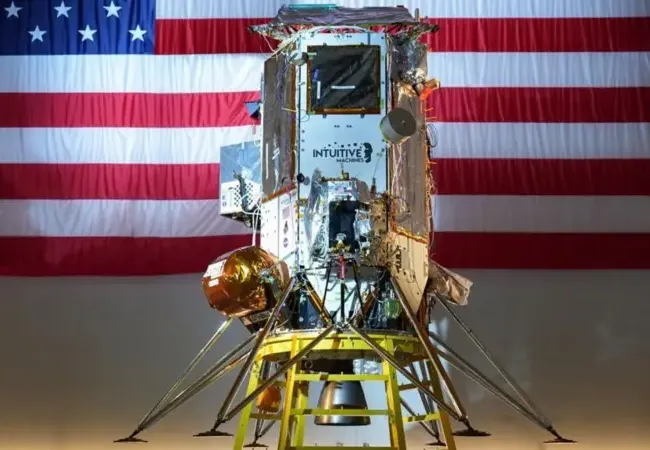
What, a few years ago, would have been dismissed as a fictional flight of fancy is now beginning to show concrete signs of technological and commercial viability. Lonestar Data Holdings, based in Florida (USA), is taking the first steps towards installing data processing centres in space – namely in Earth orbit and, in the medium term, on the lunar surface.
The vision, defended by the company’s president, Stephen Eisele, is clear: “By putting the data centre in space, you offer unparalleled security”. The conviction rests on the recent feat of sending a prototype – the size of a book – to the Moon, aboard Intuitive Machines’ Athena lunar lander, launched by a SpaceX rocket.
The proposal is based on solid premises: virtually unlimited solar energy, no neighbours protesting about noise or resource consumption, and faster data transfer between space devices. On Earth, the proliferation of artificial intelligence is causing demand for storage and processing to explode. The consultancy McKinsey forecasts annual growth of around 19% to 22% until 2030.
But expansion on Earth faces obstacles: scarce land, colossal energy consumption and rejection by local communities. By contrast, space offers new possibilities. The European Commission recently funded a feasibility study – the Ascend report – which supports installing data centres in orbit as a greener and more strategic solution for Europe.
Thales Alenia Space, which was responsible for the study, envisages a constellation of 13 interconnected satellites with a capacity of 10 MW. To achieve true scalability, systems of up to 200 MW would be needed, which implies 200 launches. The project’s architect, Damien Dumestier, believes that, with the right investment, this could be possible by 2035, with a commercial return in 2037.
Even so, the challenges are technical and logistical. Launching equipment into space remains expensive. Each kilo costs thousands of dollars, not counting the additional costs of radiation protection, cooling systems (challenging in the absence of gravity), and difficult, costly maintenance.
Domenico Vicinanza, professor of data science at Anglia Ruskin University (United Kingdom), stresses that "solving problems in orbit is extremely complicated", warning of the risks of catastrophic failures requiring crewed missions for repairs.
But business enthusiasm is undimmed. Chris Stott, CEO of Lonestar, sees in space data centres a way of guaranteeing digital sovereignty: “A box of circuits in space is subject to the jurisdiction of the state that launched it. It is, literally, a digital embassy”.
The company already has customers on a waiting list, including the governments of Florida and the Isle of Man. Meanwhile, other competitors, such as Starcloud, promise to launch next month a satellite with commercial capacity expected in 2026.
Eisele rounds off with a revealing metaphor: “It is like putting the safe at the back of the bank. You do not open it every day, but it is there to offer greater security”.


