
A scientific study published in the prestigious journal Nature Geoscience has revealed new details about a geological phenomenon that, over millions of years, could transform the map of the planet: the slow but continuous splitting of the African continent, fuelled by rhythmic pulses of molten rock from the Earth's interior.
The research, conducted by an international team of scientists, indicates that the Earth's mantle beneath the Afar region, in north-eastern Ethiopia, behaves neither uniformly nor constantly. Instead, it manifests itself through cyclical movements, similar to heartbeats, which push the tectonic plates and stretch the ground of East Africa in a regular and predictable manner.
“The discovery of these ‘geological heartbeats’ helps us understand why continental breakup occurs at different rates across the region”, explained Emma Watts, the geologist who led the research and who is currently at Swansea University in the United Kingdom.
A geological heart in the Horn of Africa
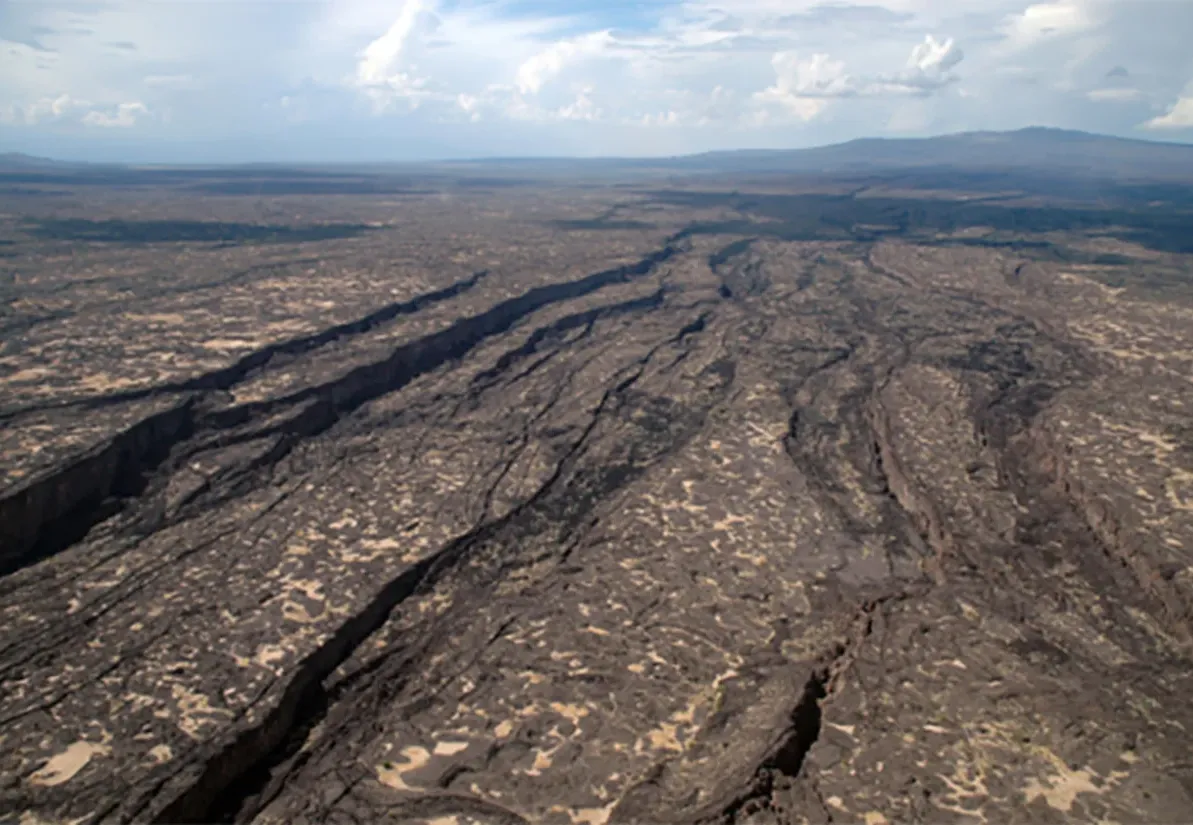
The region studied lies at the meeting point of three great rifts in the Earth's crust: the East African Rift, the Red Sea Rift and the Gulf of Aden Rift. The tectonic complexity of this area means the plates are constantly moving apart, albeit very slowly — a process that has already opened fissures several kilometres wide, visible even in satellite images.
In all, more than 130 volcanic rock samples collected in north-eastern Africa were analysed and cross-referenced with advanced statistical modelling. The data revealed the presence of a mantle plume — a deep reservoir of hot material — rising from the planet's interior with an asymmetrical composition and distinct chemical bands, comparable to geological barcodes.
Tom Gernon, a professor and co-author of the study, compared this behaviour to blood flow in a living organism: “The chemical bands indicate that the mantle pulses like a heartbeat. And, just as blood flows more quickly through narrow arteries, these pulses travel more efficiently where the tectonic plates are moving apart faster, as in the Red Sea”.
An inevitable – but slow – split
Despite the drama of the image — Africa “breaking” in two — the scientists stress that the process is natural and unfolds at an extremely slow pace. It is estimated that tens of millions of years will be needed for the rift to be completed and for a new ocean to appear between the continental blocks.
This type of phenomenon is not unprecedented in the planet's geological history. The Atlantic Ocean, for example, was born from the fragmentation of Pangaea some 150 million years ago, driven by the same type of tectonic activity. Since then, the separation between the continents has continued to grow, millimetre by millimetre each year.
“The next stages of our work involve gaining a better understanding of the speed and pattern of mantle flow beneath the tectonic plates, in order to predict how this process will continue to shape the planet”, added Derek Keir, a professor at the universities of Southampton and Florence, and also a co-author of the research.
Although the eventual creation of a new African ocean is not an immediate concern, scientists consider it essential to monitor what is happening today in the Horn of Africa. These data help us understand not only the future of the region but also the geological past of the Earth — a story written slowly, but with enough force to reshape continents.


