
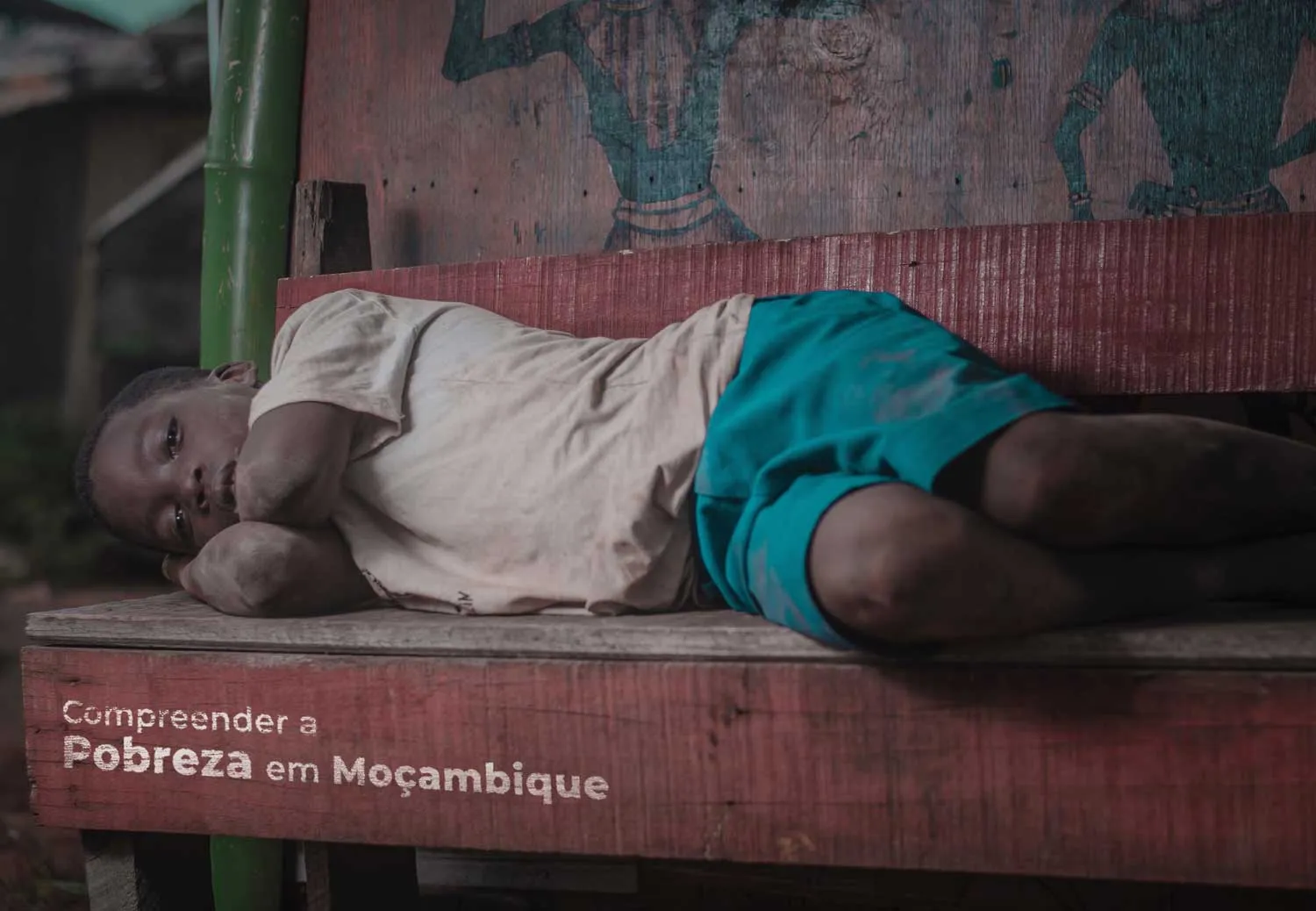
Understanding poverty in Mozambique
Written by Carlos da Maia
Over the past two decades, Mozambique has enjoyed robust and rapid economic growth that has had a positive impact on household well-being. The country’s economy grew at an average annual rate of 7% between 2000 and 2016. As a result, official figures show a reduction in the national poverty rate from 52% in 2009 to 46% in 2015. Economic progress has also translated into improvements in the non-monetary dimensions of well-being. For example, in 2015 households had a better quality of life than at the end of the 1990s; access to education has been improving since the early 2000s; life expectancy has risen significantly, from 49 years in 2001 to 58; infant mortality fell from 99 deaths per thousand live births in 2003 to 68 in 2011; to these changes can be added the improvement in housing quality and the greater ability of Mozambican households to own durable goods.
After all, what is poverty? How is it measured in Mozambique?
What paths should be followed to reduce poverty levels in Mozambique?
When there is no rice at home, the maize flour is running out, the head of the household has no job or viable business, when children go to school in torn clothes or hungry, when there is no electricity, running water or adequate sanitation in the dwelling, when there is no proper housing to protect the members of the household from the elements, when people have fewer than three meals a day not by choice, they are, in all likelihood, in a state of poverty. Sen (1983) defines poverty as the failure to attain certain minimum capabilities.
To measure poverty, it is necessary, first, to choose the dimension of the well-being indicator; second, to derive or select the poverty line or threshold; and, finally, to choose the measure to be used in reporting the results. In recent years, there has been a tendency to focus on non-monetary measures of poverty. However, the conventional dimension of poverty is the monetary one.
To fight poverty, it is necessary first to understand it. Who are the poor? Where are they located? What are their characteristics? What is their profile?
To answer these questions, it is essential to have regular, good-quality statistical data. In Mozambique this data is collected by the National Statistics Institute (INE), using scientific censuses and surveys as instruments, such as the General Population and Housing Census and the Household Budget Survey (IOF).
The World Bank has supported the country in the fight against poverty for more than three decades. One of the ways this institution does so is by supporting the implementation of these data-collection instruments, without which it would be impossible to measure and monitor the evolution of poverty and well-being in the country. These censuses and surveys carry high costs and use advanced implementation techniques that are not always available in countries like this one. For example, the implementation of the most recent Population Census (Census 2017) and the most recent household budget survey (IOF 2019/2020) had the technical and financial support of the World Bank through the National Statistics and Data for Development Project. The main objective of this project is to equip the INE and its staff for better production and dissemination of quality socioeconomic statistics. The project had initial funding of 62 million dollars, of which 44 million were earmarked for the INE. The implementation of the IOF 2019/2020 cost about 5 million dollars, and the project foresees carrying out another such survey in 2022. For the implementation of Census 2017, the World Bank contributed 25 million dollars. Analysis of the data from these censuses and surveys makes it possible to understand poverty and its profile, and thus to inform the design of public policies that contribute to poverty reduction. The aim of the next article will be to present potential paths to follow to reduce poverty levels in Mozambique.
Note:
1. From 2017 to 2020, the average annual GDP growth rate fell substantially, and in 2020 it was negative, something that had not happened in more than 30 years. The main reasons for this were the various cyclones that struck the country during that period and the health crisis caused by Covid-19, among others.


