
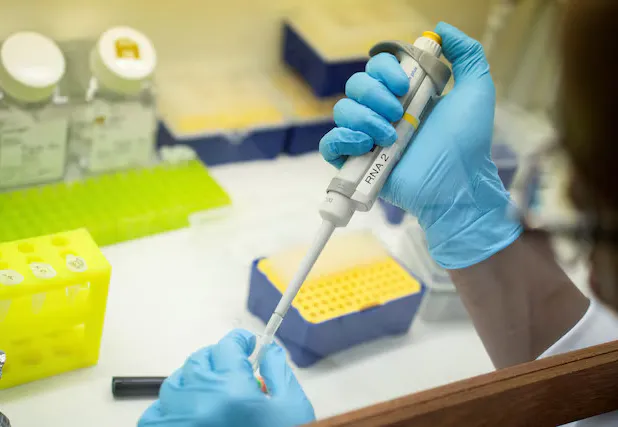
According to a Reuters report, a group of Japanese researchers has achieved an unprecedented feat in genetic science: it managed to eliminate the extra copy of chromosome 21 in human cells with trisomy 21, using the CRISPR-Cas9 technique. The study, published in the journal PNAS Nexus, could mark the start of a new era of personalised treatments for Down syndrome.
Trisomy 21 results from the presence of three copies of chromosome 21, two inherited from one parent and one from the other, and is detectable within the first few days after fertilisation, at the embryonic stage known as the blastocyst. At this stage, gene editing is already possible in other clinical contexts, but until now there has been no effective approach to correcting this chromosomal alteration.
In the study now revealed, the Japanese scientists used the CRISPR-Cas9 editing system to identify and remove, with precision, the duplicated copy of chromosome 21 in human cells grown in the laboratory. The method avoids accidentally eliminating the two distinct versions of the chromosome, one from each parent, thereby preserving the genetic integrity of the cell.
Although promising, the advance remains confined to laboratory tests. The researchers warn that for now, the method is not ready to be applied in living organisms, as some chromosomal alterations that persisted were detected. However, they firmly believe that their work paves the way for more sophisticated medical interventions in future to treat or even prevent Down syndrome.
On another front of experimental medicine, Reuters also highlights the progress of researchers who managed to deliver genetic instructions directly to the brain using lipid nanoparticles. These particles can cross the blood-brain barrier, which normally prevents medicines from entering, allowing mRNA to reach brain cells and instruct them to produce or inhibit certain proteins.
Tests carried out on rats and on samples of human brain tissue proved effective, with potential to treat diseases such as Alzheimer's, ALS, brain cancer and substance dependence. Dr Eric Nestler, co-leader of the study at Mount Sinai, stressed that the discovery “opens doors to a new generation of neurological treatments”.


