
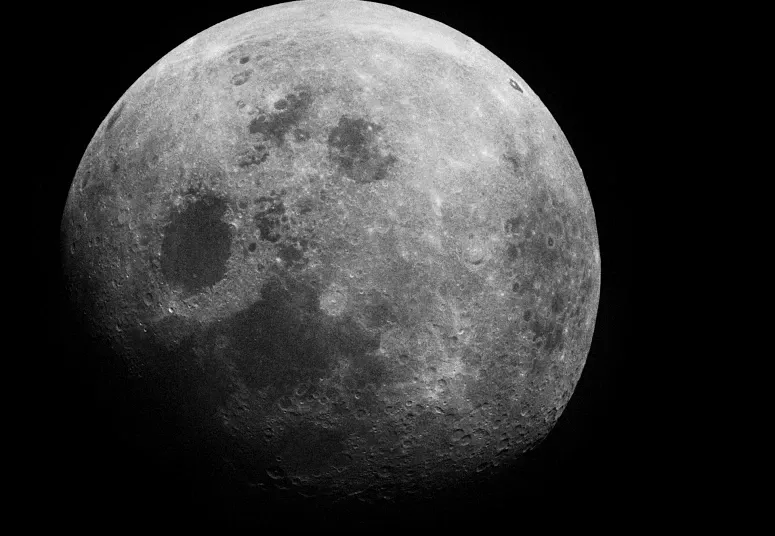
In a bold step towards supremacy in lunar exploration, China and Russia formalised this month a historic agreement to build a nuclear power plant on the Moon, intended to supply energy to the future joint lunar station – the International Lunar Research Station (ILRS). This ambitious project is expected to be operational by 2036, as revealed by the two countries’ space agencies.
According to Roscosmos, the Russian space agency, the ILRS will serve as a platform for advanced scientific research and for testing technologies applied to long-duration uncrewed missions on the lunar surface. The lunar nuclear plant will function as the station’s energy core, ensuring energy autonomy and resilience for operations to be carried out on the Earth’s natural satellite.
Officially launched in June 2021, the ILRS construction plan envisages a series of transport and installation missions between 2030 and 2035, culminating in the assembly of the lunar base’s essential structures. The ultimate goal is to link the ILRS to a space station in lunar orbit by 2050, creating a long-term scientific and technological infrastructure beyond Earth.
The Sino-Russian initiative has already attracted the interest of 17 countries, which have expressed a willingness to join the project. Among those signing up are Egypt, Pakistan, Venezuela, Thailand and South Africa, which demonstrates the geopolitical reach of the programme led by Moscow and Beijing. The growing membership positions the ILRS as a solid alternative to the US-led project.
On the other side of the Atlantic, NASA is facing successive setbacks in its Artemis programme. The Artemis II mission, initially planned for 2024, has been postponed to April 2026. Artemis III, which is meant to take astronauts back to the lunar surface, is not expected until 2027. The uncertainty worsened with the US Administration’s budget proposal, which includes cancelling the Gateway station, a key part of the Artemis project.
While the US faces political and budgetary constraints, China and Russia are revving the engines of a new space race. And this time, the goal is not just to reach the Moon – it is to stay there.


